5 Things You Need to Know Before Attending an MBA Fair
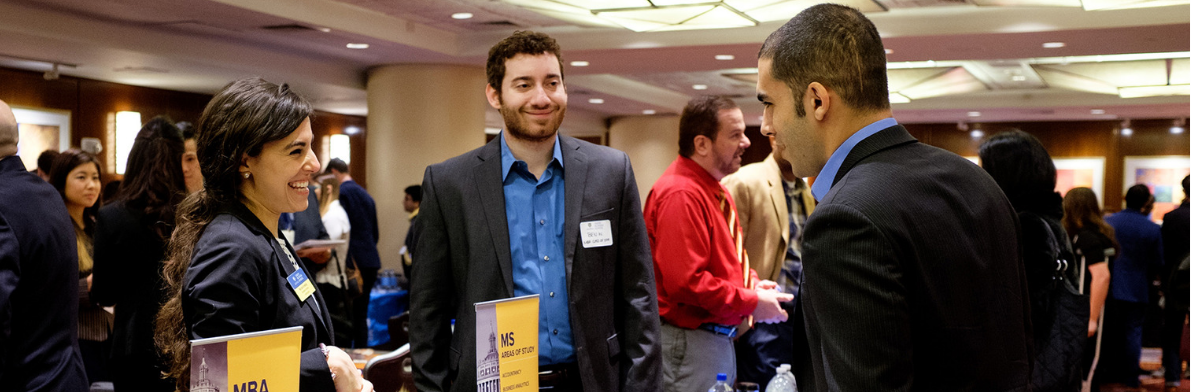
MBA Fair events provide an opportunity for candidates to efficiently learn about a variety of MBA offerings. Some Fairs might include as many as a hundred programs, in a trade fair type setting. We’re offering five pointers in terms of the best way to use these events as part of your application strategy.
1. Come prepared
Events that include multiple MBA programs can be overwhelming. The natural inclination is to come away from the event with as much information as possible, which can mean, visiting as many schools as possible, to gather that information. This approach really means you will end up knowing little about any of the programs. It’s much better to do your online research first. Go to the event’s web page. Look closely at the list of schools attending, and do your initial research online, narrowing down a list of target schools. Know your career goals and objectives for pursuing the MBA, and come to the event prepared to talk to each of your selected schools about those goals.
2. Bring a notepad
While it would seem obvious, take lots of notes during the event. Summarize your conversation with each of the schools you meet with. You might find yourself returning to a school, later in the day, after your knowledge of the MBA program space evolves, through your various discussions with the different school’s admissions teams. Your notes from the event will be useful as you draft your application essays, they also may prove an important guide for your interview preparation.
3. Don’t monopolize
You may need to wait a few minutes to talk to a specific school, especially one of the more popular ones. When it’s your turn, ask thoughtful questions (see point 1), don’t just try to get unnecessary facetime. You will annoy the admissions officer if you do this. Rarely will you be able to make a positive impression during an MBA admissions fair, but the reverse is not true. You can easily leave a bad impression, and this might get noted.
4. Dress appropriately
If you feel comfortable in a suit, feel free to wear a suit. If you feel comfortable wearing business casual dress, that’s good too. Don’t attend a fair in your beach wear, shorts and a T-shirt. Again, you don’t want to leave a negative impression. Look like you fit in, not stand out.
5. Collect contact information and follow up
Most admissions officers will have their contact information available for interested candidates to collect. Make sure you do this. Follow up with the admissions officer within 24 hours. Your follow up should include a thank you for their time, as well as some acknowledgment of the specific conversation you had. You will be helped in this endeavour by the note taking you did during the MBA fair (point 2.)
MBA Applywire
To gain IR abbreviation PEngineer.
And to get MBA for the designation CEO
Assistant Manager at EY GDS: 4.5 years in consulting at EY Global Delivery Services (Risk Consulting, software asset management); ~5.5 years by matriculation. Promoted ahead of cycle to Assistant Manager, ranked highest-performing AM in a cohort of ~60, rated top 10% of ~200 consultants.
Client-facing since year two, advising Fortune 500 clients across banking, insurance, fintech, media and business services on licensing compliance, risk exposure and cost optimisation. Present directly to client Directors, AVPs and procurement leads. Engagements have surfaced $600K–$1M+ in savings or contractual exposure; advised on renewal decisions for a ~$20M contract.
Led teams of 2–6. Trained 20+ consultants.
Indian male, B.Tech CSE, Tier II institution, 7.97/10.
GMAT Focus 675 (Q87/V84/DI80), not retaking.
Extracurriculars are thin — personally, a 50kg transformation (125→75kg) I now use to coach others informally.
Goals: strategy consulting (MBB target, tier-2/Big 4 alternates)
Long term, partner-level in technology strategy.
Applying R1/EA: Tuck, INSEAD, Darden, Ross, Emory, McCombs.
Where I'd genuinely value input:
1. Is 675 FE a meaningful constraint at Tuck/INSEAD for an Indian male consulting applicant, or is it survivable with a differentiated narrative?
2. Is my school list appropriately balanced? What are my chances in these?
3. How much does a non-IIT/NIT undergrad hurt at this level, and can EY-brand + progression offset it?
4. My extracurricular profile is thin post-college. With ~6 weeks to R1, is starting something now worth it, or is it better to lean entirely on essays?
5. Am I mis-reading the "GDS is a delivery center, not real consulting" perception risk? Everything I've done is client-facing advisory, but I'm aware of how the label reads.
3.5 years in HR before moving into marketing/ad agency account management. Currently have 8 years of full-time work experience, nearly 9 by time of matriculation.
Extensive international experience and exposure, both with clients and also relocating to Australia and being sponsored for a role there. I have worked for large, multinational marketing organisations as well as a successful UK startup.
Current responsible for $1.3m+ worth of billing/revenue annually - part of a small team that secured a landmark client win too worth $170k too. Extensive experience across print/retail/digital/experiential marketing with large, multinational brands.
Previous HR exp includes establishment of an office in MENA region. Policy creation and development during COVID as well as leading a landmark office move.
Recently created my own RTD alcohol brand including product development, branding and packaging design. I own the IP to the product including a recipe - didn't pursue commercial launch due to level of investment required, because it didn't make sense alongside starting an MBA.
Based in UK and went to UK undergrad but did year abroad at a reputable U.S. university and had a 3.43 GPA there. Conversational (B1) in French and native English speaker. Not too many extras to highlight, but proudest achievement was fundraising $2000 in 2025 for a cause I deeply care about.
Working at a contract research organisation called IQVIA. We help pharmaceutical companies conduct clinical research trials. I took up an online course on pharmaceutical business analytics which developed my interest in the consulting field which is my post MBA target.
Outside of work, I am a Toastmasters club officer, art of living volunteer and an aspiring social media influencer (health and lifestyle).
Hi! I'll be applying for the Deferred MBA programs at the above mentioned school
Broadly summarising my professional life
Indian undergraduate at a Tier-1 engineering institute majoring in Bioengineering with a Minor in Management. (affected by documented medical issues and internship commitments),
Certifications: CFA Level I Cleared
Professional experience (Internships): Quantitative Investing (systematic equities), Credit Analysis, Investment Banking (middle-market M&A and PE syndication with a return offer), and Growth Equity/VC (biotech investment thesis development, sector mapping, deal sourcing, founder evaluation, and ecosystem engagement, with a fast track interview based return offer (PPI)).
Research: Publications at CVPR and ICVGIP on multimodal financial AI and efficient Vision Transformer interpretability, with emphasis on practical AI deployment and computational efficiency.
Leadership: Led government-backed social initiatives and engineering organizations, managing volunteer teams, fundraising, education and environmental programs, community healthcare initiatives, entrepreneurship activities, and interdisciplinary engineering projects spanning robotics and bioengineering. Took initiatives during my internships as well.
Teaching: Undergraduate and continuing education teaching assistant.
Career goal: Long-term career in growth equity/venture capital focused on technology investing
MBA LiveWire
I am waiting the Decision
16th June Applied/2nd July Invite/12th July Interview/22nd July Admit Letter
I had already put down a deposit for another school (Tuck), but happy to know I was able to still remain competitive this late in. My advice, stats are table stakes, stories really matter!