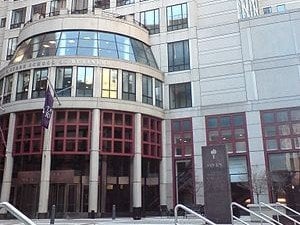
NYU Stern MBA Deadlines 2025-2026
The NYU Stern MBA deadlines for the 2025-2026 admissions season are presented in the table below. The Leonard N. Stern School of Business is conducting its full-time MBA admissions process across four rounds this admissions season.
Stern notes that all application materials must be submitted by 11:59 PM Eastern Time on the day of the deadline.
| Rounds | Application Deadline | Decision Notification* |
|---|---|---|
| Round 1 | September 15, 2025 | December 1, 2025 |
| Round 2 | October 15, 2025 | January 1, 2026 |
| Round 3 | January 15, 2026 | April 1, 2026 |
| Round 4 | April 15, 2026 | Ongoing |
*One of three initial notifications: invitation to interview, waitlist offer, or denial of admission.
In addition to its traditional two-year, full-time MBA. Stern offers two specialized MBA offerings: the Luxury & Retail MBA and the Andre Koo Tech MBA. The deadlines for each of these programs are as follows.
| Rounds | Application Deadline | Decision Notification* |
|---|---|---|
| Round 1 | September 5, 2025 | December 1, 2025 |
| Round 2 | November 5, 2025 | February 1, 2026 |
| Round 3 | January 5, 2026 | March 1, 2026 |
| Round 4 | February 5, 2026 | April 1, 2026 |
*One of three initial notifications: invitation to interview, waitlist offer, or denial of admission.
Required Materials
Applicants are required to hold a four-year bachelor’s degree from an accredited college or university in the U.S. or an equivalent degree from a foreign country. Unofficial transcripts are accepted with the application, however official transcripts are required for enrollment. Applicants must submit a resume or CV, responses to essay questions, and an EQ (Emotional Intelligence) endorsements from a current supervisor (providing a second EQ endorsement is optional), and the $250 application fee. U.S. military members or U.S. veterans who have served active duty, Teach for America and Teach for India program alumni, and Forté MBALaunch alumnae are eligible for application fee waivers. Applicants experiencing economic hardship may also request an application fee waiver.
NYU Stern accepts GMAT, GRE, EA, LSAT, MCAT or DAT scores. They also offer test waivers. Scores are valid for five years from the test date. Official score reports must be received before a final decision can be made. Non-native English speakers whose undergraduate degree was not received from an institution where English is the language of instruction must provide TOEFL, IELTS or Duolingo English Test scores to demonstrate English proficiency.
International applicants to the Full-time MBA program are encouraged to apply in the early rounds, due to visa arrangements. International applicants to the Fashion & Luxury or Tech MBA programs should apply by January 6.
When Does NYU Stern Issue Invitations to Interview?
Interviews are by invitation only and can be scheduled by the candidate through the online application portal. Candidates are notified no later than the decision notification deadline for that round. Candidates receive either an invitation to interview, a waitlist offer, or a denial of admission.
MBA Applywire
Veteran. Ivy League undergrad. Planning to pivot into consulting or LDP.
I was in the top 5 of my class in mba from India and was a beta gamma sigma. This would be my second mba. I was also in the top 5 of my class in engineering. In my general management product management role I have worked with engineering team of 131 members building solutions for the insurance company (max New York life insurance). I want to shift from product management to investment banking or private equity.
I grew up inside a pharmaceutical manufacturing business. My family produces amino acids supplied to formulation companies that manufacture injectable IV solutions. From a young age, I understood that healthcare does not begin in a hospital. It begins in a reactor, in batch yield reports, in solvent recovery metrics, and in regulatory audits. I was proud of the role we played in India’s pharmaceutical ecosystem.
That pride turned reflective when my mother was hospitalized and administered IV drips produced by one of our customers. The compounds sustaining her recovery passed through supply chains like ours, and I knew exactly how they were made. I understood the solvent-heavy synthesis, the waste streams, the emissions. In that moment, I felt both gratitude and responsibility. We were contributing to lifesaving medicine — but through processes that are environmentally intensive and structurally dependent on imported intermediates. The system works, but it is fragile.
India stands at a strategic inflection point. It is the fastest-growing major economy in the world, home to the third-largest startup ecosystem, and supplies nearly 20% of global generic medicines. Yet structurally, we remain dependent. Roughly 70–75% of bulk drug and API inputs are imported, largely from China. We dominate formulation by volume but capture limited value upstream in high-margin API innovation. At the same time, traditional pharmaceutical synthesis can generate up to 100 kilograms of waste per kilogram of API produced, making it one of the most resource-intensive manufacturing sectors. Despite the national ambition of “Make in India,” our Gross Expenditure on Research and Development remains below 0.7% of GDP — far behind global innovation leaders.
India cannot aspire to healthcare sovereignty while relying on imported chemistry and outdated processes.
My long-term goal is to transform our family’s amino acid manufacturing base into a vertically integrated, green pharmaceutical platform that serves as proof-of-concept for sustainable API production at industrial scale in India. The transition would involve replacing conventional solvent-heavy synthesis with biocatalysis, flow chemistry, and fermentation-based processes; expanding the portfolio from amino acids into high-margin APIs; and building the operational, regulatory, and export credibility needed to compete globally. Over time, I aim to scale this model into a national green API manufacturing platform that reduces import dependence and repositions India within the pharmaceutical value chain.
If executed successfully, this platform could reduce API production costs by 30–40%, lower generic drug prices by 10–20% in cost-sensitive categories, and materially cut the environmental footprint of an industry that today generates significant chemical waste. More importantly, it would move India from being the world’s low-cost pharmacy to becoming a high-value, innovation-led, and environmentally responsible pharmaceutical hub — securing healthcare sovereignty for 1.4 billion citizens while strengthening India’s standing in global medicine.
To build toward this ambition, I will first deepen my expertise in global pharmaceutical supply chains and capital allocation by working in strategy and operations roles within a global pharma or healthcare-focused investment platform. This experience will allow me to understand industrial transformation at scale, navigate regulatory environments, and structure capital-intensive manufacturing transitions. Equipped with this exposure, I will return to scale and green-transition our manufacturing base, laying the foundation for India’s next-generation pharmaceutical infrastructure.
I have a diverse profile with 6 years of experience in Marketing Consulting for global CPG clients. I have a master’s degree in Economics, a side-by-side bachelor’s degree in Classical Music, and a long experience in debate competitions. While my musical sense helps me find rhythm in marketing and storytelling, my debating abilities shine through my clear and assertive communication. I work for a global beverage company for the Latin American markets (Brazil, Argentina and Chile) and very recently optimised their $150M budget to increase their return on investment by $0.15 on the dollar. Working across predominantly portugese/spanish speakers has taught me to adapt and acknowledge cultural differences and practice effective communication.
MBA LiveWire
WL in round 1, got accepted in May
No $, accepted R2 back in March