

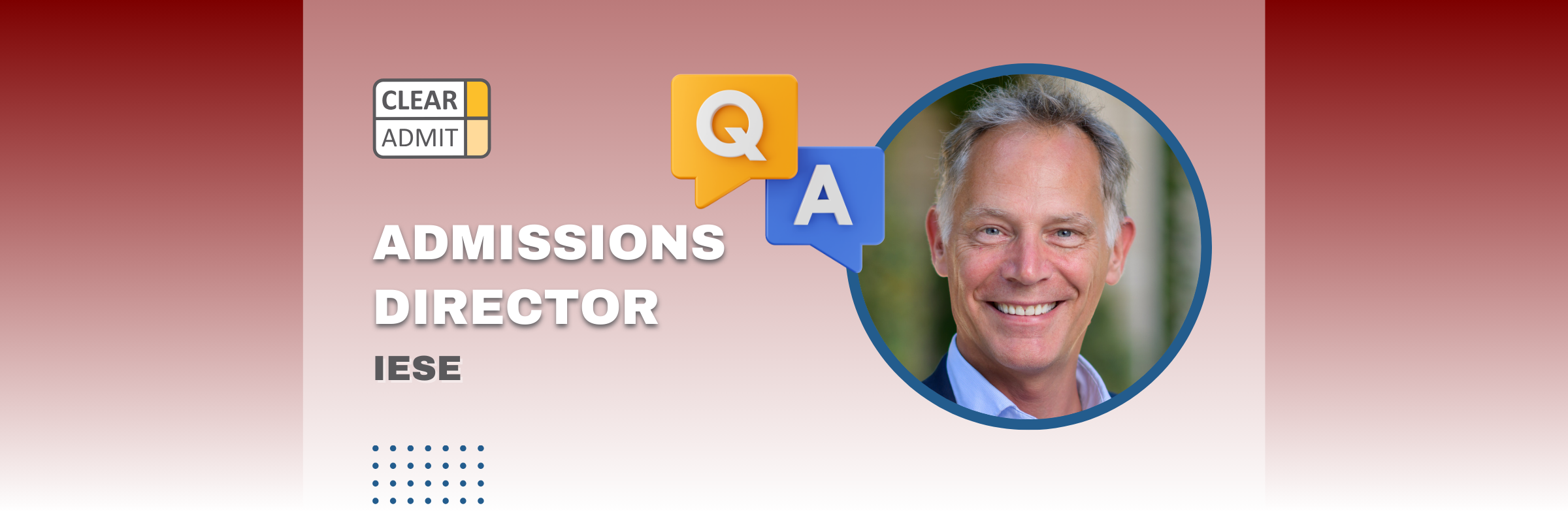
In this Admissions Director Q&A, we visit Barcelona, Spain, to learn more about IESE Business School from Patrik Wallén, the school’s MBA Admissions Director.
Prior to joining the Admissions team, Patrik spent several years leading IESE’s Career Development Center, where he supported MBA and MiM students in navigating their career paths and building relationships with global recruiters. Originally from Sweden, Patrik completed his MBA at IESE in 2007. He also holds executive coaching certifications (ORSCC, CPCC, ACC) and has been actively involved in IESE’s leadership and coaching programs.
In our interview below, Patrik takes a deep dive into the IESE application process, how AI has been integrated into the MBA program, and some of the program highlights.

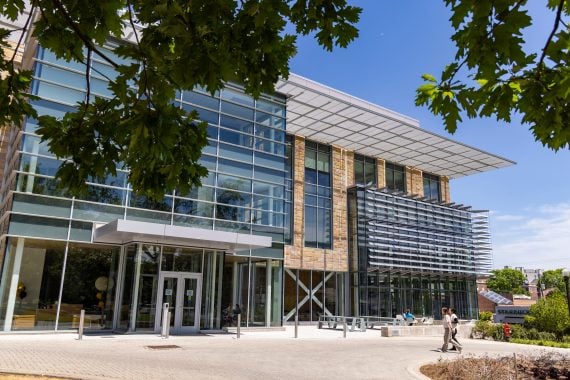
IESE Business School
Clear Admit: What is one aspect of your MBA program that you wish applicants knew more about?
Patrik Wallén: The learning environment at IESE is a special one. Community and collaboration are strong pillars of the school’s culture. This is reflected in our emphasis on the case method, a hands-on learning approach that allows students to tackle complex business challenges through real-world situations. Because discussions draw on the experiences of classmates from a wide range of countries, industries, and professional backgrounds, students are constantly challenged to broaden their perspectives and learn from one another. It is an approach that mirrors the realities of the workplace, where solutions are rarely developed in isolation.
The professors are also an integral part of the IESE community. The interactive nature of the classroom creates opportunities for students and faculty to build meaningful relationships. Professors often serve as mentors and trusted advisors long after students have graduated from the program.
This learning environment is particularly valuable at a time when business leaders are navigating rapid technological change. Whether discussing AI or other emerging challenges, students learn not only technical concepts, but also how to exercise sound judgment, evaluate different perspectives, and make responsible decisions in complex situations.
CA: Walk us through the life of an application in your office from an operational standpoint. What happens between the time an applicant clicks “submit” and the time the committee offers a final decision?
PW: Our Admissions team is organized by region to ensure candidates are assessed fairly based on the academic and professional context of their particular country of residence. Typically the Associate Director managing regional events is the one responsible throughout the admissions journey. Our approach is very high-touch, and our team endeavors to know every student who joins the MBA.
Each submitted application is reviewed by admissions staff along with the rest of the applications received in that particular round. After which, the candidate may be invited for a process interview or are rejected for that cycle. Occasionally, we might ask an applicant to improve upon some element of the application, like retaking the GMAT or GRE, before giving a final decision.
Applicants may also be asked to join us for an Assessment Day, where they either attend in person (in Barcelona, New York or Sao Paulo) or virtually. For a number of reasons, not everyone who ends up being admitted to the program receives an invitation to the Assessment, so don’t be anxious either way. Those who do attend the Assessment will do an MBA exercise that will last a few hours. Generally speaking, this is a chance for the admissions team to see how you work and think, but it is also an opportunity for the applicant to get a taste for the IESE MBA experience.
Once interviews and Assessment Days are completed, the IESE admissions and scholarship committees get together to review applications from that round as well as any Waitlisted applications from previous rounds to make decisions. Once decisions are made, we inform our applicants. Timelines can vary depending on the round. We always list deadlines and timings for decisions on our website. However, individual decisions may come out at slightly different times leading up to the decision deadline, depending on when the admissions committee is able to review their application. So don’t be anxious if others get decisions ahead of you.
CA: How does your team approach the essay portion of the application specifically? What are you looking for as you read an essay? Are there common mistakes applicants should try to avoid? What is one key thing candidates should keep in mind as they sit down to write?
PW: The essay is our chance to get to know you as a person. This is your chance to show your personality beyond the facts covered elsewhere in the application, and to help us understand what drives you and how you fit with the school.
When approaching the essay, we recommend making sure that you answer the question in your authentic voice, rather than trying to guess what the admissions committee wants to hear. Before you start, take some time to think about your answer. Typically, people find themselves working on multiple essays at once, so one of the easiest mistakes to make is trying to repurpose essays from other schools. This can lead to generic responses that do not actually answer the question.
IESE takes a lot of time each year working on our essay questions to gear them towards what we want to know so you want to make sure that you actually answer the question. By incorporating the video essay component into our application, we will be able to get a better sense of how a candidate thinks on their feet and how well they can express their ideas.
CA: Could you tell us about your interview process? Approximately what percentage of applicants are invited to interview, who typically conducts interviews, and what should candidates expect in terms of interview style and format?
PW: Interview questions vary from interview to interview and are generally conducted by admissions staff members (who are also typically alumni from IESE) as well as alumni volunteers. Interviewers review applications ahead of the interview, so try to not to regurgitate what is already in your CV and essays. Like the essays, this is an opportunity for us to get to know candidates as individuals and better understand their values, accomplishments, and fit with the program.
While each interviewer has their own style, candidates will likely be asked a blend of questions about features of their CV and application, behaviors from past professional situations, and hypothetical or thought-provoking questions. I always appreciate when candidates ask thoughtful questions about the program as well.
Given the global nature of our MBA applicants, many of our interviews are conducted virtually. However, whenever possible, we will give our candidates the option to do the admissions interviews in-person either on campus or in other international locations.
CA: If your admissions process includes any video-based components, such as video essays or recorded interview responses, what advice would you offer applicants preparing for this part of the process?
PW: The video essay gives us the opportunity to get to know candidates in a different way than we can through a written application. While essays allow applicants to carefully reflect on their experiences and motivations, the video essay helps us better understand how they communicate, think on their feet, and express themselves in a more spontaneous setting.
The video essay is a required part of the application, activated once you submit your written application and pay the application fee. Within 24 hours, you’ll receive a personalized Kira link to complete the video essay by the application round deadline. The link expires 48 hours after receipt, so we strongly recommend submitting your application a few days early to ensure enough time.
The video essay includes preparation time and a 1.5-minute response window for each question. You’ll have an opportunity to practice before you begin, but once the official questions start, you will only have one attempt per question. The questions are straightforward and interview-style. You can expect to introduce yourself beyond what is reflected in your CV (e.g., your background, values, or personal journey). The remaining questions are randomized, and one may assess your AI fluency. Be genuine—we’re interested in getting to know the real you, not hearing rehearsed answers.
In contrast, the main interview is a 45–60 minute one-on-one conversation with a member of the admissions team, an alumnus/a, or a faculty member. This interview builds upon your application and video essay, diving deeper into your goals, values, and fit with the IESE community. Your engagement with the school, such as attending events or connecting with students and alumni, can positively impact your candidacy.
We particularly encourage candidates to speak with alumni from the MBA program with similar profiles as theirs to get to know their experience. This will help candidates feel more prepared for the interview.
CA: Is there anything in particular international students should keep in mind during the admissions process?
PW: First, we always encourage international applicants to apply as early as possible. Applying early improves your chances for scholarships, as the majority are awarded in Rounds 1–3. That said, it’s just as important to apply when you feel ready. Take the time to craft an application you’re proud of, this is your chance to show us who you truly are, so don’t rush it.
Second, be mindful of recent changes to the Spanish immigration policy. Students starting in August must now submit their visa applications by early June. Any application submitted less than 60 days before the program begins will unfortunately be automatically denied. To avoid any last-minute stress, we recommend looking into visa appointment slots and preparing documents well in advance.
We know applying from abroad can feel overwhelming at times, but you’re not alone, we’re here to support and cheer you on throughout the process.
CA: Conversations about MBA value often center on jobs, salaries, and ROI. What are some of the other ways students benefit from the MBA experience that may be harder to quantify upfront?
PW: Career outcomes are certainly an important part of the MBA experience, but many of the benefits students value most are the ones that are difficult to measure in advance.
One of those is judgment. Throughout the MBA, students are constantly challenged to make decisions in complex situations where there is no single correct answer. Experiences such as EXSIM, where students take on the role of CEO and experience firsthand the consequences of their decisions across multiple stakeholders, help them appreciate the trade-offs, responsibilities, and impact that come with leadership. Over time, they become more comfortable navigating ambiguity and making decisions under pressure.
Many students come to the MBA focused on what they want to do next; they leave with a clearer sense of the type of leader they want to become. The opportunity to step back from day-to-day work, challenge your assumptions, and reflect on your values and long-term aspirations is something that often has a lasting impact.
The MBA is also an investment in long-term career development. While applicants naturally focus on their first role after graduation, many alumni find that the skills, confidence, and perspective they gain continue to create opportunities throughout their careers. The program can serve as a stepping stone not just for the next job, but for future leadership positions and career transitions many years down the road.
Finally, the MBA creates relationships that extend far beyond the classroom. While applicants often think about networking in terms of career opportunities, many alumni tell us that the greatest value comes from having a global community of trusted peers they can turn to throughout their professional and personal lives.
These benefits may not appear in salary statistics or rankings, but they are often the things our alumni continue to talk about many years after graduation.
CA: Are there any trends in the applicant pool, admissions process, or MBA experience that you are particularly focused on right now?
PW: One of the biggest topics we are focused on right now is artificial intelligence. AI is already changing how work is organized, how decisions are made, and the skills companies expect from future leaders. What we hear from employers is that they are looking for people who can do more than simply use AI tools. They need leaders who understand how to work effectively with AI while also exercising sound judgment and understanding the broader implications for organizations and society.
That is why IESE has recently integrated AI across the MBA curriculum rather than treating it as a standalone topic. Students encounter AI-related challenges throughout their courses and explore how these technologies are affecting different business functions and industries. Our goal is not simply to teach students about technology, but to help them understand how to lead when technology is reshaping the business environment.
At the same time, we continue to see strong interest in global learning experiences. Students increasingly want to understand how business is conducted across different markets and cultures, so we have expanded the range of locations available through our international modules. These experiences allow students to engage directly with companies, leaders, and business challenges around the world while developing a truly global perspective.
We are also seeing students arrive with increasingly diverse career interests and backgrounds. To reflect that, we continue to evolve our curricular offerings. One recent example is the introduction of a Family Business concentration. Family-owned enterprises play a significant role in the global economy, and the concentration provides students with opportunities to better understand the unique leadership, governance, and succession challenges these organizations face.
More broadly, today’s students are looking for an MBA experience that is highly personalized and prepares them to navigate a world that is changing more quickly than ever before. Our focus is on providing the flexibility, global exposure, and leadership development needed to help them succeed in that environment.
CA: Is there anything else you’d like to highlight about your MBA program or admissions process?
PW: IESE has always been strong in sustainability and ESG. The school is very purpose-driven and given our mission to support leaders to have a positive, lasting impact, responsible business has been a focus of the institution before it was in the mainstream. Our Responsible Business Club has been running the largest student-run sustainability conference in Europe, called Doing Good Doing Well, for over 20 years now.
Within our MBA program, we offer a concentration in Sustainability and Responsible Business, allowing students to specialize in this important area and bring their knowledge into their careers, whether they go on to work in an ESG role, or become more socially and environmentally conscious leaders no matter where their professional journey takes them. The establishment of our Alumni Sustainability Chapter will also help to further support our global alumni working in the sustainability fields with the resources and networking opportunities they need. IESE introduced the Institute for Sustainability Leadership (ISL), to directly support senior managers in the field of sustainability. This is facilitated through research conducted by a diverse faculty group and IESE’s expertise in experiential learning for executives. MBA students, acting as ISL Fellows, will be given opportunities to engage in projects focused on addressing critical global challenges, through collaborating with companies and contributing to research efforts.
Through our ongoing dedication, we are proud to share that our MBA program has achieved second place globally for ESG and net zero education and ninth place for carbon footprint reduction in the Financial Times 2026 MBA rankings.