



For decades, consulting has been one of the most popular career paths for MBA graduates. The work offers exposure to complex business problems, strong compensation, and a fast track to leadership roles across industries.
Even as the business landscape evolves with artificial intelligence reshaping many industries, consulting firms continue to recruit heavily from MBA programs. Across global business schools, consulting consistently lands among the top post-MBA destinations.
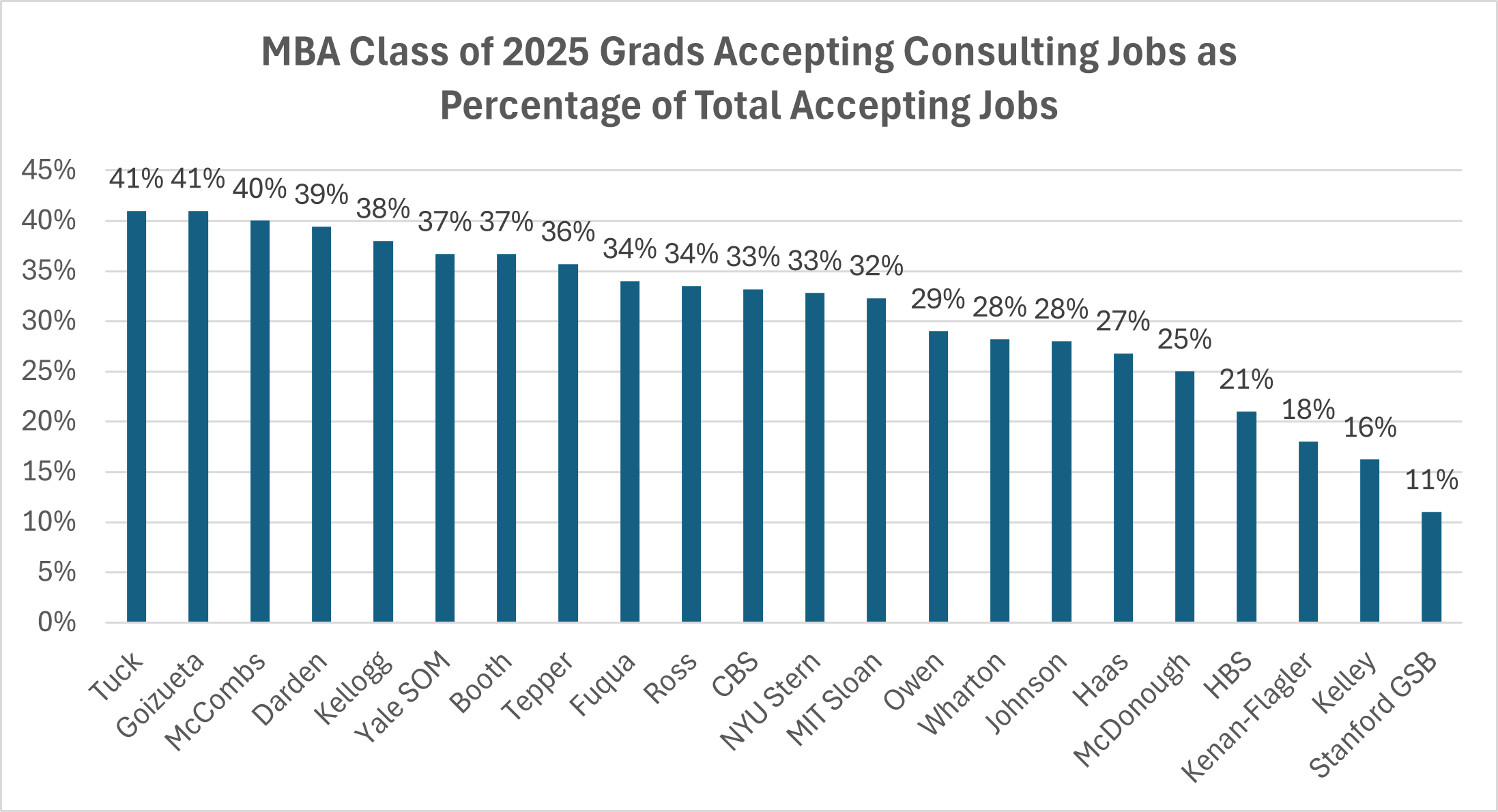
At many leading MBA programs, the share going into consulting is even higher. An analysis of MBA Class of 2025 employment reports found that consulting represented more than 30 percent of accepted jobs at 13 of the leading full time MBA programs, with Tuck (41%), Goizueta (41%), McCombs (40%) and Darden (39%) among the highest.
The Core Skills Consulting Firms Seek
Consulting firms continue to recruit heavily from MBA programs because of the specific mix of analytical, leadership, and communication skills graduates develop during business school.
Despite rapid advances in technology, the core capabilities consulting firms seek in MBA graduates have remained largely consistent.
“They’re still hiring for people who can tackle hard problems, who can look analytically at business challenges, who can think more holistically and apply first principles and strategic thinking to these problems,” says Stephanie O’Connor, associate dean of career services at the University of Chicago Booth School of Business. “That’s going to be the core of every MBA curriculum, and that hasn’t really changed.”
Consulting projects often require teams to evaluate complicated business situations and develop strategic recommendations under tight deadlines. That means consultants must be able to analyze information quickly and make informed decisions—even when they don’t have all the data.
MBA programs are designed to help students build those capabilities. “The firms are looking for great problem solvers with great people skills and, ultimately, great business acumen,” remarks Randy Albert, associate director of career coaching at the University of Michigan’s Ross School of Business. “It’s that third bucket where the MBA really helps.”
MBA coursework reinforces this skill through case discussions, analytical frameworks, and collaborative projects that mirror real-world business challenges. “The general management style of the MBA — where you’re gaining expertise across a variety of disciplines — allows you to bring enterprise-wide thinking to the role that you’re in,” says Brian Ruggiero, associate dean of career services at NYU Stern School of Business.
That broad perspective can be especially valuable in consulting, where projects often require an understanding of multiple business functions. “Typically, what firms are looking for from MBA graduates is a more well-rounded understanding of the business,” observes Greg Hanifee, associate dean for degree programs and operations at Northwestern’s Kellogg School of Management. “In a sense, the MBA is like a two-year boot camp that exposes them to parts of the firm they might not have experienced before.”
Communication and Influence Are Critical
Analytical ability alone is not enough to succeed in consulting. Consultants must also communicate insights clearly and influence decision-makers. That’s why communication consistently ranks as one of the most important skills employers look for in MBA graduates. “More importantly, it focuses on the people side of business,” Hanifee says. “How do I lead peers? How do I lead people who are older than I am?”
MBA programs often emphasize collaboration and discussion, helping students learn how to present ideas effectively and persuade others. “Students learn how to create convincing arguments and influence others,” Hanifee shares.
O’Connor notes consulting firms frequently emphasize the same skills when speaking with business schools. “These firms are also looking for people who can communicate their ideas, create influence without necessarily having direct authority over people,” she says. “They can implement or make recommendations and defend them.”
MBA classrooms often emphasize debate, discussion, and collaborative learning—all of which help students develop these abilities. At Chicago Booth, for example, students are encouraged to challenge ideas and clearly articulate their reasoning. “There’s a push for inquiries and being able to defend your thinking,” O’Connor explains. “Students must be able to explain how they reached a conclusion and know what additional information is valuable in sharpening their answer.”
Strong Compensation for MBA Consultants
Consulting roles are also among the highest-paying jobs available to MBA graduates. At the top strategy consulting firms, including McKinsey, Bain, and Boston Consulting Group, MBA hires typically earn base salaries around $190,000, along with signing bonuses and performance bonuses. For example, MBA consultants at McKinsey can expect a base salary of about $192,000 plus signing bonuses of around $30,000 and performance bonuses that can reach $40,000, bringing total first-year compensation to roughly $267,000. Compensation at Bain and Boston Consulting Group is similar, with total first year compensation often exceeding $270,000 to $285,000 for MBA hires.
At Michigan Ross, Albert says compensation packages for MBA hires entering consulting roles are broadly comparable across firms. “For MBAs, the total value is now well over $200,000,” Albert said. “For almost everybody, that’s a huge increase in what they were earning.”
These firms — among the world’s largest strategy consulting organizations — collectively employ tens of thousands of consultants across global offices and regularly recruit MBA graduates from leading business schools.
AI Is Changing Consulting Workflows
Like many industries, consulting is increasingly incorporating artificial intelligence into daily work. But rather than replacing consultants, these tools are primarily changing how certain tasks are completed. “I think AI is changing some of the day-to-day work,” O’Connor remarks. “The number of hours I spent in my hotel room transcribing interview notes from meetings with clients compared to now interviewing someone and having AI synthesize my notes is obviously a huge time saver.”
These tools allow consultants to spend less time on administrative tasks and more time focusing on analysis and strategy. “It simply means you have a tool that’s going to make one part of your work more efficient,” O’Connor observes. “But you still need to think about how all the pieces fit together, how you connect the dots across different teams or different aspects of the work. And you still have to explain your outcome.”
Business Schools Adapt the Curriculum to AI
“Recruiters and firms are expecting students not just to know the lingo, but to show what they’ve done,” Hanifee says. “They want students to talk about what they’ve tried,” he adds.
Students are increasingly expected to experiment with AI tools and demonstrate how they can apply them to real business problems. “To go back to your original question, firms now expect students to have something to show for what they’ve done,” Hanifee says. “It’s not enough to say, ‘If I had access to ChatGPT or Gemini, I could do this.’ The bar has been raised.”
Despite the emphasis on AI, what has stayed consistent are the fundamentals of what consulting firms are looking for in candidates, Ruggiero notes. “We approach conversations with employers by acknowledging that their business is changing,” he says. “We ask what’s changing in terms of the talent they’re looking for, especially when it comes to AI skills, because students want to know that. The feedback we get from hiring managers and recruiters is that their companies are still trying to figure that out themselves. There’s not a specific technical AI skill set they’re looking for from MBAs.”
What is becoming increasingly important, however, is intellectual curiosity — particularly when it comes to new technologies. “The one thing I’ve heard from all of these industries is this idea of intellectual curiosity,” O’Connor shares. “Being able and willing to mess around with technology to figure out how it improves their work.”
Leadership Development During the MBA
Consulting firms hire MBA graduates not only for analytical skills, but also for leadership potential. Consultants frequently work with clients, manage project teams, and coordinate across organizations early in their careers.
MBA programs therefore place significant emphasis on leadership development. At Booth, students participate in the Leadership Effectiveness and Development (LEAD) program, which combines coursework, coaching, and experiential learning opportunities. “Students have both coursework as well as optional extracurricular programming that they can opt into to cultivate their leadership skills,” O’Connor explains.
Self-awareness plays a key role in effective leadership. “How do others perceive me? How do I need to show up to be more effective?” O’Connor asks.
Leadership training is a core part of MBA education across many programs. “Firms value things like learning how to have difficult conversations,” Hanifee says. “There’s rarely a day in business when there isn’t a challenge that needs to be debated. The key is learning how to have those discussions respectfully and work toward the best solution.”
Networking and Career Access
Another major advantage of MBA programs for consulting careers is access to professional networks and recruiting opportunities. “It’s an alumni community and network,” O’Connor confirms.
Career services offices organize recruiting events, networking sessions, and speaker presentations that allow students to interact directly with industry professionals. “We host a number of companies on campus for recruiting events and networking sessions,” O’Connor says. “We leverage our relationships in the Chicago market and sometimes outside of Chicago to help students make deeper connections.”
Those connections can be critical to long-term success in consulting careers. “Networking is extremely important in consulting for long-term success,” Albert notes.
Why Consulting Firms Continue to Recruit MBAs
Despite ongoing debates about the future of business education, consulting firms continue to value the combination of experience and skills MBA graduates bring. “One of the things I’ve been impressed with [regarding] MBA students,” O’Connor says, “is their level of curiosity about careers in different opportunity areas.”
That curiosity — combined with prior work experience and business training — creates a distinctive professional profile. “Recruiters and Booth alumni really value the skill sets that combine leadership, fundamental business knowledge, and the prior experiences,” she adds.
For consulting firms helping clients navigate complex challenges, those capabilities remain essential. “Consulting and finance firms both have to stay ahead of their clients,” O’Connor notes. “They’re valuing the MBAs for their ability to help them do just that.”