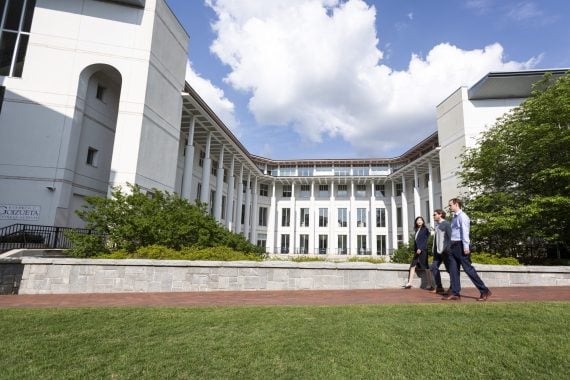



In this edition of our Admissions Director Q&A series, we welcome back Anne Kilby, Associate Dean of MBA Admissions at Georgetown McDonough in Washington, D.C.
Kilby oversees admissions, sets the admissions strategy, and manages the scholarship budget for the Full-Time MBA, Flex MBA, and Flex MBA Online programs. She has spent 18 years in higher education, mainly in admissions and recruiting. Kilby has worked within a global scope by representing programs internationally at recruiting events and fairs, partnering with universities and clients abroad, and interviewing prospective candidates residing worldwide. Prior to Georgetown, she was the Director of MPA Admissions at the University of North Carolina School of Government. Kilby also brings 7 years of experience from NYU Stern’s Global Executive Programs Office. Kilby received a Masters in Public Administration from NYU Wagner’s School of Public Policy, specializing in international policy and management. She also has a bachelor’s in political science with a minor in mathematics from North Carolina State University.
Our interview with Kilby covers the finer points of the McDonough MBA application, the impact of AI, and getting the most out of the program.

Clear Admit: What is one aspect of your MBA program that you wish applicants knew more about?
Anne Kilby: I hope applicants understand just how intentional we have been in redesigning our new MBA curriculum, which launches in fall 2026. The result of 18 months of research – including employer surveys, student focus groups, and insights from trusted partners – the new curriculum was built to prepare students for the realities of today’s business landscape.
One of the most significant changes is our emphasis on AI and data literacy. Students will engage with AI from the opening term, leaning on Georgetown’s strengths in ethics and responsible leadership, with these concepts integrated throughout the MBA experience.
We’ve also increased the flexibility around the timing of elective coursework. This enables Full-time MBA students to tailor their coursework to their career goals before recruiting ramps up. Doing so should give them a competitive advantage, help them build relevant skills, and differentiate themselves in a competitive market.
CA: Walk us through the life of an application in your office from an operational standpoint. What happens between the time an applicant clicks “submit” and the time the committee offers a final decision?
AK: Once an application is submitted, our MBA Operations team “processes” it to ensure all of the required materials have been received and the file is ready for review. Applications are then assigned randomly to an admissions reader, who blindly grabs an application to read from a virtual basket of files. The reader conducts an initial review to determine whether the candidate, on paper, is eligible for admission consideration.
Candidates who demonstrate strong potential on paper are invited to interview, allowing us to learn more about their experiences, motivations, and alignment with the values of the McDonough community. Following the interview, the Admissions Committee reviews the full picture, including the application, interview feedback, and committee notes, before making a final decision. Multiple people evaluate every application. This collaborative approach helps mitigate bias and ensures that every candidate receives a thorough, holistic review.
CA: How does your team approach the essay portion of the application specifically? What are you looking for as you read an essay? Are there common mistakes applicants should try to avoid? What is one key thing candidates should keep in mind as they sit down to write?
AK: We offer three essay prompts and invite candidates to choose the one that allows them to showcase themselves most authentically. We want candidates to be strategic and select a prompt that resonates with them, where they feel they can best highlight their personality beyond their resume, transcripts, and test scores.
Each prompt has several focusing questions. Through the essays, we may learn more about a candidate’s accomplishments, values, motivations, or perspective. We also evaluate how well they answer the question being asked and assess their written communication skills.
One common mistake is failing to proofread carefully. Grammatical errors, inconsistencies, or responses that don’t fully address the prompt can distract from an otherwise strong application. Before submitting, I encourage candidates to ask themselves: “What do I want the Admissions Committee to understand about me after reading this essay?” If you can answer that question clearly, you’re likely on the right track.
CA: Could you tell us about your interview process? Approximately what percentage of applicants are invited to interview, who typically conducts interviews, and what should candidates expect in terms of interview style and format?
AK: Our interviews are offered by invitation only. Receiving an interview invitation means a candidate has advanced in the review process based on their application materials.
Interviews may be conducted by an Admissions Committee member, a current MBA student, or an alumnus. They are also double-blind, which means candidates will not know the interviewer in advance, and the interviewer will not have read their application file. This approach helps reduce bias coming into the interview.
The interview is behavioral in nature and designed to assess qualities that contribute to success both in the MBA program and within the Georgetown community. Candidates may interview virtually via Zoom, on campus, or in person at recruiting events around the world. All formats are evaluated equally to maximize accessibility.
CA: If your admissions process includes any video-based components, such as video essays or recorded interview responses, what advice would you offer applicants preparing for this part of the process?
AK: Georgetown McDonough requires a video essay as part of the MBA application because it allows us to understand candidates more holistically. The video helps bring the application to life by giving us insight into an applicant’s communication style, presence, and personality.
We assess the content of the response, along with factors such as communication skills and executive presence. What we do not evaluate is production quality. Most applicants record their videos using a laptop or smartphone, and that’s perfectly acceptable. Focus on being authentic, answering the prompt thoughtfully, and presenting yourself professionally.
CA: Is there anything in particular international students should keep in mind during the admissions process?
AK: International students are a vital part of the Georgetown McDonough community, bringing diverse perspectives and global experiences that enrich the MBA experience for everyone. We strive to foster a welcoming and supportive environment where students from around the world can thrive. From career advising tailored to the unique considerations international students may face to a collaborative community of classmates, alumni, and mentors, students find both practical support and a strong sense of belonging.
That being said, no one can predict what the job market will look like two years from now when today’s applicants graduate, and international candidates should recognize that not every U.S.-based employer sponsors work authorization. As they reflect on their post-MBA goals, I encourage international applicants to be both intentional and open-minded. Having a clear sense of direction is important, but flexibility can also create opportunities as industries and hiring trends evolve.
CA: Conversations about MBA value often center on jobs, salaries, and ROI. What are some of the other ways students benefit from the MBA experience that may be harder to quantify upfront?
AK: An MBA is valuable not only because of the job it helps you secure immediately after graduation but because it equips you with skills that will serve you throughout your career. As a general management degree, it builds capabilities that transfer across industries, functions, and leadership roles.
Specifically at Georgetown, I would highlight our “power skills” – students gain both technical competencies, such as data analysis and AI literacy, and also the human “power skills” that effective leaders need, like critical thinking, empathy, and collaboration.
Perhaps most importantly, they gain a community. The relationships formed during the MBA experience often evolve into lifelong friendships, trusted advisors, business partners, and a professional network that continues to provide support long after graduation.
CA: Are there any trends in the applicant pool, admissions process, or MBA experience that you are particularly focused on right now?
AK: I’m particularly interested in how AI will shape the future of admissions, and I look forward to presenting on this subject at the GMAC Annual Conference this year. I believe admissions teams will increasingly use AI to streamline administrative and task-oriented work, creating more capacity for the human side of the process.