



After nearly seven years building products across Indian banking and fintech, Dhruv Tandon wanted to experiment with different roles in the tech ecosystem. At London Business School, he found the entrepreneurial community, diverse cohort, and access to the European and global startup ecosystem made it the ideal fit. In this edition of our Real Humans: Alumni series, we follow Tandon’s journey to co-founding Decisional AI.

Dhruv Tandon, London Business School MBA ’24, Co-Founder at Decisional AI
Age: 33
Hometown: Pune, India
Undergraduate Institution and Major: Birla Institute of Technology & Science, Pilani
Pre-MBA Work Experience: Senior Product Manager, ICICI Bank, ~2.5 years, Banking; Senior Product Manager, Drip Capital (YC W15), ~2 years, Trade Finance/Fintech; Product Manager, Razorpay (YC W15), ~1.5 years, Payments/Fintech
Post-MBA Work Experience: Co-Founder, Decisional AI (YC S24, VC backed startup), 2024–present, AI/SaaS
Why did you choose to attend business school?
I had deep operational and technical chops, but I wanted to step back and consider what kind of work I wanted to do and where I wanted to be. An MBA was a great way to satisfy that. I’d spent nearly seven years building products across Indian banking and fintech. I worked on launching one of India’s first UPI wallets at ICICI Bank, scaling payment infrastructure at Razorpay, and leading Drip Capital’s expansion into the US market. I knew I wanted a career in technology, but the most important thing for me was to experiment with different roles in the tech ecosystem, such as Product roles at early startups and analyst roles at Venture Capital funds. These experiments helped me shape my opinion, leading me to pursue entrepreneurship at an AI startup.
Why LBS? What factors figured most prominently into your decision of where to attend?
LBS’s entrepreneurial community, the extraordinary diversity of the cohort (90%+ international), and access to the European and global startup ecosystem made it the ideal fit. London itself is the second-largest AI ecosystem in the world, which meant I was surrounded by cutting-edge AI companies, talent, and capital right outside the classroom. I was also drawn to the school’s strong network in fintech and emerging tech, which felt directly relevant to where I wanted to take my career. LBS also offers great support for entrepreneurs looking to start up. I thought teaching entrepreneurship was impossible, but Gary Dushnitsky, Professor of Strategy and Entrepreneurship; Deputy Dean (Degree Education and Digital Learning) and Luisa Alemany, Associate Professor of Management Practice in Strategy and Entrepreneurship; Academic Director, Institute of Entrepreneurship and Private Capital changed my mind about this. Plus, David Morris from LBS’s career centre knows the ins and outs of the London tech ecosystem; his help in targeting internships and companies to engage with greatly benefited me.
What about your MBA experience prepared you for your current career?
Most of the trials and tribulations of being an entrepreneur involve managing emotions through ups and downs and consistently showing up to improve your business. Engaging in diverse perspectives, learning through internships, building friendships, and traveling the world helps you build resilience. With AI becoming a larger bearer of cognitive load, the human aspects of managing people, learning to understand yourself, and leaning on friends are becoming more valuable. The LBS MBA brings all this together.
In practical terms, I spent time working in Venture Capital, which helped me get connected to founders in the AI ecosystem, and did internships with tech companies that helped me hone in on the idea and space I wanted to work on.
In addition, the backing of the LBS Incubator – help with resources and the amazing support of the Incubator lead Osman Haneef, Senior Manager of Ventures – was super in shaping the company in its early days.
How do you feel that your MBA has been an asset when it comes to navigating new challenges, such as AI?
Technical knowledge used to be how people set themselves apart. Polished decks, crisp documents, thoughtful emails. Now everyone can do that. There’s no room in the world for being average at anything; that’s AI’s job.
If used correctly, the MBA gives you something far from average: etched memories and lived lessons. It’s the right melting pot for these moments. You take ambitious people from wildly different backgrounds, put them in a room with a great professor and a compelling case, and something clicks that you can’t replicate on your own or through a YouTube video. I learned about the importance of timing, an aspect of entrepreneurship that’s often overlooked. The difference between OpenAI’s world-changing ChatGPT release and Google’s risk-averse hesitation to ship their own LLM amounted to a trillion dollars in value.
There are specific cases and classroom discussions I still anchor to. To someone who simply reads the case study, it’s worthless technical knowledge. But, to someone who lived the discussion, surrounded by sharp minds, guided by great professors, that same material leaves a lasting mark. The average becomes special. For me it was a case study about an entrepreneur building a game called Trivial Pursuit and how the way he sequenced resources at exactly the right moments helped him kickstart the business. You might think: Trivial Pursuit? An 80s board game? What does it matter? Turns out it does, to me and to everyone who was part of that discussion.
What was your internship during business school? How did that inform your post-MBA career choice?
I spent time at two London-based venture capital firms during my MBA. First at Concentric, a seed-stage fund focused on fintech and Bitcoin infrastructure, and then at Moonfire Ventures, an AI-native VC that uses machine learning for sourcing, screening, and thesis development. Being in London, the second-largest AI hub globally, meant these weren’t niche firms operating on the periphery; they were at the centre of a thriving ecosystem of AI founders, researchers, and capital. Seeing hundreds of startups from the investor side gave me a sharp sense of what ideas I found interesting. These ideas became the foundation for Decisional. I built solid relationships – infact, the VC I worked at, Moonfire Ventures, later backed my company.
Why did you choose your current company? What factors figured most prominently into your decision of where to work?
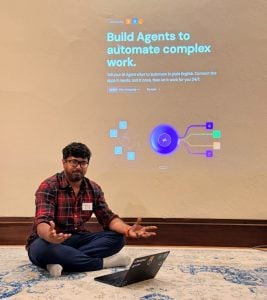
I didn’t choose a company. I started one. Decisional builds AI agents that automate workflows while you sleep, no technical knowledge needed. We bring code generation for workflow automation right into the spreadsheets operations teams already live in, serving businesses that could never afford to hire software engineers.
When I talk to business owners, they’re excited by AI. And they should be. Companies are going to be more efficient than ever. But, AI’s capabilities are jagged: superhuman in some areas, deeply flawed in others. That gap is going to create a ton of opportunities for new businesses. Things are moving too fast to be a bystander, so I decided to work on the cutting edge of AI research and applications.
 Advice to current MBA students:
—One thing you would absolutely do again as part of the job search?
If you think the timing is right, skip the job search and start a company. I knew I wanted to build something and I used every minute of the MBA to lay the groundwork. Customer conversations, co-founder chemistry, sharpening how I think about markets. If you have the itch, don’t suppress it with a safe recruiting process. The MBA is the best launchpad you’ll get.
—One thing you would change or do differently as part of the job search?
While I chose to become a founder post-MBA rather than pursuing a full-time role elsewhere, I did get selected for three internships: one at Big Tech (Amazon), and two in Venture Capital (mentioned above). What helped me most is being open to engaging with the LBS and London community, being honest and curious, rather than being more tactical about recruiting.
—Were there any surprises regarding your current employer’s recruiting process?
My employer is me, so the recruiting process was betting on myself. The surprise was how much the LBS network made that bet less risky. Early customers, advisors, warm intros to investors – none of that came from cold outreach. It came from people I sat next to in class. The global reach of LBS meant I had doors opening in markets I hadn’t even planned for.
—What piece of advice do you wish you had been given during your MBA?
Learn AI tools, but don’t get attached to any single one. What matters is locking into the fundamentals: understand the shape of LLM intelligence, where it’s superhuman and where it falls apart. That mental model outlasts any specific product. And remember, AI companies still sell to humans. You still need to read a room, build trust, and close a deal. The MBA gives you that. Technical knowledge is table stakes now, but the melting pot of sharp minds, diverse backgrounds, and great professors gives you something AI can’t replicate. Invest in those moments. They compound in ways a polished resume never will.