



In this edition of Real Humans: Alumni, Sam Ederle shares his professional journey. After leaving an acting career, he knew he faced a challenge: He was capable of succeeding in business, but nobody was going to hire him. Business school was the solution. He chose the MBA program at Vanderbilt Owen based on its strong career outcomes, small, tight-knit community, and the quality of life in Nashville. Read his story here.

Sam Ederle, Vanderbilt Owen MBA ’24, Consultant at L.E.K. Consulting
Age: 30
Hometown: Duxbury, MA
Undergraduate Institution and Major: Wake Forest University, Communications Major
Graduate Business School, Graduation Year and Concentration: Vanderbilt University’s Owen Graduate School of Management, 2024, Strategy Concentration
Pre-MBA Work Experience: 4 years self-employed as a Professional actor (and as a Membership Sales Associate at OrangeTheory Fitness!)
Post-MBA Work Experience: Senior Consultant, L.E.K. Consulting, 1.5 years
Why did you choose to attend business school?
Coming off of my career as a professional actor I was positive of two things: I was capable of succeeding in business, and nobody was going to hire me.
Business school helped solve that problem. It allowed me to build a knowledge base and credibility simultaneously. I gained much needed analytical depth, exposure to multiple industries, and a strong network of friends. That combination created both competence and confidence, which made the career transition possible.
Why Vanderbilt Owen? What factors figured most prominently into your decision of where to attend?
Other than Vanderbilt having the same colors as my undergrad at Wake Forest, three factors drove my decision:
First, career outcomes. Owen has strong placement across core post-MBA paths, including consulting. I was able to leverage both the Owen alumni base and the broader Vanderbilt network throughout recruiting.
Second, class size and culture. Through many years of learning about myself, I have found that I thrive in small, tight knit communities. I prefer to have a real relationship with my professors and classmates and I felt that Owen would provide that type of community.
Third, geography and quality of life. My wife and I had both gone to Wake Forest which was just a state over and the combination of academic / professional success with great weather was extremely appealing.
What about your MBA experience prepared you for your current career? How do you feel that your MBA has been an asset when it comes to navigating new challenges, such as AI?
At a foundational level, the MBA reinforced structured problem solving and how to make decisions with imperfect information. Those skills are central to consulting.
That said, some of the non-core classes have been the most valuable for me. I took a course on managing under uncertainty that focused on navigating high-intensity situations and maintaining composure as conditions change. I also took a class on implementing AI during the year ChatGPT was first released, which forced us to think in real time about how emerging technology would affect operating models and decision-making.
The core curriculum provides the fundamentals, but the flexibility beyond that allowed us to explore topics that were still evolving. In several cases, we were working through the implications alongside the professor as the landscape was shifting. That experience of operating without a clear playbook has been central to my post-MBA career and I believe the learnings from those courses have been used as much as the core curriculum.
What was your internship during business school? How did that inform your post-MBA career choice?
My internship was with L.E.K. Consulting and I was given an offer to return and accepted it.
Why did you choose your current company? What factors figured most prominently into your decision of where to work?
I knew I wanted to pursue consulting, and there are many strong firms in the industry. What stood out to me about L.E.K. came down to three things.
Through conversations and interviews, I built genuine connections with several members of the firm. My final interview was with the head of the Boston office at the time, and he combined intellectual rigor with humility and kindness. That interaction made it clear this was a group I would enjoy working with.
Also, L.E.K. does significant work supporting private equity firms in their investment decisions. The analysis goes well beyond financials and focuses on market size, competitive dynamics, customer behavior, and overall attractiveness of the business. That level of work was compelling and aligned with the kind of problems I wanted to solve.
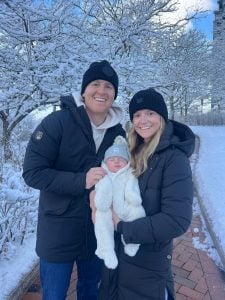
Lastly, L.E.K.’s model involves materially less travel than many consulting firms. My wife and I knew we wanted to start a family (and now have a 3-month old!) and the prospect of limited travel was important.
 Advice to current MBA students:
–One thing you would absolutely do again as part of the job search?
I would absolutely focus on relationships again. I made great friends in the program, was close with the career development center, and asked professors questions outside of class that were on my mind. At my coffee chats with people at different firms, I focused on getting to know the person and tried to ignore the fact that I might be applying there in the future. Some of these relationships turned into opportunities, some didn’t, but I enjoyed all of the conversations and would absolutely go about things in the same way again.
–One thing you would change or do differently as part of the job search?
Spread a wider net. I ended up getting L.E.K. Which was great, but you have no idea why certain things do or don’t workout in this process and you have a very very long career ahead of you. I have friends who started in consulting and left quickly, and others who did not receive offers initially, but later transitioned in. Give yourself a lot of opportunities and focus on preparation, professionalism, and relationships. This is a long journey and the goal is to try your best, learn from the good and bad experiences, always be kind, and trust that what’s supposed to happen is going to happen.
–Were there any surprises regarding your current employer’s recruiting process?
L.E.K.’s second-round process was meaningfully different from standard case interviews and, in my view, more reflective of the actual job.
There was a take home case where you were given a case question and about 20 slides worth of “findings” from your associates. Your job was to look through all of the materials and build a 1 page summary slide to present during your interview. Another required building a structured workplan and assigning tasks to a hypothetical case team based on a client question.
These two assignments, in my opinion, do a far better job than the standard case interview at determining who is going to succeed in the consulting role. We rarely if ever sit in front of the client and do mental math while they watch for 20 minutes and then have to present our conclusion confidently on something we just heard about for the first time. The job involves far more understanding, planning, discovery, redirection, and refinement followed by consolidation, storytelling, and presentation. I think that L.E.K.’s interview process does a better job at testing those skillsets than any interview I had.
–What piece of advice do you wish you had been given during your MBA?
For career switchers: you are not as far behind as you think.
There are technical concepts and terminology to learn, but the underlying math and frameworks are manageable. The true differentiators are judgment, leadership, communication, and resilience. Those are capabilities you have likely been building long before business school.