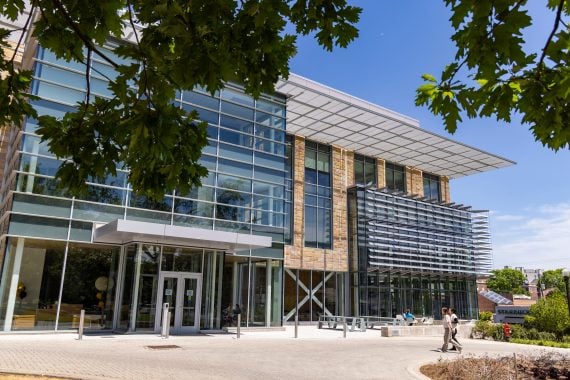



Originally from Houston, Texas, Amna Hussain-Holliday spent 11 years living abroad and working in London. She wanted to move back to the U.S., but had never experienced American work culture. Business school was the ideal place to transition and plan her next career move. In this edition of Real Humans: Alumni, Hussain-Holliday explains how Northwestern Kellogg‘s culture and more helped her pivot from corporate strategy into consulting at Bain.

Amna Hussain-Holliday, Northwestern Kellogg MBA ’25, Consultant at Bain & Company
Age: 32
Hometown: Houston, TX
Undergraduate Institution and Major: King’s College London, Business Management
Pre-MBA Work Experience: (all in London) Investment Analyst, Willis Towers Watson, Aug 2016 – Jan 2018, Pensions Investments; Corporate Strategy & Innovation Associate, Willis Towers Watson, Jan 2018 – Nov 2019, Insurance; Corporate Strategy Manager, British Telecommunications, Dec 2019 – Jun 2021, Telecom; Senior Associate Consultant, Bain & Company, Jul 2021 – Sep 2022, Consulting; Consultant, Bain & Company, Oct 2022 – Jul 2023, Consulting
Post-MBA Work Experience: Consultant, Bain & Company, Jul 2025 – Present, Consulting (Denver)
Why did you choose to attend business school?
After spending 11 years living abroad and working in London, I knew I wanted to move back to the US but wanted to do so thoughtfully because I hadn’t lived there since becoming an adult and had never experienced the American work culture. Business school felt like the ideal transition point to allow me to re-anchor myself professionally in the US while also being intentional about my next career step.
Equally important was the opportunity to expand my network. Having built my career internationally, I recognized the value of developing a strong US-based professional community across industries and functions. I saw business school as more than an academic experience – it was a chance to build lifelong relationships with peers who would go on to shape industries in different ways.
For me, business school was both a strategic and personal venture where I could build a bridge between geographies and create a strong network for my career.
Why Kellogg? What factors figured most prominently into your decision of where to attend?
Kellogg stood out to me because of its collaborative culture and its strong investment in spouses (called JVs) being involved in the business school experience. I was looking for an environment where classmates collaborate together, and Kellogg’s culture of teamwork drew me to the school. Actively integrating JVs into the school community was also very meaningful. It signaled that the school recognizes business school as a shared experience, not just an individual one.
What about your MBA experience prepared you for your current career? How do you feel that your MBA has been an asset when it comes to navigating new challenges, such as AI?
My MBA prepared me mainly due to the exposure to new and diverse perspectives. Business school taught me to work closely with people who had different communication styles, levels of professionalism, and approaches to teamwork. In a highly diverse environment, not all differences are easy and navigating dynamics often required more patience and adaptability than I anticipated. But that experience became one of the most valuable aspects of my MBA. It taught me how to lead and collaborate even when expectations aren’t aligned, which is very different to my career in corporate strategy and consulting where at the start of a project, stakeholders and team members are broadly aligned.
What was your internship during business school? How did that inform your post-MBA career choice?
I interned at ServiceNow as a Sr. Outbound Product Manager. I pursued the role intentionally because I wanted to explore product management as a potential long-term path. The PM role is often viewed as a natural complement or exit opportunity for consultants, given the overlap in strategic thinking, stakeholder management, and translating complex problems into actionable solutions.
The experience was incredibly rewarding. I worked in a fantastic team with very sharp people who gave me the opportunity to own a project for the summer where I produced a competitor analysis of the product we owned. I was able to shape the product narrative and work cross-functionally with engineering, sales, and marketing. Ultimately, the internship provided incredible learning and while I loved the work, I missed the pace and breadth of consulting. I thrive in environments where problems are constantly evolving and each engagement brings exposure to a new industry or challenge.
Why did you choose your current company? What factors figured most prominently into your decision of where to work?
I already worked at Bain prior to business school and went to business school sponsored by them. I chose to work for them when I did because I knew I wanted to pivot from Corporate Strategy into Consulting. While I was in Corporate Strategy, I worked with people who had been at a number of different consulting firms and I found that my colleagues who were ex-Bain were some of the best people to work with in terms of the culture they created, the coaching and mentoring they were willing to offer, and how they were able to drive to answers to create value for our stakeholders. They were the only consulting firm I interviewed with because I knew they were the company I wanted to work at!
 Advice to current MBA students:
–One thing you would absolutely do again as part of the job search?
I spent a lot of time upfront pressure-testing what I actually wanted and reaching out to anyone I could to learn what it is that I wanted. Being intentional early really helped me find the right fit for my summer internship.
–One thing you would change or do differently as part of the job search?
It was so easy to compare to other students. MBA environments can amplify comparison and it’s incredibly distracting. I’d remind myself more that everyone’s timeline and path are different and don’t let the noise of others impact what you are pursuing.
–What piece of advice do you wish you had been given during your MBA?
Treat business school as a 2-year period that you will never get back. Do all the things you keep telling yourself you don’t have time for because of work – that’s why I trained for and completed a triathlon while I was there!