


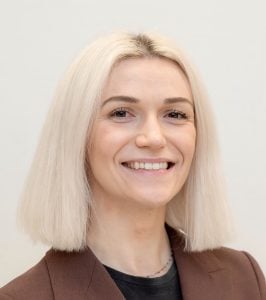
Alicia Younker, NYU Stern MS, Business Analytics and AI Class of 2027
Hometown: Fairbanks, Alaska
Undergraduate Institution and Major: Seattle University, Finance
Pre-MSBAi Work Experience: Boeing, Corporate Strategy Analyst, 8 Years, Military Aerospace, Aviation & Aftermarket Services
Current Professional Role: Technical/Engineering Integrator
Why did you make the decision to attend business school?
I’ve always loved the structure of going to school, the satisfying challenge of mastering new subjects, and being surrounded by like-minded, curious classmates. In the last couple of years of my career, I started to realize that master’s degrees really open doors in ways I didn’t fully appreciate earlier on, which inspired me to start looking more seriously and intentionally at these types of programs.
But even before I started looking at programs, I made sure I had a solid vision in mind of what I wanted to get out of it: I wanted to deepen my analytical skills while staying rooted in business, and I wanted to graduate with a degree that would open new career doors for me. After rotating around several roles that supported highly technical teams, I also realized I wanted to dig deeper into the analytical and data side of business, since I didn’t have that background. With all of this in mind and after researching various options, the NYU Stern Master’s in Business Analytics and AI Program felt like a no-brainer.
Why did you choose NYU Stern? What factors figured most prominently into your decision of where to attend?
Beyond its reputation, I was particularly drawn to the faculty of NYU Stern; many of my professors at Stern literally wrote the textbooks that serve as the backbone of the program! The design of the program was also a big factor: a part-time, modular format that allows me to continue working full-time while still having the opportunity to build relationships with my classmates in-person throughout the program. And, it’s in the heart of New York City (a strong bonus factor for me).
What do you think is your most valuable or differentiating contribution to the class?
Growing up, I attended a small, Catholic high school where I played a lot of sports. I learned early on what a difference having a strong community makes on one’s success, that attitude makes or breaks a team, and attitude is a conscious choice. In everything I do – work, life, friendships, sports – I always, always, always make a conscious effort to get to know the people I’m working with and bring a positive attitude through encouragement, vulnerability, and humor. I like to think that I helped to bring our class together as a team and create a community where everyone feels like they’re a part of a bigger effort, together. Every assignment, every class, every module accomplished is a team success to be celebrated.
Tell us a fun fact about yourself that didn’t get included on your application:
Business and entrepreneurship run in my family: both sets of my grandparents and my parents are/were small business owners in Alaska! My mom’s dad immigrated from Italy and opened one of the first Italian restaurants in Fairbanks, Alaska.
Advice for Current Prospective Applicants:
–What is one thing you would absolutely do again as part of your application process?
There were a few YouTube videos and blog posts from current and former MSBAi students that really helped me to grasp what I would be getting into and what to expect. I would highly recommend that to anyone starting the process of picking programs and schools: read through what courses are offered, read about the professors teaching the courses (and what they’ve written or researched), and absolutely talk to former students.
–What is one thing you would change or do differently?
I underestimated how long of an adjustment it would be to return to school after working full time. It took a bit for me to regain my stamina for studying for long periods of time! If I could go back, I would have enrolled in a few “intro to coding” classes or something similar to get my mind back into the routine of studying and getting that discipline back again. That, and start chipping away at my coursework as early and often as possible – it will catch up with you!
 How do you balance the demands of the program with your professional responsibilities, and what strategies have worked best for you?
Honestly, I think I’m still figuring that one out, but I’ve been really lucky to have managers and teammates at work who have been really supportive and understanding when I need to take time off to focus on studying or homework. When I first started the program, I definitely spent some time experimenting with studying at different times of the day and different places to figure out what worked best for me. That really helped me find my rhythm and build a structure and routine around my life.
This is going to sound corny, but for me, a lot of finding my balance has also been me reminding myself that I get to choose to study in my free time and on my weekends; it’s an immense sacrifice but it’s also an immense privilege to have the opportunity to learn from so many fantastic professors alongside so many of my incredible classmates. I have to give major credit to my classmates as well, as I rely heavily on our 70-person WhatsApp group chat for help when I get stuck, or sounding board for advice on which assignments to tackle and how to tackle them.
How has the format of the program allowed you to immediately apply what you’re learning to your current role and impact your career?
One of the biggest advantages of the part-time, modular format is that I don’t have to wait until I graduate to apply what I’m learning. Every module has given me tools that I can immediately bring back to work, whether it’s vibe coding a PowerPoint macro, or using Google Cloud Storage and SQL to clean datasets, or thinking about business decisions through a more analytical lens. The program has already changed the way I approach problems at work and has helped me find a new level of confidence in the skills I have, and I know these skills will continue to compound throughout my career and as I finish the program.
What is one thing you have learned about NYU Stern that has surprised you?
I am in awe at the breadth and depth of resources NYU Stern has for their students and alumni. It was a big reason NYU was at the top of my list, but I truly didn’t realize all of the different institutes, library resources, and networking opportunities available to Stern students. That, and how humble all of my professors have been! Like I said, a lot of the Stern professors literally wrote the book on their subject, but all of my professors have been so approachable and eager to help us all succeed. That humility has created a remarkably collaborative culture within my cohort. I’ve never felt like I’m competing with my classmates.