


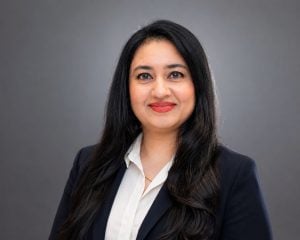
Priyanka Swarna, NYU Stern MS, Business Analytics and AI Class of 2027
Hometown: Chennai, India
Undergraduate Institution and Major: Anna University, Electrical and Electronics Engineering; International Business
Pre-MSBAi Work Experience: BMW of North America / Tata Consultancy Services, BI Developer through Feature Team Lead, 17+ years, Data & Analytics, Technology, Automotive
Current Professional Role: BMW of North America, Feature Team Lead, Enterprise Data, Analytics & Architecture; Automotive Technology
Why did you make the decision to attend business school? Why now?
AI is fundamentally reshaping what enterprise data leadership means, and I wanted to be inside that shift, not watching it from the outside. After 17 years of leading data transformation at BMW of North America, I know what I know well. The harder question was: what do I not yet know that will matter most in the next decade? The answer pointed directly to the intersection of AI, business strategy, and decision science. I wanted a rigorous environment that would challenge me to think differently, not just more efficiently. NYU Stern’s MSBAi Program offers exactly that, at exactly the moment the industry demands it.
Why did you choose NYU Stern? What factors figured most prominently into your decision of where to attend?
Three things set NYU Stern apart. First, the MSBAi curriculum is built for practitioners.It is designed for working professionals and challenges you to go deeper, not start over.
Second, New York City itself. Being embedded in one of the world’s most active technology and business ecosystems creates access and exposure that no classroom alone can replicate. Third, the faculty. The caliber of research and real-world engagement, particularly in AI and data-driven decision-making, is exceptional. Their dual commitment to pioneering research and practical execution bridges the gap between academic theory and corporate strategy in a way that is rare. Stern felt less like academia and more like stepping into the conversation among the people who are not just studying the industry but actively building it.
What do you think is your most valuable or differentiating contribution to the class?
I bring 17 years of enterprise-scale implementation experience in one of the most complex, globally distributed industries in the world, working across BMW, MINI, Motorrad, and Rolls-Royce. When data governance frameworks or cloud data strategies come up in the classroom, I have lived those decisions, including the ones that did not go as planned. I have built data foundations from the ground up, navigated legacy ecosystems that resisted every modern pattern, and delivered analytics platforms that executives across four automotive brands relied on daily. Having started my career in data from day one, I have had the rare opportunity to watch the discipline evolve in real time, from the infrastructure up. What that taught me is that patterns tell stories. The ability to translate complexity into meaning, to surface what the data is actually saying and make it actionable for the people who need it most, is the skill that travels furthest.
Tell us a fun fact about yourself that didn’t get included on your application:
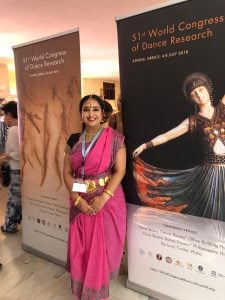
Classical Indian dance has been a parallel discipline for most of my life. I have been a member of the International Dance Council (CID UNESCO) since 2017, represented the United States at the 51st UNESCO World Dance Congress in Athens, received a competitive Folk Arts Apprenticeship Grant from the New Jersey State Council on the Arts through a formal statewide panel review in 2021, and have over 50 performances across the tri-state area. The practice has called for the same rigor, discipline, and composure under pressure as any high-stakes professional environment. If anything, it has demanded more.
Advice for Current Prospective Applicants:
–What is one thing you would absolutely do again as part of your application process?
I would choose the same approach again: decide what I still wanted to learn first, then find the school best positioned to deliver it. I chose the program that offered the strongest executive-level education in my field at this point in my career, applied early as a commitment to myself, and let the decision begin with an honest question about what I still needed. It would have been easy to build an application entirely around what I had already done. Instead, the most genuine part of my essay was the acknowledgment that leading through an AI-driven era demands continuous reinvention, no matter how much experience you bring. Intellectual honesty about where your edges are is not a liability. It is what made the application process feel less like a formality and more like the first step toward something real.
–What is one thing you would change or do differently?
I would have started networking earlier and with more intention. I came into the program focused on the academics, which is natural, but the relationships you build with peers, faculty, and the broader Stern community are just as much a part of the investment as the coursework. I would tell my pre-application self not to wait until enrollment to introduce yourself to the ecosystem. Research the faculty whose work intersects with yours. Connect with current students before decision day. Show up to admitted student events with real questions, not just enthusiasm. The program rewards people who come prepared with purpose, and that preparation starts well before orientation.
–What is one part you would have skipped if you could, and what helped you get through it?
If I could skip one part, it would be the deliberation. Senior practitioners do not approach education the way fresh graduates do; knowing when to step back into a classroom is its own kind of decision, and that weight can slow the decision down considerably. I kept waiting for the right moment and there was always a reason to defer: one more project, one more milestone and planning self-capacity. What got me through it was accepting that the perfect time does not exist. It will always be a choice made for personal growth, not one handed to you by circumstance. The only non-negotiable is that the program must be grounded in where the industry is actually going, not where it has been.
 How do you balance the demands of the program with your professional responsibilities, and what strategies have worked best for you?
Ruthless prioritization and calendar discipline. I treat coursework the same way I treat a high-stakes project at work: with defined time blocks, clear deliverables, and no tolerance for drift. I have also been intentional about not fully compartmentalizing the two. It is more of an integration. The program makes me sharper at work and my professional experience makes me a more grounded student. Neither feels borrowed from the other. When both directions are flowing, the balance takes care of itself more naturally than I expected. The one thing I have not fully solved is protecting space to step away from both, but I am more deliberate about it than I used to be.
How has the format of the program allowed you to immediately apply what you’re learning to your current role and impact your career?
Almost immediately and in both directions. Frameworks from the program, particularly around AI applications, data-driven decision modeling, and business strategy, have already shaped how I approach architecture decisions and stakeholder conversations at BMW. At the same time, the real-world problems I bring from BMW give my coursework an immediacy that purely academic study would not have. Our capstone project on global end-of-life vehicle recycling is a perfect example of how industry expertise, course content, and genuine drive can come together in one place. I am applying analytical discipline from the program to a domain I have worked inside for 17 years, and the result is richer than either direction would produce on its own.
What is one thing you have learned about NYU Stern that has surprised you?
I expected intellectual rigor, industry exposure, and the chance to learn across domains. I got all of that. What I did not anticipate was how much it would open up my own sense of possibility, professionally and personally. Routine has a way of narrowing your view of what you are already capable of. Business school interrupted that. The mindset shift has been the most significant takeaway, not a framework or a course, but a fundamentally different way of seeing what I have built and where it can go. It’s made me more motivated and has given me a totally different perspective on how I see myself.