

Tatiana Sokolova was good at technical decision-making, possessing a robust analytical skillset. But, she was interested in the financial levers that affect decision-making. Pursuing an MBA and Master of Environmental Management was a great great opportunity to pivot into the more niche industry of sustainability in energy. In this Real Humans: Alumni, Tatiana explains how Duke Fuqua met the requirements she was looking for in a graduate business program: a rigorous curriculum in finance and clean energy sectors, with a significant alumni presence. Read her story here to find out how she forged a new career in sustainable energy.
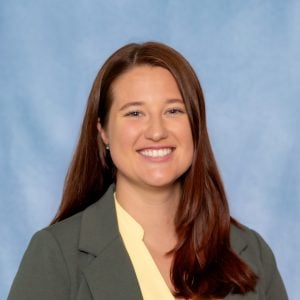
Tatiana Sokolova, Duke Fuqua MBA/MEM ’24, Lead Analyst, National Grid Ventures
Age: 31
Pronouns: she/her
Hometown: Novokuznetsk, Russia
Undergraduate Institution and Major: University of Virginia, B.S. Mechanical Engineering
Graduate Business School, Graduation Year and Concentration: Duke University, Fuqua School of Business, Class of 2024, Corporate & Energy Finance (Concurrently received a Master of Environmental Management from the Nicholas School of the Environment focused on Energy & the Environment)
Pre-MBA Work Experience: I spent a little under 6 years serving as a technology consultant at IBM supporting the U.S. Federal Government in developing and delivering on solutions in the areas of Cloud, Advanced Analytics, and Artificial Intelligence.
Post-MBA Work Experience: I’ve been at National Grid Ventures for a little over 1.5 years. I’m currently a Lead Analyst within our Commercial Business Development group and focus on analyzing various business opportunities within the electric power sector.
Why did you choose to attend business school?
While I developed a robust analytical skillset for technical decision-making in my post-undergraduate career, I found that I had a gap in knowledge when it came to the financial levers that affect decision-making. I also observed that a lot of the leaders I admired and respected at my firm had MBAs and were very supportive of the pursuit of a postgraduate degree. Thus, I pursued an MBA to round out my technical skillset as well as strengthen my leadership acumen.
Why Duke Fuqua? What factors figured most prominently into your decision of where to attend?
While I enjoyed my role as a technology consultant, going to graduate school felt like a great opportunity to pivot into the more niche industry of sustainability in the energy industry which I had been interested in (and worked in) during my undergraduate education. Thus, along with my interest in a strong curriculum that would give me a rigorous foundation in finance, I also wanted to attend a school that had a strong curriculum and alumni presence within the clean energy sector. Fuqua, with resources like the EDGE center and hands-on learning opportunities like FCCP that focused on working with companies in the energy sector, seemed like the perfect fit for the education I was looking for. The ability to also take an extra year and get a deep dive into the technical side of the energy industry through the MEM (usually a two-year program) set Duke apart from the rest, along with the opportunities to take classes from the Duke’s world-renowned Law and Policy schools as well.
Beyond classes, the factor that cemented my choice was the students and alumni that I had connected with during my business school research phase. One of Team Fuqua’s core principles is “Authentic Engagement” which shone brightly any time I had a conversation with a Fuquan. Each person was incredibly passionate about what they did, showed up 100% authentically as themselves, and were incredibly supportive of their peers and potential future peers.
What about your MBA experience prepared you for your current career? How do you feel that your MBA has been an asset when it comes to navigating new challenges, such as AI?
While there were many aspects of the MBA that prepared me for my current career, I think the lesson that shows up daily for me is the importance of networking in a sincere and authentic manner. When you show genuine interest in a person and their work, that connection becomes a lot stronger (and generally more fruitful) than when you go into an interaction purely with a transaction in mind.
My MBA experience strengthened my adaptability and resilience which I believe are crucial when navigating new challenges, especially new technologies the world does not have a playbook for, such as AI. When you’re juggling 4 to 6 classes that change in topic every 6 weeks, extra-curriculars, networking & the job search, along with personal commitments (like getting 7-8 hours of sleep a night!), you need to pivot and bounce back quickly when new challenges arise. The more you use the “adaptability muscle,” the stronger it gets, and the easier it becomes to think critically about and act quickly upon new challenges.
What was your internship during business school? How did that inform your post-MBA career choice?
I interned with the AES Corporation in their new solution development department focused on Heavy-Duty Fleet Electrification. During this summer experience, I realized there was much more work needed in the United States to develop a clean and resilient electric grid so that new solutions like electric trucks could provide the most benefits to our society. Thus, I focused my post-MBA career search on roles that were focused on strengthening the backbone of our power system.
Why did you choose your current company? What factors figured most prominently into your decision of where to work?
I chose National Grid both for the company culture as well as the specific role I’d be taking on. My role as a business analyst at National Grid Ventures leverages my technical knowledge gained from my Mechanical Engineering undergraduate degree and MEM, the analytical skillset I gained at IBM and sharpened at Duke, and the financial knowledge I had gained at Fuqua into meaningful and impactful work that moves forward the energy transition at large. From the company culture perspective, National Grid has a lot of the values I appreciated at Fuqua such as a focus on making a positive contribution to society and a commitment to diversity, equity, and inclusion.
 Advice to current MBA students:
–One thing you would absolutely do again as part of the job search?
Go to every networking event you can, and ask the folks you’ve spoken with about additional connections you could speak with.
–One thing you would change or do differently as part of the job search?
Ask more about the challenges each person you’re speaking with is currently tackling; if you don’t get excited about what they’re talking about, it’s a good sign that you should look to other industries/roles. If you do get excited about the challenge, follow up to the person after the conversation with concrete ideas about what could make their roles and challenges easier (which could possibly lead to role creation for you!).
–Were there any surprises regarding your current employer’s recruiting process?
I did not expect a robust case interview for my role which involved creating a financial model for various business decisions and summarizing the model’s outcomes into an executive recommendation presentation. I enjoyed the process and it gave me good insights on what my actual day-to-day role would entail!
–What piece of advice do you wish you had been given during your MBA?
Write out your specific goals each quarter, order them by level of priority, and then only focus on the top 3 (revisiting them once a week to ensure you’re on track and still aligned with those goals). With so many different opportunities to engage with during your two years in the MBA, it can be easy to get distracted and overwhelmed in trying to do everything. Embracing the JOMO “Joy of missing out” is much easier when you know you are exactly on the path towards meeting your specific goals.