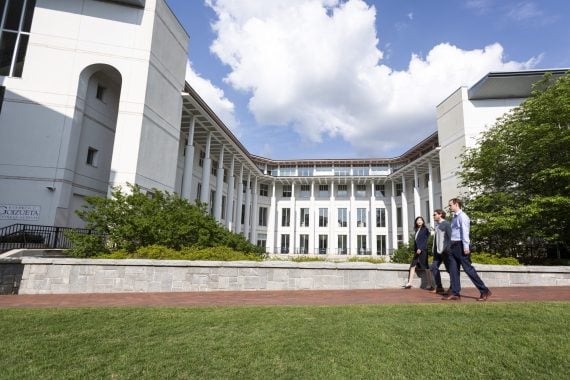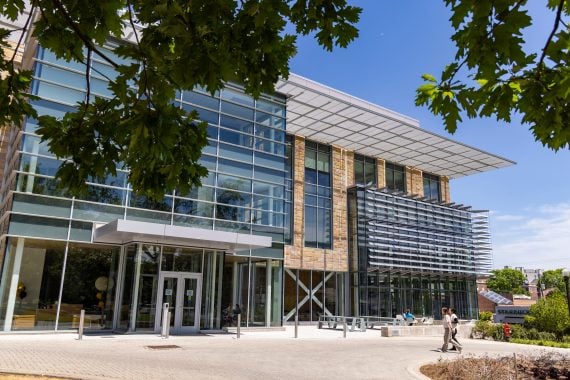



We are back at the University of Michigan – Stephen M. Ross School of Business to meet Jada Kavanagh, Director of Full Time MBA Admissions, in this Admissions Director Q&A.
Jada brings more than 20 years of leadership experience across higher education, politics, and private enterprise, with a focus on strategic growth and operational excellence. She has led teams, managed budgets, implemented CRM systems, and developed multi-year strategic plans to advance mission-driven goals. Jada is known for her thoughtful leadership and clear communication, and she builds collaborative cultures that prioritize accountability, innovation, and belonging. Her work centers on aligning strategy with people so systems, teams, and vision can move forward together.
Outside of the office, Jada enjoys restoring antique homes, cooking, traveling the world, and spending time with her animals.
Read on for Jada’s favorite aspects of the Ross MBA, her insight into the admissions process, and the current trends impacting MBA programs.

Clear Admit: What is one aspect of your MBA program that you wish applicants knew more about?
Jada Kavanagh: I wish applicants knew more about how intentionally we combine our collaborative culture with our action-based learning philosophy. We believe that to be successful in business, you have to do the work, and learning by doing shapes our entire MBA experience. Students don’t have to wait for their internship to test themselves and the skills they learn in the classroom. Through our partner organizations, they can pair what they are learning with consequential, real problems from day one. This allows our students the opportunity to ideate and innovate, receive feedback, and build confidence through experience. This learning style gives our students credible evidence that they can operate and lead in any context.
Within a community known for being both supportive and ambitious, our students strive for excellence and achieve at high levels. They do this by investing in one another. We participate, hold each other accountable, communicate clearly, and trust one another to bring our best selves to every project. That combination of real responsibility and a culture of peers helping one another grow is difficult to capture in a brochure, but it is central to the Ross experience.
CA: Walk us through the life of an application in your office from an operational standpoint. What happens between the time an applicant clicks “submit” and the time the committee offers a final decision?
JK: Once an applicant hits submit, the first review is administrative and ensures all required materials have been submitted. After that, the application goes through the holistic review process. We do not evaluate any one component in isolation. As we move through the individual elements of the application, we ask ourselves: Will the person be academically successful in the rigor of our program? Will they be an active community member and participate fully in the action-based learning components of our program? Is an MBA from Ross the right fit for them at this point in their career? For example, academic preparedness can be found in a transcript, test scores, resume, letter of recommendation, and an essay. Our job is to mine the entire application to answer our questions. It is important for applicants to remember that no single piece will get them into a top MBA program, nor will one element keep them out of an MBA class.
Selected candidates will be invited to interview. This evaluation provides the AdComm with another perspective on the candidate and helps us to understand how the applicant communicates their goals and experiences effectively. After the interviews are completed, we include the interview report with the full file to make a decision based on the complete evaluative experience.
The process is contextual. We are not looking for one specific background or personality type. Heterogeneity in the class is what opens learning and success. To that end, we are building a class of people with different experiences, backgrounds, perspectives, strengths, and goals who want to learn from one another and contribute fully to the learning experience.
CA: How does your team approach the essay portion of the application specifically? What are you looking for as you read an essay? Are there common mistakes applicants should try to avoid? What is one key thing candidates should keep in mind as they sit down to write?
JK: We approach essays as an opportunity to get to know the applicant beyond their resume. Essays help us to determine why the applicant wants an MBA at this point in their career. We are also assessing if Ross is the right fit for the applicant. We are looking for the applicant’s ability to be self-aware and self-reflective, and to clearly communicate what they value.
The best essays are authentic and tell a story that focuses on something meaningful to the applicant’s journey. Whether a meaningful professional experience, relationship, setback, or contribution to a community, we are interested in hearing your story and not something you think we want to hear. When applicants choose that route, or the route of fully formed AI essays, they sound just like the applicant before them. To truly stand out, successful applicants tell their story in their own voice.
A tip I often give applicants is to give their essay to a trusted friend or advisor and not include the prompt. After they read it, ask them to guess what the question was. If they get it right, then you effectively answered the question. Too often, applicants tell us what they want to tell, not the information we are asking for. If you need to, revise for clarity. Your essays should sound like a thoughtful and professional representation of you, not a regurgitation of our website.
CA: Could you tell us about your interview process? Approximately what percentage of applicants are invited to interview, who typically conducts interviews, and what should candidates expect in terms of interview style and format?
JK: Our interview process is by invitation only and is designed to be conversational in nature. Candidates should be prepared to discuss their professional journey to date, career goals, and interest in Ross. During the interview, we explore behavioral questions around leadership, collaboration, and community.
The percentage of applicants varies year to year based on the applicant pool. Our interviews are conducted virtually by alumni and current students. The only information the interviewer will know about you is your resume. Successful applicants can reflect on a range of experiences and are prepared to explain what they have learned throughout their career journey. Memorizing scripts is not as effective as taking time to understand and communicate who you are, where you want to go, and how you believe Ross will help you get there.
CA: Is there anything in particular international students should keep in mind during the admissions process?
JK: Though our application and evaluative process is the same throughout our rounds, I encourage international students to apply early in the process to ensure time for visa processing. There are also some logistical requirements, including academic records translations and English-language testing that may vary by applicant.
International applicants should also understand that their achievements are evaluated in the context of educational systems, grading practices, career paths, and access to opportunities. International business experiences are an important part of our learning environment.
CA: Conversations about MBA value often center on jobs, salaries, and ROI. What are some of the other ways students benefit from the MBA experience that may be harder to quantify upfront?
JK: We focus on ROI through three distinct value propositions: financial, career, and personal. Employment outcomes and financial return matter. We are proud to have one of the highest ROI rates among top-rated MBA programs. In particular, the Ross MBA was just ranked #1 for ROI in the U.S. by QS for the second year in a row. And according to Bloomberg, our program offers one of the strongest 10-year returns relative to its cost, so you can be confident your degree will pay off in more ways than one.
But our program offers much more than that. At Ross, students learn durable skills that pay dividends in their careers in meaningful ways. We cultivate leadership skills, develop judgment, and strengthen collaboration. Graduates leave Ross with the ability to make decisions with incomplete information, competing priorities, and real consequences. We have prepared them to lead teams through challenges by providing opportunities to gain self-awareness and to practice working effectively across different teams, influencing people without relying on personal authority. Our MBA program gives students the room to experiment, explore unfamiliar industries, lead organizations, test start-ups, or take courses beyond their prior experience. This exploration reveals strengths they had not previously realized.
The relationships formed during the MBA extend well beyond their first role outside of graduation. Classmates will become trusted advisors, collaborators, and friends. The alumni network will embrace new graduates as a part of our community of excellence. These are the relationships that compound over decades: friends, colleagues, investors, collaborators.
CA: Are there any trends in the applicant pool, admissions process, or MBA experience that you are particularly focused on right now?
JK: Throughout the years, the common thread has been adaptability. We educate and prepare students to lead through change while staying grounded in Ross’ collaborative, action-oriented culture. As admissions officers, we are looking for candidates who are curious, adaptable, and thoughtful about how they approach and learn through change.
Currently, AI is the tool rapidly reshaping the business landscape and the careers our students pursue. Our applicants want to understand how to use AI tools and how to lead through ethical and strategic changes created by AI. That does not mean we are only looking for applicants with deep technical expertise. Career agility is important. An MBA prepares students not just for their first role after graduation, but to be adaptable and ready for any moment they encounter throughout their career. This reinforces the value of action-based learning. Ross students utilize their classroom experiences to collaborate across disciplines while building the durable skills needed to excel during times of organizational fluctuation.
Our holistic approach to application evaluation values academic readiness and professional accomplishment. We are looking for the context behind an applicant’s experiences and the impact they have made thus far. As our businesses evolve, leadership qualities are becoming more important. An MBA will help you develop leadership that adapts to any situation.
CA: Is there anything else you’d like to highlight about your MBA program or admissions process?
JK: I encourage applicants to think about showing us how they would engage with the opportunities and community here at Ross. There isn’t a magic phrase, industry or career goal that will guarantee admission. What brings our community together is a willingness to participate fully. Whether you are asking for help or offering help, excellence comes from experimentation and learning through action.
Ross is unique not because of a single program, but because several strengths reinforce one another. Strengthened by 10+ centers and institutes with focuses ranging from innovation to leadership to global studies, our students can learn and collaborate across one of the world’s leading public research universities. Here, you have the opportunity to spend your electives outside of the business school. Access to other disciplines like engineering, public policy, public health, law and sustainability enables our students to build their MBA around their individual goals.
Students come to Ross not only to acquire business knowledge, but to test themselves, shape the community, and develop the judgment to lead across industries and through change. The result is an MBA that is rigorous, highly customizable, and deeply connected. “Go Blue” is more than school spirit. It reflects a durable network with a shared purpose and identity.
Lastly, Ross is introducing a Deferred MBA pathway for college seniors and recent graduates who have not yet started their professional careers. Eligible candidates can apply before beginning their first full-time role and, if admitted, defer enrollment for three to five years while gaining meaningful work experience and accessing Ross resources. The application for the Deferred Admission Pathway is available November 1, 2026, and due by April 1, 2027.