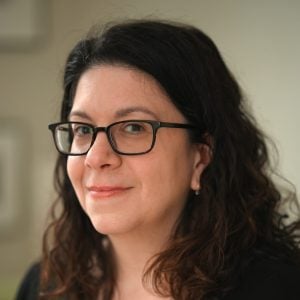




Maria-Ni(cole) Ikonomou, IESE MBA Class of 2027
Age: 30
Hometown: Melbourne, Australia/San Francisco, California
Undergraduate Institution and Major: University of California, Santa Cruz. Literature with highest honors and a minor in education.
Pre-MBA Work Experience: 9 years, PR, communications, and content strategy for technology companies modernizing legacy industries
Why did you make the decision to attend business school? Why now?
I was at an inflection point in my career, and the world was at one, too. I spent a decade thinking about what it means to learn new things, personally and professionally, as a mindset and as an investment strategy. I studied to be a high school English teacher, but ended up building a career in strategic communications instead.
For the last nine years, I led PR, communications, and content strategy for technology companies modernizing legacy industries to expand access to essential resources like housing, trucking, education, and jobs. I was at Coursera, the global online learning platform, first to manage pandemic response initiatives providing free training to displaced workers and students and then to lead global B2B2C communications and research. I had my dream job. But, after five years of working hand-in-hand with governments, businesses, and universities around the world to prepare their workforces for jobs of the future, I was ready to become a student again.
Everything I knew about business, I learned on the job. It felt like my turn to go back to school. Back to the beginning. To have time to process the last decade. To unlearn and relearn my foundations. And find out what’s on the other side.
It’s a privilege to return to the classroom with real work experience and real-world context, especially now. I believe we’re living in the zeitgeist: this is an interesting time in global political, technological, or economic history to exchange ideas with peers and experts from over 60 countries to shape my understanding of the future of global markets.
My favorite part about my work is having friends and community members all over the world that make me a smarter and better person just by being in my life. And now I get to do that full time. I’m very grateful.
Why did you choose IESE? What factors figured most prominently into your decision?
The global diversity, academic rigor, and human-centered approach to leadership at IESE are unmatched. Many business schools try to claim global diversity, but at IESE, it’s actually true. Over 60 countries are represented in our cohort alone, with even more industries and functions. In your first year, every class is based on the case method, and you’re assigned a team of eight or nine students to prepare your course work. The professors are top-notch, and the case method is designed to expand your worldview and teach you how to solve real business problems. Every person on your team comes from a different country, industry, and function, which means everyone sees every case from a different perspective. There’s no single right answer. At IESE, professors emphasize that who we are and how we lead is just as important as what we accomplish. I feel lucky to be here.
What do you think is your most valuable or differentiating contribution to the Class of 2027?
I believe most problems can be solved with good communication. One of the most powerful tools you have is your voice. It matters how you use it. I built my career on that ethos, and I bring that mindset to campus every day.
I spent the last decade in strategic communications, helping C-suite executives and founders find their authentic voice, build their brand, and stay relevant in high-growth, fast-changing markets. I help leaders make and communicate decisions with clarity and compassion when the stakes are high, the pressure is on, the stakeholders are many, and the clock is ticking (think: IPO, GenAI, pandemic, organizational changes). At Coursera, I had to write global campaigns that were simple, true, and compelling enough to resonate across 90 markets, despite their vast cultural differences. This work has made me a strong executive coach and global translator. And now, I get to be in a room full of future global leaders. I want to bring my skills to the classroom and campus workshops to help my peers feel more confident in their own voice, cut through the noise, and say what they really mean, even (and especially) when it’s hard.
I’m probably most known on campus for the way that I dress. I think of dressing myself as an extension of the same ethos: For me, it’s a daily practice of showing up as my most authentic self. I think fashion is comfort, armor, and self-expression. Every day, I get to write a poem to myself with my clothes. It lets me tell a story before I’ve had a chance to speak. I wear a lot of color these days.
Tell us a fun fact about yourself that didn’t get included on your application:
I’m a self-taught illustrator and maximalist, with a decade of freelance work as a visual artist, stylist, and bookmaker in San Francisco, New York, and the Philippines. But mostly, I draw for myself. I think it’s important to have a private practice where you get to work with your hands or your body. Drawing helps me feel present, grounded, and expansive. I’m in love with Barcelona, its architecture, wilderness, and whimsy, and I can’t wait to see what it pulls out of me creatively over the next two years.
Post-MBA career interests:
In high school, I wrote a six-page spread for the student newspaper about how students were placed on or off the university track as early as primary school. I’ve always been preoccupied with who gets a seat at the table and why—a question that has shaped my values and career mission: creating pathways to opportunity for those historically excluded.
The world is accelerating at an unprecedented pace and many risk being left behind. I’m pursuing my MBA to deepen my understanding of the future of global markets so I can build solutions to enduring threats to economic equity: 1) AI and human capacity, 2) misinformation and media literacy, and 3) workforce transformation (change management, cross-cultural workplaces, humans vs machines). I believe change and pressure are inevitable forces. We have to learn to live with them. But they don’t always have to be painful. They can be transformative, even fun. Whether in consulting, tech, or executive coaching 1:1, my mission continues to be helping leaders and their workforces respond to change and disruption with clarity, compassion, and foresight. I want to use my seat at the table to help others secure theirs.
Advice for Current Prospective Applicants:
–What is one thing you would absolutely do again as part of your application process?
Talk to as many current students and alumni as you can before you make your decision. These are your future friends, peers, and networks. Try to get an honest sense of who they are, what the program is like, what they want out of it, and whether they feel satisfied with what they got. Talk about the costs too. Business school is a significant investment-of your money, of your energy, of your time. It’s important that you talk to as many people as you can to build a census view of each program. Only you can decide which one is right for you.
–What is one part you would have skipped if you could—and what helped you get through it?
GRE/GMAT! I hadn’t done that kind of math since high school. It wasn’t my strength, and I found it challenging to relearn on my own while I was working full time. I felt insecure and rushed at first: why couldn’t I remember how to do math that 16-year-old me knew how to do? So, I did what anyone does when starting over: I went back to the basics. I signed up for a GRE prep course with an amazing local instructor (thank you Tom!) where I lived in New York. That small class gave me the structure, safety, and social accountability I needed to relearn those foundations on a tight timeline. I got through it, and you can, too!

What is your initial impression of the IESE students/culture/community?
I’ve been on campus for less than two months but it’s already starting to feel like home. The people are warm. You get to be yourself. You don’t have to fit neatly in a box. You can be a lot of things at once. I’ve met so many people that are unlike anyone I’ve ever met before. There’s no one right answer or way to be. That includes the classroom. My professors are innovative, encouraging, and grounded in the real world. I didn’t know learning advanced concepts could also feel like I’m watching theatre. The show gets better the more we talk. The campus staff has such bright energy that I can’t help but feel brighter after I get my lunch every day. I’m very happy with my decision to come here. I can already feel my brain and heart expanding!
What student organizations have you joined/are you hoping to join and why?
I joined the Women in Business Club (WiB) and the Startup & Entrepreneurship Club.
Often in business, you’re one of the only women in the room, or the only one willing to disagree with a group of male leaders. At WiB, we are the majority. It’s the largest club on campus. That’s a special feeling. We often talk about the gender gap in terms of access, but retention is just as critical. You can recruit all you want, but if the workplace doesn’t have the right culture, women will leave. WiB gives us the community, space, and structure we need to speak openly about real workplace challenges, exchange ideas with peers and experts, and turn empowerment from a concept into a practice. This is a safe space where we can practice building the culture we would want to work in and become the kind of leaders we’d want to work for.
I joined the Startup & Entrepreneurship Club because I’ve spent the last nine years working in startups and global technology in Silicon Valley and New York. I have a strong entrepreneurial spirit and want to stay close to emerging companies and technologies, discuss ideas with other like-minded builders, and maybe even start a new project with my classmates! I’d love to work for myself one day, and it’s inspiring to be around people who are making that a reality in sustainable ways. I’ve always dreamed about doing work I can touch with my hands.
What is one thing you have learned about IESE that has surprised you?
There’s a turtle pond on campus. It’s green and gorgeous. About ten turtles (“tortugas”) live there, including several babies. It’s become a daily ritual for me to stop by on my coffee break and say hello to my little friends. It’s very peaceful. I could watch them swim for hours. The entire campus has that feeling. Kind staff that feel like neighbors or friends. Lush plants and palm trees you can see through the classroom windows, rooftops with views of the city and the water, and terraces and gardens to enjoy the sun. It’s a perfect balance to the rigor of the MBA.
What is one thing you are most excited about in your first year?
To have my mind changed! I want to unlearn and relearn what I know and truly expand my world view. 60 countries in one room. The future of global industries is sitting all around me. Everyone has something to teach you, and we all have more in common than we think. That’s a pretty amazing place to start.