

In this edition of Real Humans: Alumni, we meet Barbara Rion, a Berkeley Haas MBA Class of 2025 graduate who successfully navigated the transition from government service to the private sector. The coursework at Haas promised to build her skills in emerging business areas like AI and sustainability, and offered cutting-edge tech experience not available at many other schools. Read on to learn more about her experience.
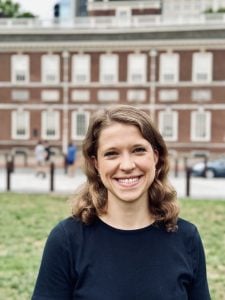
Barbara Rion, Berkeley Haas MBA ’25, Policy Specialist, Trust & Safety at Google
Age: 33
Hometown: Sterling, VA
Undergraduate Institution and Major: College of William & Mary, Bachelor of Business Administration, Marketing & Entrepreneurship
Pre-MBA Work Experience: Account Manager, immixGroup, 11 months; Data Analyst and Manager of Development Services, Prison Fellowship, 2 years; Intelligence Analyst and Operations Specialist, U.S. federal government, 4 years 4 months
Post-MBA Work Experience: Policy Specialist, Trust & Safety, Google, 8 months
Why did you choose to attend business school?
I had this idea that I wanted to transition from government into the private sector, but that’s about as far as the idea went. When you’ve been in government for a while, it can become hard to tell which roles are a good fit for you at private companies. The language used to describe similar roles and tasks varies widely. I wanted the time to explore and figure out what I enjoyed and what even existed out there! I also had always wanted to get an advanced degree at some point in my career, and the timing made sense.
Why UC Berkeley Haas? What factors figured most prominently into your decision of where to attend?
For me, the most critical feature of a business school was its course offerings. With a background primarily in the public sector, I was looking to build skills in emerging business areas that I care about: sustainability, AI, and global policy. Of all the schools I considered, UC Berkeley Haas had the most compelling classes, faculty, and experiential opportunities for my topics of interest. Two of my favorite classes were Professor Andrew Isaac’s Climate Change and Business Strategy and Professor Lucas Davis’ Energy and Environmental Markets. These classes helped me understand foundational principles of climate science and energy issues in a business context. To me, it is incumbent on all future business leaders to understand the critical forces like climate change that are shaping our world so that we can lead intelligently, strategically, and ethically, even if we aren’t working directly in a role that addresses those issues. UC Berkeley Haas enabled me to educate myself thoroughly across many cutting-edge areas and technologies—not something you can get just anywhere!
On a personal level, Haas’ location also played a role in my decision. I’m an avid outdoor rock climber, backpacker, and hiker, and you can’t beat the Bay Area for proximity to world-class outdoor areas. Yosemite, Tahoe, Joshua Tree, Red Rocks…the list goes on and on. I knew being in a place where I also enjoyed life outside of the program would go a long way toward getting the most out of my two years as an MBA student. And as a bonus, I became co-president of the Haas outdoors club and got to plan a camping trip to Yosemite for over 500 people (Haasemite, it’s a tradition)!
What about your MBA experience prepared you for your current career? How do you feel that your MBA has been an asset when it comes to navigating new challenges, such as AI?
My MBA experience allowed me to develop substantive expertise in new areas and to mature my mental models for how to approach problems. The three things at UC Berkeley Haas that have contributed most to my current career thus far are:
1) Courses about AI: I took Professor Olaf Groth’s Ethics & AI class and Professor Greg LaBlanc’s Data and AI Strategy class during the program. Between the two classes, I gained a foundational understanding of AI, LLMs, agentic AI, and how to approach emerging capabilities with both optimism and skepticism. I use that foundation every day in my current role.
2) Course about nonmarket strategy: Professor Vinod Aggarwal’s class about the global political economy and nonmarket strategy gave me a strong foundation for understanding the parts of public companies and their strategies that aren’t directly revenue-generating but are critical to success in an evolving geopolitical landscape. Working within Global Affairs at Google, the academic grounding from Professor Aggarwal’s class has given me the ability to understand and contribute to what’s happening around me very quickly.
3) Exposure to consulting frameworks: Both my internship with the National Park Service and a semester long project I did for an applied innovation class at Haas gave me exposure to and training in consulting frameworks. They really are useful tools for decomposition of tough new problems into smaller pieces that can be tackled one at a time.
What was your internship during business school? How did that inform your post-MBA career choice?
I participated in the National Park Service’s Business Plan Internship (BPI) during summer 2024. We were teamed up in pairs of consultants and sent to a national park site for the summer to try to solve tough operational challenges being faced by NPS leadership. It was so much fun and gave me valuable exposure to the cycle of a consulting project, the internal workings of our irreplaceable national parks, and the energizing feeling of doing something that contributes to the unique landscape and fabric of the U.S., literally and figuratively. The sense of working for an organization that I felt was always trying to do the right thing lingered with me after the summer, showing me that I needed to prioritize recruiting with companies where I could fully buy into the ethics and values, which ultimately led me to Google.
Why did you choose your current company? What factors figured most prominently into your decision of where to work?
I focused on three primary factors as part of my job search: ethical alignment with the organization, skill and role alignment for the career I’ve envisioned, and organizational culture.
I’ve already touched on this in a prior response, so I’ll just say that the ethics of any organization where I recruited were top of mind. It mattered to me whether I feel as if I am contributing to making the world better, regardless of the scale. As one of my favorite fictional characters once said, “It is the small everyday deeds of ordinary folk that keep the darkness at bay. Small acts of kindness and love.” We spend so much of our lives working; we may as well be doing good for more than just us.
Aside from ethics, I was hoping to find a role that was at the intersection of policy, geopolitics, and security. I knew about trust & safety in the tech industry, and thought it would be a strong fit for my analytical skills and background, so I pursued those roles very specifically. Getting the role at Google where I also get to leverage my data analytics skills and education in GenAI at Haas has been a huge bonus.
And finally, culture. As I said, we spend so much of our time working! It was important to me to find a workplace where I enjoyed the people around me, trusted them, and felt that the culture was healthy and supportive. Google gave me all of that and more—the people around me are the best part of my workday.
 Advice to current MBA students:
–One thing you would absolutely do again as part of the job search?
I chose to focus on applying to organizations where I felt a personal connection to the mission in some way. By narrowing my search to places where I truly admired the work being done, it became very easy to create a narrative for cover letters and interviews about why the role mattered to me, and therefore, why I could uniquely contribute to the organization’s success. I found that I was much more successful in differentiating my application enough to get an interview when I had a meaningful narrative about why I cared for the role and the organization.
–One thing you would change or do differently as part of the job search?
It’s easy to get caught up in what the people around you are recruiting for, whether that’s consulting or investment banking, tech or startups. It can make you second-guess what you think you like, and you can spend valuable time exploring paths that you were never really excited about in the first place. If I were to go back, I would focus on what I care about and not get sidetracked by other people’s plans or opinions (even though I never got distracted for long!). At the end of the day, you’re the one who has to do the job you get hired for. It matters if you like and value it, not anyone else.
–Were there any surprises regarding your current employer’s recruiting process?
I was pleasantly surprised by the undercurrent of authenticity running through all the stages of Google’s recruiting process. It genuinely felt like everyone was trying to get to know me as a person, not only as a professional and job applicant. It was just very human, which hasn’t always been the case with other recruiting processes I’ve experienced!
–What piece of advice do you wish you had been given during your MBA?
I wish someone had told me at the beginning that while it is important to bond with your fellow MBAs (of course!), it is also crucial for balance and perspective to get outside of the MBA bubble sometimes. Having relationships with people who aren’t going through the degree program at the same time as you can help ground you and keep things in perspective. I realized this partway through the program and found that forming external relationships was something that brought me a lot of joy.