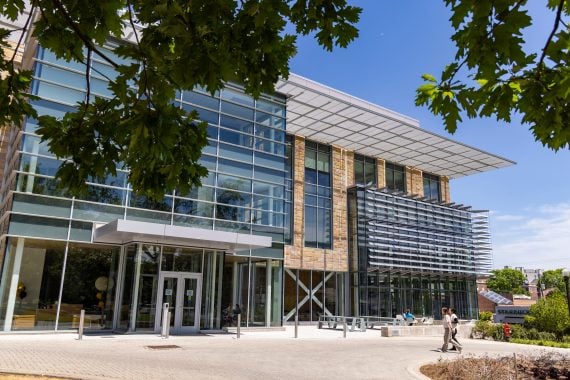



We welcome back Rebecca Mallen-Churchill, Senior Director of Recruitment, Admission, and Financial Services for graduate programs at Arizona State University (ASU) W.P. Carey School of Business for this installment of our Admissions Director Q&A series.
Rebecca Mallen-Churchill is the Senior Director of Recruitment, Admission, and Financial Services for graduate business programs at Arizona State University’s W. P. Carey School of Business. A proud ASU alumna, she first discovered her passion for higher education while working in graduate admissions as a student. Since joining W. P. Carey in 2013, she has helped prospective students from around the world navigate the admissions process and today leads the teams responsible for recruitment, admissions, and scholarship strategy across the school’s graduate business portfolio.
Read on for her insights into ASU Carey MBA admissions, the interview process and more.

Clear Admit: What is one aspect of your MBA program that you wish applicants knew more about?
Rebecca Mallen-Churchill: I wish more applicants knew about the level of investment we make in our Full-time MBA students. Every admitted Full-time MBA student receives at least a 100% tuition scholarship. While the financial benefit is significant, what often gets overlooked is how that investment shapes the experience and culture of the program.
By removing tuition as a barrier, we’re able to attract talented, high-potential professionals from a wide range of industries and backgrounds who are focused on maximizing the MBA experience rather than simply calculating the return on their investment. It creates a collaborative, close-knit environment where students challenge and support one another as they prepare for the next stage of their careers.
That spirit of investment extends beyond scholarships. As part of the nation’s most innovative university, our students participate in interdisciplinary learning experiences alongside graduate students from engineering, healthcare, education, sustainability, and other fields across Arizona State University. These experiences reflect the reality of modern leadership, where solving complex problems requires collaboration across disciplines.
Ultimately, we want applicants to know that we’re not just offering an MBA, we’re making a substantial investment in individuals we believe have the potential to become exceptional leaders.
CA: Walk us through the life of an application in your office from an operational standpoint. What happens between the time an applicant clicks “submit” and the time the committee offers a final decision?
RMC: When we say business is personal, we mean it. Every application receives a comprehensive review from our admission operations team and admission committee, with each file read by no fewer than eight individuals throughout the process.
Once an application is complete, our team conducts an initial review for interview consideration. While not every applicant will be invited to interview, those who are have successfully advanced through the first stage of the process. Our recruitment team is available to provide guidance on what to expect and help candidates prepare so they can present their experiences and goals effectively.
Following the interview, applicants may wait anywhere from a few days to a few weeks for a final decision, depending on the application round. At the conclusion of each round, the admissions committee, which includes recruitment and admissions staff, deans, faculty, and members of our career management team, meets to discuss every candidate individually.
Once final decisions are made, one of our favorite traditions begins: admitted students receive a personal congratulatory call from their recruiter, often someone who has worked closely with them throughout their MBA journey.
CA: How does your team approach the essay portion of the application specifically? What are you looking for as you read an essay? Are there common mistakes applicants should try to avoid? What is one key thing candidates should keep in mind as they sit down to write?
RMC: One thing applicants notice quickly is that we do not ask for a traditional personal statement. Instead, we’ve intentionally crafted essay questions that help us understand not only why you want to pursue an MBA, but also how you will contribute to the W. P. Carey community.
The biggest piece of advice I can offer is simple: be yourself. Write in your authentic voice. Don’t feel compelled to use business jargon or leadership buzzwords if they aren’t part of how you naturally communicate. Likewise, don’t write what you think the admissions committee wants to hear. The most compelling essays are genuine, thoughtful, and reflective.
As we review essays, we’re looking for self-awareness, clarity of purpose, and a strong understanding of why an MBA, and why now, fits into your personal and professional journey. We also want to understand what perspectives and experiences you will bring to the classroom and broader community.
Common mistakes are often surprisingly simple: failing to answer the question being asked, submitting essays with avoidable errors, or using a generic response that could be sent to any business school. One of my favorite pieces of advice is to have someone else read your essay without seeing the prompt and ask them what they think the question was. If they can’t tell, you may need to sharpen your response.
Most importantly, remember that your essay is often your first opportunity to speak directly to the admissions committee. We’d much rather gain insight into what motivates you, what matters to you, and where you hope to grow than read a polished response that doesn’t genuinely reflect who you are.
CA: Could you tell us about your interview process? Approximately what percentage of applicants are invited to interview, who typically conducts interviews, and what should candidates expect in terms of interview style and format (including whether interviews are conducted virtually, in person, or if you offer both options)?
RMC: We view the interview as a two-way conversation and one of the most important opportunities for both the candidate and W. P. Carey to determine whether we’re the right fit for one another. Consistent with our philosophy that business is personal, we approach interviews in a conversational and welcoming manner while still conducting a thorough assessment of each candidate.
Our interviews are invitation-only, and historically, approximately half of our applicants are invited to interview. Candidates should prepare as they would for a professional job interview, but they can expect a discussion rather than an interrogation. We’re interested in learning more about their experiences, leadership potential, career aspirations, and why they believe W. P. Carey is the right place to achieve their goals.
Interviews are conducted by a member of our recruitment and admission team and a representative from our Career Management Center. The interview typically lasts about 45 minutes and includes dedicated time for candidates to ask questions and learn more about the program.
Beyond the formal interview, we offer several opportunities for candidates to experience the W. P. Carey community firsthand, including one-on-one conversations with faculty and staff, as well as roundtable discussions with current students. We want candidates to gain meaningful insight into the people, culture, and resources that make our MBA experience unique.
For the 2026-2027 admission cycle, candidates may complete their interview either virtually or in person.
CA: Is there anything in particular international students should keep in mind during the admissions process?
RMC: We value international students and students from outside the U.S. make up nearly half of our Full-time MBA cohort. We want you here and value your experience and input. The application process can be quite time consuming, so I recommend you start early. Apply as early as you can, and if admitted, start the visa process as early as possible as well to avoid potential delays.
CA: Conversations about MBA value often center on jobs, salaries, and ROI. What are some of the other ways students benefit from the MBA experience that may be harder to quantify upfront?
RMC: Career outcomes and ROI are important considerations, and they should be. An MBA is a significant investment, and candidates deserve to understand the opportunities that may result from it.
That said, some of the most meaningful benefits of an MBA are difficult to measure on a spreadsheet. One of the biggest is the confidence students gain in their ability to lead. Throughout the program, they’re challenged to think differently, navigate ambiguity, collaborate with people from diverse backgrounds, and solve complex problems. Those experiences often transform how they approach leadership long after graduation.
Another lasting benefit is the network they build. Beyond professional connections, MBA students develop relationships with classmates, faculty, and alumni who become trusted advisors, collaborators, and friends throughout their careers.
At W. P. Carey, students also gain exposure to perspectives and disciplines beyond traditional business education, helping them become more adaptable and effective leaders.
The salary increase and career advancement matter, but the MBA’s lasting value often comes from the growth in confidence, perspective, leadership capability, and relationships that continue to pay dividends for years to come.
CA: Are there any trends in the applicant pool, admissions process, or MBA experience that you are particularly focused on right now (e.g. AI, changing career interests, evolving student expectations, new curricular offerings, etc.)?
RMC: One trend we’re paying close attention to is how prospective students define value. A decade ago, conversations were often centered almost exclusively on rankings, salary outcomes, and job placement. While those factors remain important, today’s candidates are asking more nuanced questions. They want to understand how an MBA will help them navigate a rapidly changing business environment, develop as leaders, and prepare for careers that may look very different five or ten years from now.
Artificial intelligence is certainly part of that conversation. Students recognize that AI is reshaping industries and job functions, and they’re looking to business schools to help them understand not only the technology itself, but how to lead organizations through that change. We view AI as a tool that will enhance decision-making and productivity, but it also reinforces the importance of distinctly human skills such as leadership, communication, critical thinking, and ethical judgment.
We’re also seeing students place greater value on flexibility, personalization, and community. They want access to world-class education and career opportunities, but they also want meaningful relationships with faculty, staff, classmates, and alumni. That’s one reason our philosophy that “business is personal” continues to resonate. Even as technology transforms the way we work and learn, students still want a highly personal and supportive educational experience.
Ultimately, the candidates who stand out today are not necessarily those with the most linear career paths. They’re the individuals who demonstrate curiosity, adaptability, and a commitment to continuous learning—qualities that will be essential for success in the future of business.
CA: Is there anything else you’d like to highlight about your MBA program or admissions process?
RMC: If there’s one thing I’d want prospective students to remember about W. P. Carey, it’s that our philosophy of “Business is Personal” is more than a tagline – it’s how we approach everything we do.
Business schools often talk about community, but we work intentionally to ensure that candidates feel supported and connected from their very first interaction with us. We encourage prospective students to ask questions, engage with our faculty, connect with current students, and build relationships with our team throughout the admissions process. We want to get to know them as individuals, not simply as applications.
That same philosophy carries into the MBA experience. Our students develop close relationships with classmates, faculty, staff, alumni, and industry partners who challenge them, support them, and help them grow as leaders.
Choosing an MBA is one of the most important professional decisions a person will make. We believe that decision should be grounded not only in rankings, employment reports, or ROI calculations, but also in finding a community where you feel supported, challenged, and empowered to succeed.
At W. P. Carey, business is personal – and we believe that makes all the difference.