

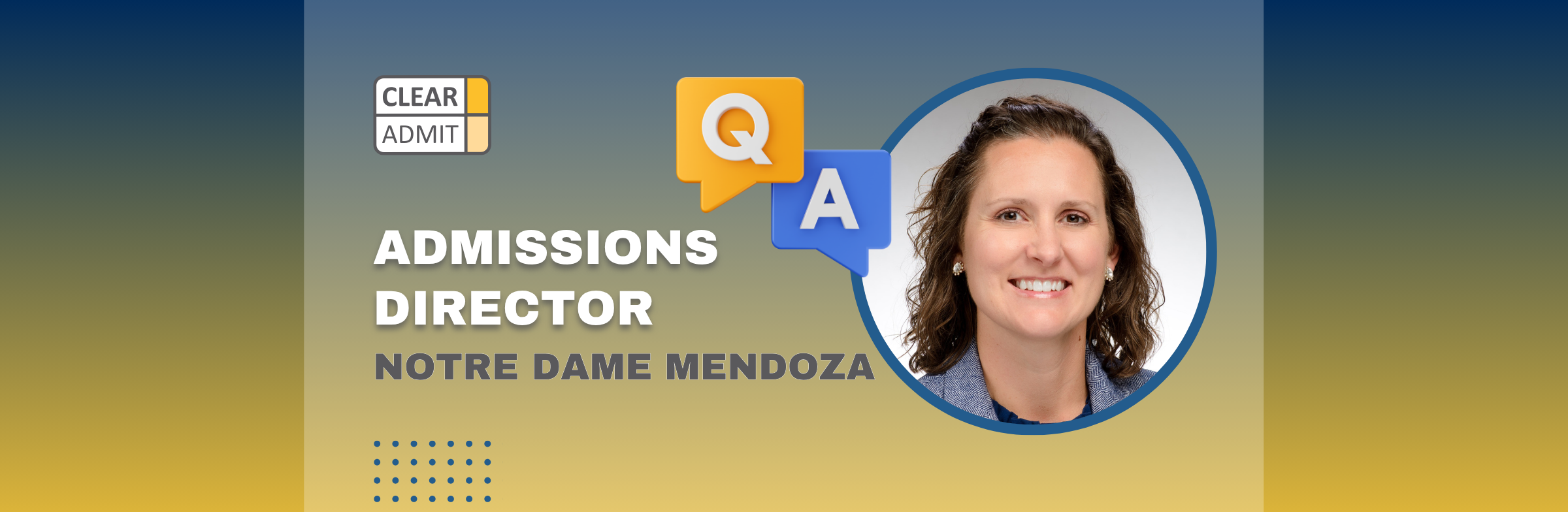
We welcome back Claire Fitzgibbon, Senior Director of Graduate Enrollment at the University of Notre Dame Mendoza College of Business, to delve into the MBA program in this Admissions Director Q&A.
Claire is responsible for the strategy and oversight of all aspects of the graduate admission process. She began her career at Notre Dame in 2023 after many years leading undergraduate admission teams. Claire graduated from Mendoza while also a member of the Notre Dame Drumline. She also holds an M.A. in Industrial/Organizational Psychology from Hofstra University.
Keep reading for her insights into the application process, how to approach your interviews, and her take on emerging trends in business education.

Clear Admit: What is one aspect of your MBA program that you wish applicants knew more about?
Claire Fitzgibbon: We are a program, and a campus, that thrives on community. This comes to life in a couple of meaningful ways for our students.
The alumni network. Notre Dame’s alumni network is consistently ranked among the best in the country, though “ranked highly” undersells it. The power of the network shows up in tangible ways: alumni sponsoring Grow Irish projects, sitting in on mock interviews, or connecting with students. I was recently listening to a group of MBA students talk about their alumni networking efforts. Each one said that more than 90% of alumni returned their outreach. That culture of “people help you because they were once helped” is something applicants often don’t fully grasp until they’re inside it.
The size of the program. Mendoza’s MBA cohort is intentionally small at about 75 students per year, which means more resources are available for more (really, all) students. Students aren’t competing for attention from faculty, career coaches, or each other. It’s a different experience than a 300- or 500-person class where, because of the program size, resources may be limited, or even first come, first served. Additionally, our focus on community means that you’ll get to know all 75 throughout your MBA journey.
CA: Walk us through the life of an application in your office from an operational standpoint. What happens between the time an applicant clicks “submit” and the time the committee offers a final decision?
CF: Once an applicant has completed the application and hit the “submit” button, our admissions team will start reviewing your application. This time from submit to notifying you of your decision typically takes 6-8 weeks; please take note of our application and decision release dates. We know the time and attention you spent preparing your application and want to ensure we take the same care to review it.
After initial review, select applicants will receive an email invitation inviting them to interview with members of the Admissions Committee. After the interview is complete, the Committee does one final review of the application and makes a decision.
We know waiting is not easy, so we encourage students to reach out to us at any point during their application process to answer any questions or address any concerns that may come up! We can be reached at mba.business[at]nd.edu.
CA: How does your team approach the essay portion of the application specifically? What are you looking for as you read an essay? Are there common mistakes applicants should try to avoid? What is one key thing candidates should keep in mind as they sit down to write?
CF: Our essay prompt asks applicants to lay out their detailed short- and long-term post-MBA career plans, and to connect those goals to their own background, experiences, and the specific resources at Notre Dame.
What we’re really looking for is coherence and specificity. We want to see the through line from where you’ve been to where you say you’re going. And we mean it when we say be specific: naming an industry is a start, but naming the function, and telling us why Notre Dame specifically (not an MBA generically) is what gets you there, is what makes an essay memorable.
A common mistake is treating the essay as a highlight reel of accomplishments that are already visible elsewhere in the application. We can see your resume. Great candidates use the essay to add the context and reasoning the resume can’t: why an MBA, why now, why at Notre Dame.
The one thing I’d tell every applicant sitting down to write: don’t hedge. The Admission Committee appreciates when you take a position on where you’re headed, even if it feels like a risk to be that specific.
Alongside the resume, transcripts, and essay, we also ask every applicant to put together a short slide deck we call the Applicant Snapshot. The goal is to give us a fuller picture of who you are beyond your academic and professional background. We invite you to share your passions, tell us your perspective and share the experiences that have shaped you.
There’s intentionally no template and no “right” way to do it. We tell applicants to think of it as a conversation starter. Something informal and creative that lets the committee start getting to know you in the way your friends know you. It’s optional, but I’d genuinely encourage everyone to do it. We use it to get a real sense of the person on the other side of the application, and it often helps us connect with applicants we haven’t had the chance to meet in person yet. Past applicants have used it to show us where they want to travel next, walk us through their Spotify Wrapped, or simply remind us that time with family and friends is what matters most to them. However you choose to use those slides, make them feel like you.
CA: Could you tell us about your interview process? Approximately what percentage of applicants are invited to interview, who typically conducts interviews, and what should candidates expect in terms of interview style and format?
CF: Students are invited to interview after their application has been reviewed, and the Admission Committee tends to favor interviewing a candidate over not, giving applicants opportunities to show their preparation and fit for the program. Applicants who apply during our Early Action round are guaranteed an interview as part of that round; for all subsequent rounds, interviews are by invitation only after the Committee’s initial file review.
Interviews are currently conducted either in person or virtually. They typically last 30-40 minutes and are conducted by a member of the Admissions Committee, with a mix of resume-based, application-based, and behavioral questions. There’s no advantage to interviewing in person or virtually in terms of the decision. We want candidates to choose whatever works best logistically for them.
CA: If your admissions process includes any video-based components, such as video essays or recorded interview responses, what advice would you offer applicants preparing for this part of the process?
CF: After pressing “submit” on their application, candidates receive a link to complete a short video assessment; it’s a required step to move forward in the process. The questions aren’t shared in advance, so it’s intentionally off-the-cuff.
My advice is not to be too scripted. We’re not grading you on a polished, rehearsed answer. We’re trying to get a sense of how you think and communicate in the moment, which is honestly a lot like what you’ll be doing in a case discussion or Notre Dame classroom. Find a quiet space with good lighting and a stable connection, look at the camera rather than the screen, and give yourself permission to pause and think before answering rather than filling silence with filler words. Treat it like a real conversation, not a performance.
CA: Is there anything in particular international students should keep in mind during the admissions process?
CF: International students shape this program in ways that go well beyond what you see on a website. Some of our best classroom discussions happen because someone is comparing how a decision would actually play out in their home market versus how a case study assumes it would play out in the U.S. We don’t just welcome that kind of perspective, we go looking for it, and the program is better for it.
For the application itself, my advice to international candidates is the same advice I’d give anyone, just with a bit more emphasis: don’t write goals that sound impressive in the abstract. Tell us specifically what you’ve built or led so far, and be just as specific about where you want to take that; what role, what industry, what kind of growth are you pursuing. Vague ambition is hard to evaluate no matter where an applicant is writing from, but it’s especially easy to fall into when you’re trying to translate a career story across countries and systems for an unfamiliar audience.
Practically speaking, don’t wait. We strongly encourage international applicants to apply by our Round 2 deadline to leave enough runway for visa paperwork and processing once a decision is made. If you have a question about the process, email us early. Our team would much rather field a question in October than try to solve a timeline problem in May. International applicants also need to submit an English proficiency score. TOEFL, IELTS, or Duolingo are all accepted.
International students are also adjusting to a new country, educational system, professional culture, and job market, all at once. This is where our community focus can help; having classmates, career coaches, professors and alumni ready to help in the early days of the program matters for students navigating the most change.
CA: Conversations about MBA value often center on jobs, salaries, and ROI. What are some of the other ways students benefit from the MBA experience that may be harder to quantify upfront?
CF: The employment outcomes matter, but the harder to quantify value is the network and the formation that happens alongside the coursework. Two years immersed in a tight-knit, mission-driven community changes how you make decisions for the rest of your career, not just what job you take next. Students tell us the relationships they build, the mentors they gain, and the habit of thinking about business as a force for the common good (not just shareholder return) are things they carry long after graduation.
I think students also gain a lot of confidence within their MBA. Many arrive unsure whether they can hold their own in a room with consultants and bankers and engineers, or lead through ambiguity. They leave their MBA program knowing they can.
Additionally, employers continue to tell us that the durable skills the MBA enhances are vital to a student’s career. Spending time developing your critical thinking, data communication and analytic skills are very valuable now, in the age of AI, and also many years down the road as technology evolves.
CA: Are there any trends in the applicant pool, admissions process, or MBA experience that you are particularly focused on right now?
CF: Two trends are at the top of my mind right now, and they’re more connected than they might appear at first glance.
The first is AI. Applicants want to know what the future of work looks like, and honestly, that’s a fair and important question. Our answer at Notre Dame starts with something we already have: a deep, embedded commitment to ethical decision-making. The question isn’t just what AI can do, but what it should do and who’s accountable when it doesn’t. We’ve built that into our curriculum directly. Whether it’s a core course like Fundamentals of AI or embedded in a different course, our approach to AI is designed not just to teach technical fluency, but to develop leaders who can make values-driven decisions in an AI-enabled world. Our new Analytics & AI major and minor take that further, anchoring foundational AI knowledge in ethical considerations and leadership application from the start.
Here’s what applicants who are anxious about AI should know about the future of work: as AI continues to grow, so will the need for human leaders. The skills that define the Notre Dame MBA like collaboration, strategic thinking, communication, emotional intelligence, and sound judgment, are the durable skills AI cannot replicate. That’s where we win, and it’s where our graduates are going to have an advantage for years to come.
That brings me to the second trend. Because applicants who are thinking carefully about what AI means for their career are also thinking more carefully than ever about what an MBA costs. The elimination of Grad PLUS loans has added a new layer of urgency and complexity to it. We are not shying away from that conversation. We host “Financing Your Degree” webinars, and our team is ready to walk through the financial details with students.
The Notre Dame MBA was already a strong ROI story before any of this. A tight-knit network that picks up the phone, a cohort small enough that faculty and career coaches know your name, and outcomes that reflect that level of investment in each student. The funding we offer makes a compelling choice even more accessible. The Meyer MBA Fellowship provides full tuition plus a $25,000 annual stipend to a select group of students who demonstrate exceptional academic achievement and leadership potential. The Angrick Military Scholars Program provides up to $30,000 per year in wraparound funding — covering costs like relocation, housing, and childcare — for military-affiliated students and their families. And beyond these flagship programs, we offer plentiful scholarships across the board. Students come to Notre Dame because it’s the right fit. The funding means more of them can.
CA: Is there anything else you’d like to highlight about your MBA program or admissions process?
CF: The Notre Dame MBA is very integrated into campus life at Notre Dame. In addition to the many clubs offered in the MBA program, students are able to join most clubs offered to undergraduates. Any guest speaker, lecture series, concert, intramural sport, and sporting event are available for MBA students to join. Students in the program also have the opportunity to purchase season football tickets in the student section to cheer on the Fighting Irish football team.
That same personal, close-knit spirit shows up in how we approach admissions. Our team is genuinely available to answer questions, talk through fit, or connect you with current students. We’d rather you reach out with a question than guess! You can reach us at [email protected].