

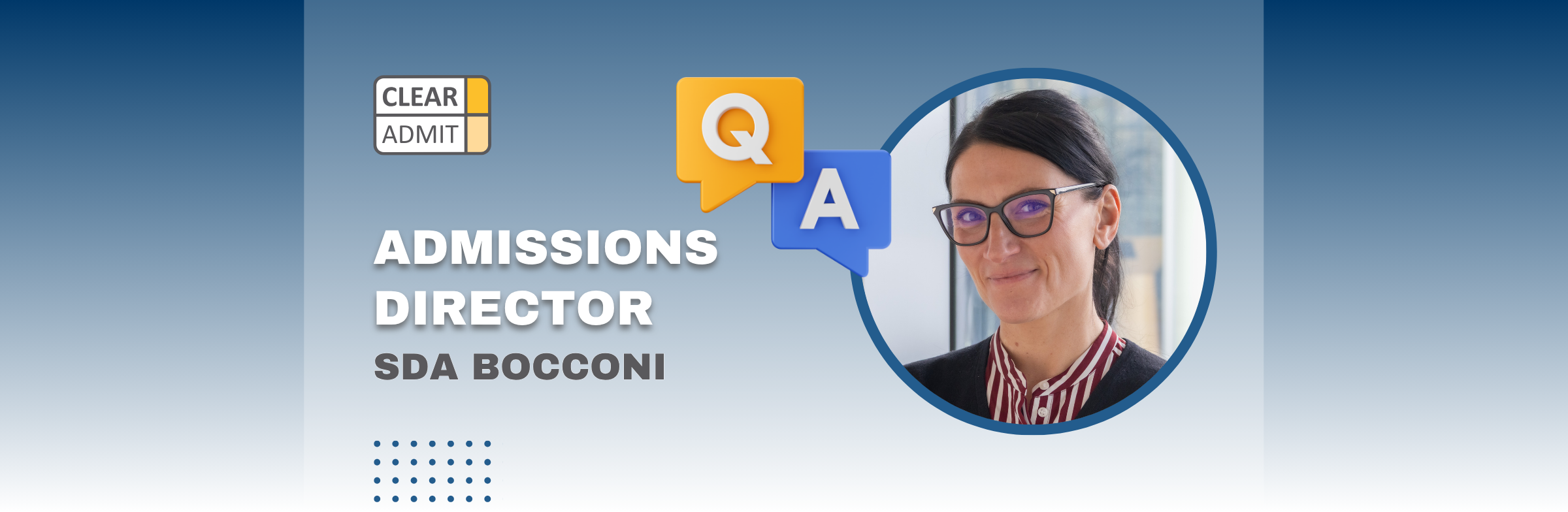
Welcome to Milan, Italy, where we meet Alessandra Gazzola, the Admissions Manager for Full-time MBA and International Masters Programs at SDA Bocconi School of Management for this installment of our Admissions Director Q&A.
Alessandra Gazzola oversees the admissions strategy and selection process for the Full-Time MBA and International Master’s programs. With over 13 years of experience in graduate management education, she has dedicated her career to helping prospective students navigate the admissions process and building diverse, high-performing cohorts.
Before joining SDA Bocconi, Alessandra spent more than a decade at London Business School in a variety of senior admissions and recruitment roles, working with MBA candidates from around the world and gaining extensive international experience. She holds a degree in Business Administration from Università Cattolica del Sacro Cuore.
Outside of work, Alessandra’s lifelong passion is horse riding, but she also enjoys traveling and baking homemade pizzas in her wood-fired oven.
Read our Q&A with Alessandra for her insights on how AI is being integrated into the MBA program, the emphasis on leadership at Bocconi, and what to expect from the admissions process.

Clear Admit: What is one aspect of your MBA program that you wish applicants knew more about?
Alessandra Gazzola: One aspect I wish applicants understood better about our MBA is that it is far more than an academic experience – it is what we call a leadership laboratory. The intensity of the program, rotating teams, international and experiential learning activities are deliberately designed to push students. Along the way, they learn to navigate ambiguity, collaborate across differences, and exercise sound judgment in complex situations.
Our MBA is also intentionally ‘boutique’ because we believe leaders are shaped through proximity: to faculty, classmates, mentors, and real-world experiences. Being in Milan adds another dimension, giving students direct access to one of Europe’s most dynamic business ecosystems, where Italy’s strengths in design, luxury, manufacturing, entrepreneurship, and innovation become an extension of the classroom.
Our motto, “Change Together, Lead with Impact,” captures this philosophy. Together defines the SDA MBA experience – working with peers from different countries, industries, and perspectives broadens students’ thinking, challenges their assumptions, and creates lifelong relationships that continue well beyond graduation.
By the end of the program, our students leave with more than new knowledge and career opportunities. They leave with greater self-awareness, the confidence to lead with purpose, and a community that will support them throughout their careers.
CA: Walk us through the life of an application in your office from an operational standpoint. What happens between the time an applicant clicks “submit” and the time the committee offers a final decision?
AG: Once an application is submitted, our team first verifies that all required materials, including transcripts, test scores, and references, have been received and that the application is complete. We then conduct a holistic review to gain a deeper understanding of the candidate’s background, motivations, and fit with our MBA.
Candidates who advance beyond this initial review are invited to an admissions interview, which may be conducted either in person or virtually. The interview is an opportunity for candidates to introduce themselves in more depth and to bring their application to life through conversation.
Following the interview, the Admissions Committee conducts a final review of the entire application before reaching a final decision. Candidates are then notified of the outcome according to the published admissions timeline.
CA: How does your team approach the essay portion of the application specifically? What are you looking for as you read an essay? Are there common mistakes applicants should try to avoid? What is one key thing candidates should keep in mind as they sit down to write?
AG: At SDA Bocconi, the MBA application essays are a little different. Rather than asking for long, traditional essays, we use a series of focused questions covering topics such as achievements, career goals, expectations for the MBA, and the contributions candidates hope to make to—and gain from—the experience.
We value responses that are thoughtful, authentic, and demonstrate genuine self-reflection, while also answering the question that has been asked. One common mistake is to focus so much on telling a compelling story that it no longer answers the question. Another is to write what candidates think the Admissions Committee wants to hear rather than sharing their own perspective.
My two main pieces of advice are to invest time in reflection before writing, as the strongest essays give us a genuine sense of the person behind the application. And while AI tools can help with editing, it’s important that the ideas and voice remain entirely the candidate’s own.
CA: Could you tell us about your interview process? Approximately what percentage of applicants are invited to interview, who typically conducts interviews, and what should candidates expect in terms of interview style and format?
AG: We do invite a good number of applicants to interview, as we like to get to know our candidates better, and the interview provides another dimension to the written application. We offer both virtual and in-person interviews, and we accommodate interviews on campus as well. This is usually also a great opportunity to combine the interview with a School visit, which can include a campus tour, sitting in a class, and a chat with our current students to get firsthand experience of our community. The interview is primarily designed to help us better assess the candidate’s profile, motivations, career goals, and overall fit with the program. We typically ask a combination of behavioral and professional questions, giving candidates the opportunity to present themselves in a more complete and authentic way, with plenty of time at the end for their questions. In fact, the interview is also an opportunity for candidates to ‘interview’ us and ask all those important questions to get to know the program, School, and community in more depth.
CA: If your admissions process includes any video-based components, such as video essays or recorded interview responses, what advice would you offer applicants preparing for this part of the process?
AG: Our MBA application includes a video pre-interview, which should be completed before submitting. Questions are chosen randomly by the system from a pool of questions and given the limited preparation and response time candidates have, our main advice is not to prepare! We truly value answers that are authentic, thoughtful, and reflective. I would also recommend candidates avoid reading from a script and instead speak freely, sharing thoughts in a clear and concise manner.
CA: Is there anything in particular international students should keep in mind during the admissions process?
AG: Roughly 80% of our MBA class is international. They should pay close attention to the application timelines and make sure they apply as early as possible to make sure they have plenty of time to complete the process and arrange relocation logistics if they are successful. They should also carefully research the visa requirements to not get caught by surprise. Notice periods and visa processing times can be quite lengthy and shouldn’t be underestimated.
CA: Conversations about MBA value often center on jobs, salaries, and ROI. What are some of the other ways students benefit from the MBA experience that may be harder to quantify upfront?
AG: While career progression is undoubtedly an important outcome of an MBA, many of the most meaningful benefits only become apparent over time and are much harder to quantify. Our MBA is not only about preparing students for their next job; it is also about equipping them with the mindset, skills, and global perspective to lead throughout their careers and make a meaningful impact in their organizations and communities.
The program challenges students to become more self-aware leaders who can navigate uncertainty, make difficult decisions, and collaborate effectively with people from different cultures, industries, and perspectives. Studying in Milan further enriches this experience by immersing students in a unique ecosystem that combines international business, entrepreneurship, creativity, and innovation in one of Europe’s most dynamic business hubs.
Perhaps the greatest long-term benefit is the network. The relationships students build with classmates, faculty, alumni, and corporate partners often become a lifelong source of ideas, opportunities, and support that shape careers and personal growth in ways that are difficult to predict during the MBA.
CA: Are there any trends in the applicant pool, admissions process, or MBA experience that you are particularly focused on right now?
AG: There are few areas we are paying particularly close attention to.
The first is the rapid integration of AI into the workplace. AI has evolved from being a support tool to becoming an integral part of how managers analyze information, make decisions, and drive innovation. At SDA Bocconi we have introduced a new Digital Transformation & AI concentration that goes beyond teaching students how to use AI tools. Our goal is to help them understand how to work with AI as a partner that enhances critical thinking, creativity, collaboration, and decision-making. AI also has a profound impact on the pedagogical journey itself. As technical tasks and tool-based skills are increasingly augmented — and in some cases replaced — by agentic AI, management education must shift its focus from knowing how to operate specific tools to developing higher-order capabilities: critical thinking, judgment, decision-making under uncertainty, the ability to frame problems, ask the right questions, and evaluate the quality and implications of AI-generated outputs.
This also requires a transformation in the way students learn and work in teams. If AI can support individual productivity, the real educational challenge is to ensure that it does not reduce collaboration to a set of fragmented individual contributions. We need to design learning experiences that foster genuine integration, inclusion, dialogue, and shared accountability, helping students use AI not only to produce better outputs, but also to build stronger collective intelligence.
Finally, is the evolution of candidates’ expectations and career aspirations. As industries continue to transform and career paths become less linear, students are looking for an MBA that equips them not only with technical knowledge but also with the adaptability and leadership skills to navigate change. We continuously review and evolve our curriculum by combining academics with hands-on learning experiences, ensuring our students develop the mindset and capabilities needed to thrive in a rapidly changing world.
CA: Is there anything else you’d like to highlight about your MBA program or admissions process?
AG: I would highlight the unique combination of global perspective, close-knit community, experiential learning, and local immersion that defines the SDA Bocconi MBA. With a small, highly international class and faculty, students are exposed to diverse viewpoints every day. At the same time, studying in Milan gives them direct access to one of Europe’s most dynamic business ecosystems and serves as a gateway to the broader European market.
I would encourage prospective candidates to experience SDA Bocconi firsthand by visiting campus, attending an event, or speaking with our students and alumni. It’s the best way to appreciate what makes our community and learning environment so distinctive.