


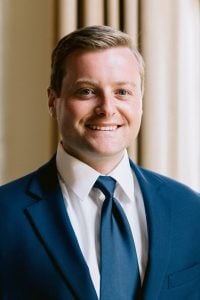
Matthew Brady, UNC Kenan-Flagler’s MBA Class of 2028
Age: 33
Hometown: New Canaan, Connecticut
Undergraduate and Graduate Institution and Major: Davidson College, B.S. Chemistry, Minor in Mathematics; University of North Carolina at Chapel Hill, Ph.D. Chemistry
Pre-MBA Work Experience: Research Scientist, Cree/Wolfspeed (semiconductor materials, automotive LED components; co-inventor, U.S. Patent No. 11,688,832); Chemistry Researcher, Battelle Memorial Institute (Counter-WMD Solutions, National Security Department); Research Staff Member, Institute for Defense Analyses (Major Defense Acquisition Program operational testing and evaluation)
Why did you make the decision to attend business school? Why now?
My path started at the bench, in a PhD program focused on using direct sunlight to drive new fuel and energy storage strategies. From there I moved into industry as a research scientist on semiconductor materials at Cree/Wolfspeed, then worked as a chemistry researcher on counter-WMD solutions at Battelle Memorial Institute, before spending about four and a half years at the Institute for Defense Analyses evaluating some of the country’s largest and most complex defense acquisition programs. That work was about exercising judgment under real uncertainty about messy, specific situations and it always put me closer to big capital and technology decisions without letting me be the person in the room making the call.
Business school is the deliberate pivot to closing that gap. The “why now” is straightforward: I recently became a dad, and that kind of life moment has a way of sharpening what you actually want. I’m bringing the same evaluative instincts I built at the bench, at Battelle, and at IDA back to the energy transition, exploring in real time whether that means investing in it, building it or advising the people who do.
Why did you choose UNC Kenan-Flagler? What factors figured most prominently into your decision of where to attend?
UNC wasn’t unfamiliar territory. I did my chemistry PhD at Chapel Hill, so the university was already high on my list, and UNC Kenan-Flagler quickly proved the fit went beyond familiarity. Being awarded the R. Steven Vetter MBA Fellowship, which covers full tuition and named a Vetter Dean’s Fellow was a major factor in my decision. The Vetter Dean’s Fellows Program is a unique leadership development opportunity that I did not see anywhere else among the programs I was considering, and being selected for it told me that UNC Kenan-Flagler saw something in my background worth investing in.
Structurally, no other program gave me the same combination. The Energy Center, the Center for Excellence in Investment Management, and the Energy, Investment Management, and Consulting clubs are all substantial enough to let me explore the investing and implementation sides of the energy transition in parallel, rather than picking a lane too early. The school’s size also gave me the close-knit community I wanted, coming in later in my career with a family, where depth of relationships matters more than breadth of network.
What do you think is your most valuable or differentiating contribution to the Class of 2028?
I think my biggest contribution is a genuinely unusual technical background applied to a sector where that background is rare. I have a PhD grounded in alternative energy research, patent experience from commercializing semiconductor technology, and years spent across national security chemistry and defense acquisition evaluation, most recently at IDA assessing whether complex, capital-intensive defense programs would actually deliver on their promises. That combination is useful to the energy transition whether the conversation in the room is about underwriting a deal, running a project, or advising a client on one.
Beyond the resume, I bring a mindset built on making high-stakes calls when the right answer isn’t obvious and the consequences are real. That instinct came from years of evaluating programs and technologies that never came with a clean textbook answer. I’m also staying intentionally cross-functional this year instead of picking a lane on day one, which I think gives classmates a different lens in case discussions than the standard recruiting pipeline usually provides.
Tell us a fun fact about yourself that didn’t get included on your application:
I’m the oldest of seven kids in a blended family, which meant I was managing logistics and mediating disputes long before I ever sat in a classroom or lab. Frankly, my childhood was probably better training for group project dynamics than anything I will ever learn in the classroom. On the more literal side: I went from doing academic research on artificial photosynthesis to holding a U.S. patent for automotive LED headlight technology, which is not a career path anyone, including me, would have predicted.
Post-MBA career interests:
My honest answer right now is plural, on purpose. I’m focused on the energy transition broadly, and I’m using my first year to test two different sides of it rather than assume I already know the answer. First, energy transition investing, including private credit, direct lending, distressed and special situations. Second, energy transition implementation, meaning the operating and project development side of actually building this stuff. I’m using my clubs and coursework to get real exposure to both before I commit to one, and letting the answer come from experience rather than assumption.
Advice for Current Prospective Applicants
–What is one thing you would absolutely do again as part of your application process?
I’d lean fully into my unconventional story again, instead of smoothing it over to sound like a typical finance applicant. My path from a chemistry PhD to industry to federal acquisition work to business school doesn’t look like most applicants’ resumes, and I made the choice early to make that the throughline of my application rather than something to explain away.
–What is one thing you would change or do differently?
I’d start my technical prep, things like Python and core finance fundamentals, earlier, instead of treating it as a first-semester scramble. I’d also start building my energy private capital network sooner. A lot of recruiting in this space doesn’t run through the school’s formal on-campus channels, and the earlier those relationships start, the better.
–What is one part you would have skipped if you could, and what helped you get through it?
I wish I could have skipped the gaps between each knowledge point: the gap between applying and being invited to interview, and the gap between interviewing and learning about my acceptance. The waiting is always tough, so finding healthy and helpful distractions, like diving into projects at my previous job or spending more time with my family, helped me fill the time.
 What is your initial impression of the UNC Kenan-Flagler students/culture/community?
What’s struck me most so far is how genuinely collaborative the culture is. This is not just a talking point, but honestly how classmates show up for each other in study groups, case prep, and day-to-day activities. The core values of UNC Kenan-Flagler— integrity, inclusion, innovation and impact — are obvious and make coming on campus each day a real pleasure. I’m sure we all have horror stories of group projects gone awry from our high school days. Here at UNC Kenan-Flagler it is truly different in all the right ways, and I have my fantastic cohort of first-year students to thank for that.
What student organizations have you joined/are you hoping to join and why?
I’ve joined three organizations this year, each intentionally: the Energy Club, for direct exposure to the industry and technology side of the transition, including the Energy Career Trek; the Investment Management Club, where I’m hoping to compete in the Alpha Challenge in either the equity or credit tracks; and the Consulting Club, which I added specifically to explore the implementation and advisory side of the energy transition rather than only the financing side. Using all three in parallel is deliberate. I want real exposure before I commit to one lane.
What is one thing you have learned about UNC Kenan-Flagler that has surprised you?
I have been surprised at how much I have enjoyed being back in the classroom here at UNC Kenan-Flagler. I was in academia for a very long time prior to returning to business school and was honestly a bit nervous about shifting back to that classroom-learning mindset again. Thankfully, the quality of the professors and the courses have been absolutely worthwhile and very engaging. Sure, it can feel like drinking from a fire hose at times, but the UNC Kenan-Flagler faculty is truly top-notch and an absolute pleasure to learn from. Shoutout especially to Professor Kristopher Keller in the marketing department. I had never taken any sort of marketing course before, but his energetic teaching style and the case method approach make for a fun and engaging way to learn a completely new concept.
What is one thing you are most excited about in your first year?
What I’m most excited about is the process itself, charting a path into the energy transition that’s genuinely mine rather than defaulting to the most well-worn recruiting pipeline. From sector-specific career treks in October, to the Alpha Challenge with the Investment Management Club, to case competitions through the fall and winter, to the many coffee chats to come as I learn how to navigate my next steps, all of this will be exciting.