

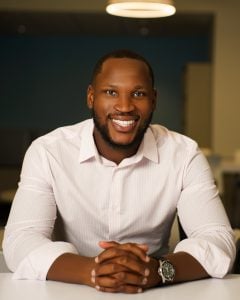
Jubelo Oyeniran, Johns Hopkins Carey MBA Class of 2028
Age: 23
Hometown: Owings Mills, Maryland & Ijebu-Ode, Ogun State, Nigeria
Undergraduate Institution and Major: Stevenson University — B.S. in Accounting; completed an accelerated 4+1 pathway and subsequently earned an M.S. in Forensic Accounting & Investigative Finance
Pre-MBA Work Experience: Auditor/accounting professional with experience at RSM US LLP, Citrin Cooperman, and Clearview Group, primarily across assurance, advisory, and accounting services.
Why did you make the decision to attend business school? Why now?
I reached a point where I realized the question was no longer whether I wanted to build something, but how far I could take it. Before business school, I worked in public accounting while building Kairos Nexus Global, a TEDCO-backed company connecting businesses with pre-vetted talent across emerging markets. As the company grew, so did the complexity of the decisions I was making—from strategy and operations to business development and leadership. An MBA felt timely because I wanted to become a better builder and leader while actively applying what I learned. It also presented an opportunity to build upon my background in accounting and finance and pivot from traditional auditing into roles where I can combine that foundation with the strategy, leadership, and business development skills I’ve developed through entrepreneurship.
Whether through consulting, leadership development programs, corporate strategy, or other opportunities, I wanted to position myself to solve broader business problems while continuing to grow as an entrepreneur. I didn’t want to wait until someday to pursue entrepreneurship or expand my capabilities. I wanted business school to become part of the journey.
Why did you choose Johns Hopkins Carey? What factors figured most prominently into your decision of where to attend?
Johns Hopkins was actually the only business school I applied to.
My confidence in that decision came from having experienced the Hopkins community before I ever became an MBA student. As a rising senior at Stevenson University, I participated in the Johns Hopkins Summer Business Academy. My team won the case competition that summer, and the following year, I was invited back—not as a participant, but as a coach. The team I coached won as well. That experience meant a lot to me because Hopkins didn’t just give me an opportunity to grow; it gave me an opportunity to come back and help someone else grow. Through those two summers, and through mentors like Roger Williams and Dr. James Calvin, I saw firsthand the mentorship, network, resources, and intentional investment Hopkins makes in people.
Entrepreneurship was another major factor. Even before becoming a Hopkins student, I had admired the resources available to student founders. Later, while completing my master’s at Stevenson and building Kairos Nexus Global, my experience with the Pava Center for Entrepreneurship reinforced that impression. I saw an ecosystem that didn’t just talk about entrepreneurship but actively backed people willing to build. Carey’s emphasis on “building for what’s next” ultimately felt deeply aligned with where I was in my own life. I was leaving public accounting to bet on myself, pursue my MBA, and continue building Kairos Nexus Global with an ambition to help position African talent as a global force in outsourcing.
Angela Duckworth has said, “If you want to join a gritty organization, join a gritty culture.” I looked at Hopkins similarly: if I wanted to build what’s next, I wanted to be somewhere that had already shown me it would help me do exactly that.
What do you think is your most valuable or differentiating contribution to the Class of 2028?
I think my differentiating contribution is the range of experiences I bring to the table—and my ability to connect them. I grew up in Nigeria before moving to the United States in middle school. I’ve been a junior Olympian and an NCAA collegiate athlete, a child actor on the Nigerian television series The Valley Between, an accountant with graduate training in forensic accounting and investigative finance, and now an entrepreneur building a TEDCO-backed company operating across global markets. Each of those experiences taught me something different. Athletics taught me discipline and resilience. Accounting taught me how to understand businesses through numbers and ask the right questions. Acting gave me an appreciation for creativity, storytelling, and connecting with people. Entrepreneurship has forced me to bring all of those skills together while building across cultures and markets.
That’s what I hope to contribute to the Class of 2028: the ability to look at a problem from more than one lens. I can bring the financial lens, the founder’s lens, the athlete’s mentality, the creative perspective, and an international outlook. More importantly, I want to use those experiences to help my classmates win, too.
Tell us a fun fact about yourself that didn’t get included on your application:
I’m also a professional emcee! Outside of school and entrepreneurship, you can occasionally find me with a microphone hosting weddings, corporate functions, and professional events. It’s probably one of the reasons I’m rarely afraid of speaking in front of a room full of people.
Post-MBA career interests:
My post-MBA interests center on roles where I can bring together my foundation in accounting and finance with the strategy, leadership, and business development experience I’ve developed as an entrepreneur. I’m particularly interested in consulting, leadership development and rotational programs, corporate strategy, corporate finance, and investment banking. I’m especially drawn to consulting environments like Slalom and leadership development programs like Amazon’s, where I can work across complex business problems and continue developing as a well-rounded business leader. I’m also interested in opportunities across technology, healthcare, medtech, biotech, and pharmaceutical companies. Entrepreneurship will remain an important part of my journey as I continue building Kairos Nexus Global, but I’m equally excited about the opportunity to contribute what I’ve learned as a founder inside a larger organization—and learn from operating at that scale.
Advice for Current Prospective Applicants:
—What is one thing you would absolutely do again as part of your application process?
Be unapologetically specific about my story. I didn’t try to manufacture the “perfect MBA applicant.” I focused on connecting the dots between where I had been, what I was building, and why an MBA made sense at this particular point in my life. I think authenticity becomes much easier when you stop trying to predict what an admissions committee wants to hear.
I would also absolutely invest in building genuine relationships with people at the university before applying. Whether that’s an admissions counselor, professor, program leader, alumnus, or someone else within the institution, seek out people who can help you understand the culture beyond what’s written on the website. Some of the relationships I developed at Johns Hopkins before applying gave me a much clearer understanding of the institution and ultimately gave me greater confidence that it was where I wanted to be.
—What is one thing you would change or do differently?
I would have started earlier. Not necessarily because I needed months to complete the application, but because more time gives you the opportunity to reflect. The strongest answers often come from understanding why something matters to you rather than simply describing what you have accomplished.
—What is one part you would have skipped if you could—and what helped you get through it?
The waiting!
Once you hit submit, there is very little left in your control, but it’s easy to replay your interview or reread your application in your head. Staying busy with work, entrepreneurship, and the people around me helped me remember that life was still moving regardless of the admissions decision.
 What is your initial impression of the JH Carey students/culture/community?
The sheer range of people in my class surprised me almost immediately. I’m learning alongside physicians, a plastic surgeon, a PhD, military professionals, former collegiate athletes, entrepreneurs, and people with backgrounds spanning Big Four, Big Tech, pharmaceuticals, biotechnology, research, finance, and operations. Some classmates have studied at institutions like Harvard, Columbia, and Cambridge, while others have built careers and lives across Africa, Asia, and other parts of the world.
Yet what has impressed me just as much as everyone’s résumé is how quickly people want to help one another. There is tremendous ambition in the room, but it doesn’t feel like ambition has to come at someone else’s expense.
My initial impression is that Carey has assembled a community of people who want to work hard, learn from one another, accomplish meaningful things—and still have a good time together along the way.
What student organizations have you joined/are you hoping to join and why?
I’m particularly excited about becoming involved with the African Business Club and the Pava Center for Entrepreneurship.
The African Business Club naturally aligns with a major part of my personal and entrepreneurial journey. Through Kairos Nexus Global, we’re working to help position African talent as a global force in outsourcing while helping businesses access high-quality talent and operate more efficiently. I’m excited to connect with classmates who are equally passionate about the continent’s economic potential and contribute to conversations about business and innovation across Africa.
I’m also excited to deepen my involvement with the Pava Center for Entrepreneurship. As a founder, I want to continue learning from the entrepreneurial ecosystem at Johns Hopkins while also contributing my own experiences and supporting other students who are building.
What is one thing you have learned about JH Carey that has surprised you?
The depth of infrastructure built specifically to help MBA students accomplish what they came here to do. I expected career resources and academic support, but I didn’t fully appreciate how many people at Carey are intentionally dedicated to helping students identify opportunities, develop professionally, build relationships, and ultimately achieve their post-MBA goals. That has reinforced something I first noticed about Johns Hopkins years ago: there is an incredible amount of intentionality behind the student experience. The resources are here, the people are here, and the support is here. If you come in knowing why you’re here and are willing to do the work, Carey gives you an incredibly rich ecosystem to pursue it.
What is one thing you are most excited about in your first year?
The people I haven’t met yet.
Some of the biggest opportunities in my life have started with a conversation I couldn’t have predicted. I’m excited about classes and especially about continuing to build through the Pava Center for Entrepreneurship, but I’m probably most excited about the classmates, professors, founders, alumni, and mentors I’ll encounter over the next year. I have no idea which conversation will lead to a friendship, an idea, a partnership, or an entirely new direction—and that’s what makes the first year exciting.