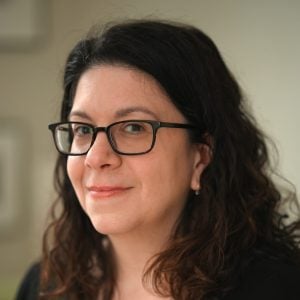



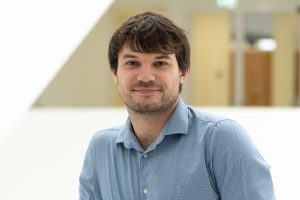
Lewis Hill, Manchester AMBS MBA Class of 2028
Age: 33
Hometown: Bridport, Dorset, England, UK
Undergraduate Institution and Major: Cardiff University – BSc in Theoretical and Computational Physics
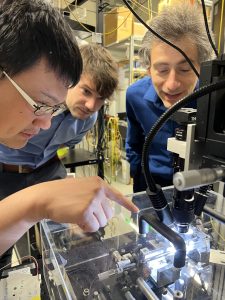
Pre-MBA Work Experience: I have spent roughly a decade working in scientific research, primarily in photonics and optical physics. Most recently, I was a Senior Scientist at the Max Planck Institute for the Science of Light in Germany, working on nonlinear photonics and optical resonators. My career has also included research appointments in France, Canada and New Zealand, alongside collaborations with industry and national laboratories. As I begin the MBA, I am also moving into a new role as General Manager of the UK Photonics Leadership Group, representing and supporting the UK photonics industry.
Why did you make the decision to attend business school? Why now?
For most of my career, I have been trained to think like a scientist: understand a difficult problem, interrogate the evidence and work towards a solution. Increasingly, however, I found myself interested not only in the science itself, but in the bigger questions around how technologies move from laboratories into industry, how organisations make strategic decisions and how science and engineering can contribute to economic growth.
The timing was particularly important. Alongside starting the MBA, I am becoming General Manager of the UK Photonics Leadership Group, with responsibility for helping represent and develop a major UK technology sector. That transition made this the right moment to complement my scientific background with a much stronger grounding in strategy, finance, organisational leadership and business.
I wanted an MBA that I could apply immediately rather than something I might use several years in the future.
Why did you choose Manchester AMBS? What factors figured most prominently into your decision of where to attend?
I wanted a school with a strong international outlook, but also one with a very practical approach to management education. The Manchester Method and the emphasis on learning by working on real problems were therefore particularly attractive.
Manchester itself was also important. It is a city with an extraordinary history of science, engineering and industrial innovation, but it is also part of a region that is increasingly important in areas such as advanced manufacturing, materials, digital technologies and photonics. That felt very aligned with the direction of my own career.
The quality and diversity of the cohort, the opportunity for international experiences, and the flexibility to explore areas outside my existing expertise were also major factors. Receiving the Joseph Wright Scholarship reinforced my feeling that Manchester was somewhere that recognised both my previous experience and what I was trying to achieve next.
What do you think is your most valuable or differentiating contribution to the Class of 2028?
Probably the ability to bridge several worlds that do not always communicate as effectively as they could.
I have spent most of my career as a scientist working on fundamental and applied photonics research, but I am now working much more directly with industry, government and policymakers. That means I often find myself translating between people who approach the same issue from very different perspectives.
I also bring an unusually international scientific background, having worked in the UK, Germany, France, Canada and New Zealand. At the same time, I expect to learn an enormous amount from classmates whose experience is in finance, consulting, entrepreneurship and industries completely different from my own.
Hopefully I can contribute a scientist’s way of thinking while having that way of thinking challenged in return.
Tell us a fun fact about yourself that didn’t get included on your application:
I love playing a wide range of sports. I think sport provides a healthy outlet for competition while constantly pushing you to improve and bring your best each time you play.
Post-MBA career interests:
I want to continue working at the interface between science, technology, industry and public policy.
In the immediate term, that means helping grow the impact of the UK Photonics Leadership Group and supporting the development of the UK photonics sector. Longer term, I am interested in leadership roles in science- and technology-intensive organisations where I can help turn exceptional research and engineering into wider economic and societal impact.
I also intend to retain a connection with scientific research. I like the idea of a career in which I do not have to choose completely between being a scientist and being a business leader.
Advice for Current Prospective Applicants:
–What is one thing you would absolutely do again as part of your application process?
Be very clear about “why now?”
It is relatively easy to explain why an MBA might be useful in general. I found it much more valuable to think carefully about why I needed one at this specific point in my career and what I wanted to be able to do differently afterwards.
Once I had that clear in my own mind, the rest of the application became much more coherent because my previous experience, the MBA and my future ambitions formed one connected story.
–What is one thing you would change or do differently?
I would probably start speaking to students and alumni even earlier.
Websites and rankings can tell you a great deal about a programme, but conversations with people who actually experience the school are much better at revealing its personality. They also help you think beyond simply “Which MBA is best?” towards the much more useful question of “Which MBA is best for me?”
–What is one part you would have skipped if you could—and what helped you get through it?
The administrative side of applying is probably the part I would happily have skipped — gathering documents, checking requirements and making sure every small part of the application was complete.
What helped was treating it like a project rather than one enormous task: break it into individual pieces, deal with them one at a time and keep a checklist. Perhaps unsurprisingly, that is the scientist in me coming out again.
 What is your initial impression of the Manchester AMBS students/culture/community?
The first thing that has struck me is how international the cohort is and how quickly people from very different backgrounds have started talking to one another.
There is clearly a lot of ambition in the room, but my initial impression is that it is not an overly competitive or transactional environment. People seem genuinely interested in what everyone else has done and what they can learn from one another.
Coming from academia and science, I particularly enjoy being surrounded by people who look at problems through completely different lenses. A conversation that begins with technology can very quickly turn into one about finance, entrepreneurship, supply chains or international markets.
What student organizations have you joined/are you hoping to join and why?
I am still exploring the full range of student organisations, but I am particularly interested in activities around technology, entrepreneurship, strategy and international business.
One of my reasons for doing an MBA is deliberately to spend time with people outside my existing professional world, so I do not want to restrict myself only to science and technology activities. I would like to use the student community to explore areas where I have much less experience and to meet people whose career paths are very different from mine.
I am also interested in opportunities where I can contribute some of my own experience in research, technology leadership and science policy.
What is one thing you have learned about Manchester AMBS that has surprised you?
I have been surprised by how quickly the MBA starts to feel like a community rather than simply a course.
You arrive with an extremely diverse group of people from different countries, industries and professional backgrounds, yet within a very short period you are already comparing experiences, discussing ideas and helping one another navigate the programme.
I expected the international diversity before arriving; I did not necessarily appreciate how much that diversity would shape even quite ordinary conversations.
What is one thing you are most excited about in your first year?
I am most excited about being able to apply what I am learning almost immediately.
Because I am beginning a major new leadership role at the same time as the MBA, I will be encountering questions around strategy, organisational development, finance, stakeholder management and growth in my professional life while studying many of those same subjects at Manchester.
That creates a rather unusual real-world laboratory for the MBA. I am also particularly looking forward to the live projects and international elements of the programme, which should push me well outside the scientific environment in which I have spent most of my career.