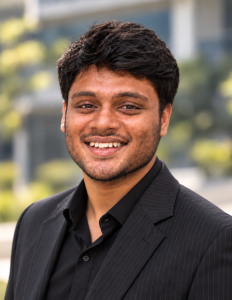
Pratham Dhawal Goud Veeramalla, Carnegie Mellon Tepper MSM Class of 2027
Age: 22
Hometown: Hyderabad, India
Undergraduate Institution and Major: Osmania University – Bachelor of Engineering | Computer Science Engineering (AI/ML)
Pre-MSM Work Experience: Cofounder, The Culinary Hub, Hyderabad (December 2025 to August 2026); Founder’s Office, Trugame Experiences / Pickl’Out, Hyderabad (January 2025 to July 2025). Leadership Experience: Vice President, Outgoing Social Sector, AIESEC Hyderabad (February 2024 to February 2025); Divisional President, Street Cause (July 2023 to January 2024).
Why did you make the decision to attend business school? Why now?
I studied Computer Science, but through my experiences outside the classroom, I found myself increasingly drawn to the business side of things. Leading teams at AIESEC, working in the founder’s office at a sports management company, and co-founding a restaurant gave me opportunities to work on strategy, operations, marketing, and growth. I enjoyed figuring out why something wasn’t working and bringing people together to improve it.
Those experiences also showed me where I needed to grow. I could learn by doing, but I wanted a stronger foundation in finance, organizational behavior, and business decision making. Business school felt like the right place to connect my practical experience with a more structured understanding of management.
The timing made sense because I had just completed engineering and had enough experience to understand what I wanted from the next step. I’m still exploring where I want to build my career, but I know the kind of work that excites me. I wanted to build that foundation now and make my next career decisions with greater clarity.
Why did you choose Carnegie Mellon Tepper? What factors figured most prominently into your decision of where to attend?
The Tepper School felt like a natural fit for the direction I wanted to take. Coming from Computer Science, I wanted to build my understanding of business while continuing to use my technical background. Tepper’s analytical approach and Carnegie Mellon’s connection to technology appealed to me, especially given my interests in strategy, business operations, and growth.
I also wanted room to explore. I know the kind of problems I enjoy working on, but I’m still figuring out where I want to focus my career. The Tepper School’s Master of Science in Management (MSM) degree offered an opportunity to build a broad business foundation and learn alongside people bringing different experiences and perspectives.
The people mattered just as much. My interactions with the admissions team made a major international move feel more personal and manageable. I felt comfortable asking questions and being honest about my circumstances. Academic fit, opportunities to grow, and that sense of support were the biggest factors in my decision.
What do you think is your most valuable or differentiating contribution to the class?
I bring a perspective shaped by working in very different environments, from leading a 40-member department at AIESEC to working in a sports management company and co-founding a restaurant. Those experiences give me practical examples to draw on in class. When we discuss team alignment, customer retention, or operational decisions, I can connect the concepts to situations where I had responsibility for the outcome, including things I got wrong.
My engineering background also helps me approach problems analytically, while my leadership experience reminds me to consider the people behind the numbers. At AIESEC, for example, I saw how marketing could meet its lead generation targets while the exchange team struggled to convert those leads. Aligning those goals taught me to look beyond whether each function was doing well individually and ask whether we were succeeding together.
I also enjoy bringing people together. As MS in Management Student Senator, I want to help classmates feel heard and create more opportunities for us to connect. I hope my contribution is both a useful perspective in the classroom and a willingness to take initiative outside it.
Tell us a fun fact about yourself that didn’t get included on your application:
I can get surprisingly philosophical about video games. To me, they bring together storytelling, music, visual art, and technology, then let you become part of the story. What starts as a conversation about a game can easily turn into a discussion about human choices. I’m also an Arsenal fan, so I spend the rest of my free time debating things I have absolutely no control over.
Post-MSM career interests: I’m interested in working at the intersection of strategy, consulting, growth, and business operations, particularly in entertainment, technology, and sports. I enjoy figuring out how a business can improve and working with people to make those changes happen. I’m exploring roles that combine my technical background with my experience in leadership and entrepreneurship. Longer term, I would love to build a business of my own again.
 Advice for Current Prospective Applicants:
–What is one thing you would absolutely do again as part of your application process?
I would absolutely go through the process of researching schools and reflecting on my own experiences again. Learning about different programs pushed me to ask what I actually wanted from business school and why. Writing the essays made me revisit decisions I had made, experiences that had shaped me, and ambitions I hadn’t fully put into words.
I started out trying to understand where I wanted to study and ended up understanding myself better. That is something I would gladly do again, even without an application deadline waiting at the end.
–What is one thing you would change or do differently?
I would start earlier and aim to apply in Round 1. Giving myself more time would have helped me reflect on my essays, get feedback, and manage everything that follows an admission offer without feeling rushed. I would also research scholarship opportunities earlier and give those applications the attention they deserve. My biggest change would be to leave myself more breathing room throughout the process.
–What is one part you would have skipped if you could—and what helped you get through it?
If I could have skipped one part, it would have been the uncertainty around the visa process. It was difficult to be excited about this next chapter while not knowing when I would actually be able to begin it. There is only so much planning you can do when a major part of the timeline is outside your control.
Staying in touch with the school and having people I could lean on helped me get through it. I tried to focus on whatever I could prepare rather than put everything on hold. It was a lesson in patience, although I would have happily taken a shorter course.
What is your initial impression of the Carnegie Mellon Tepper students/culture/community?
My initial impression is that people at the Tepper School are ambitious, curious, and willing to help. Everyone brings different experiences, which makes conversations interesting both inside and outside class. I’m finding that there is a lot to learn simply by getting to know the people around me.
The biggest lesson for me so far has been to ask. Whether I need guidance, want to explore an opportunity, or am simply curious about something, asking has opened conversations I would otherwise have missed. Faculty, staff, and classmates have made moving to a new country feel less overwhelming.
One especially meaningful moment was connecting with a communication coach who also had an AIESEC background. I felt understood beyond my resume. That experience made the community feel much more personal, and it is the kind of connection I hope to help others find as an MSM Student Senator and an Admissions Ambassador.
What is one thing you have learned about Carnegie Mellon Tepper that has surprised you?
I’ve been surprised by how much a different approach to teaching can change your relationship with a subject. During engineering, I struggled with parts of mathematics, particularly calculus and differential equations. At theTepper School, Probability & Statistics has become a course I genuinely enjoy. Connecting the concepts to practical questions makes them feel more intuitive and gives me a reason to want to understand them.
I expected business school to help me build new skills. I didn’t expect it to make me reconsider something I thought I already knew about myself. It has been a reminder to give myself another chance before deciding I’m simply “not good at” something.