


At a time when artificial intelligence is reshaping jobs, career paths feel less predictable, and headlines regularly question the value of graduate education, it’s reasonable for prospective MBA candidates to pause.
A full-time MBA requires a significant investment — often exceeding $200,000 when tuition, living expenses, and forgone salary are considered. For international applicants, added uncertainty around U.S. work visas only raises the stakes. Against this backdrop, many young professionals are asking a fair question: Is the MBA still worth it?
Our view is unequivocal: yes. Not because the MBA is unchanged, but because its core strengths — career mobility, leadership development, trusted networks, and global perspective — are even more valuable in periods of disruption than in times of stability.
Why the MBA Continues to Deliver Value Where It Matters Most
A Proven Platform for Career Reinvention.
For career switchers, the MBA offers a uniquely structured and supportive environment for change. Classroom learning, career clubs, internships, and career management offices allow students to explore and test post-MBA paths in a way that is difficult to replicate while working full time.
Consistently Strong Employment Outcomes in the Most Competitive Industries.
The MBA continues to deliver high job placement rates in coveted fields such as consulting, finance, and technology. For example, despite the current job market, 90% of job seekers among Class of 2025 MBA graduates from Chicago Booth, Columbia Business School, Harvard Business School, Stanford GSB, and Wharton received job offers within three months of graduation (at $185,000 median base salaries). The MBA degree remains particularly effective for candidates pursuing consulting, finance, technology, and general management roles across a wide range of industries.
A Network Built on Trust, Not Transactions.
MBA students gain access to a powerful professional network that extends well beyond graduation. Trust-based relationships formed under the pressure of team-based coursework and shared deadlines are difficult to replicate elsewhere. Over time, classmates become potential founders, investors, operators, mentors, and board members. More broadly, alumni networks function as a lifelong problem-solving infrastructure that graduates can draw upon throughout their careers.
From Individual Contributors to Confident Leaders
Many MBA candidates enter business school as strong individual contributors who are seeking to develop their leadership skills. MBA programs meet this need by providing structured opportunities for students to develop as leaders through class participation, student leadership roles, 360-degree feedback, and experiential learning. In addition, case studies and simulations allow students to grapple with decision-making under uncertainty, effectively compressing years of managerial experience into a two-year program.
Why the MBA Credential Still Opens Doors.
The MBA degree remains a strong signal to employers. It indicates that the MBA student is comfortable with ambiguity, has a willingness to invest in one’s own development, and has the ability to perform in selective, high-pressure environments.
Built for Global Careers
MBA programs help students develop the ability to operate across borders. Coursework focused on global management, combined with internationally diverse cohorts, provides real-world exposure to cultural differences and geopolitical dynamics that increasingly shape business decisions. For example, 26% of Wharton’s Class of 2027 are international students hailing from 68 countries and 41% of Yale SOM’s Class of 2027 are from 47 different countries. The LBS Class of 2027 is even more international: Only 9% are from the UK and 11% from the rest of Europe. The other 80% hail from 66 countries outside of Europe.
The Most Common MBA Critiques — and Why They Miss the Point
Despite these benefits, skepticism around the MBA abounds. Below are several common critiques as well as our thoughts as to why these critiques are misguided.
“The MBA Costs Too Much to Pay Off.”
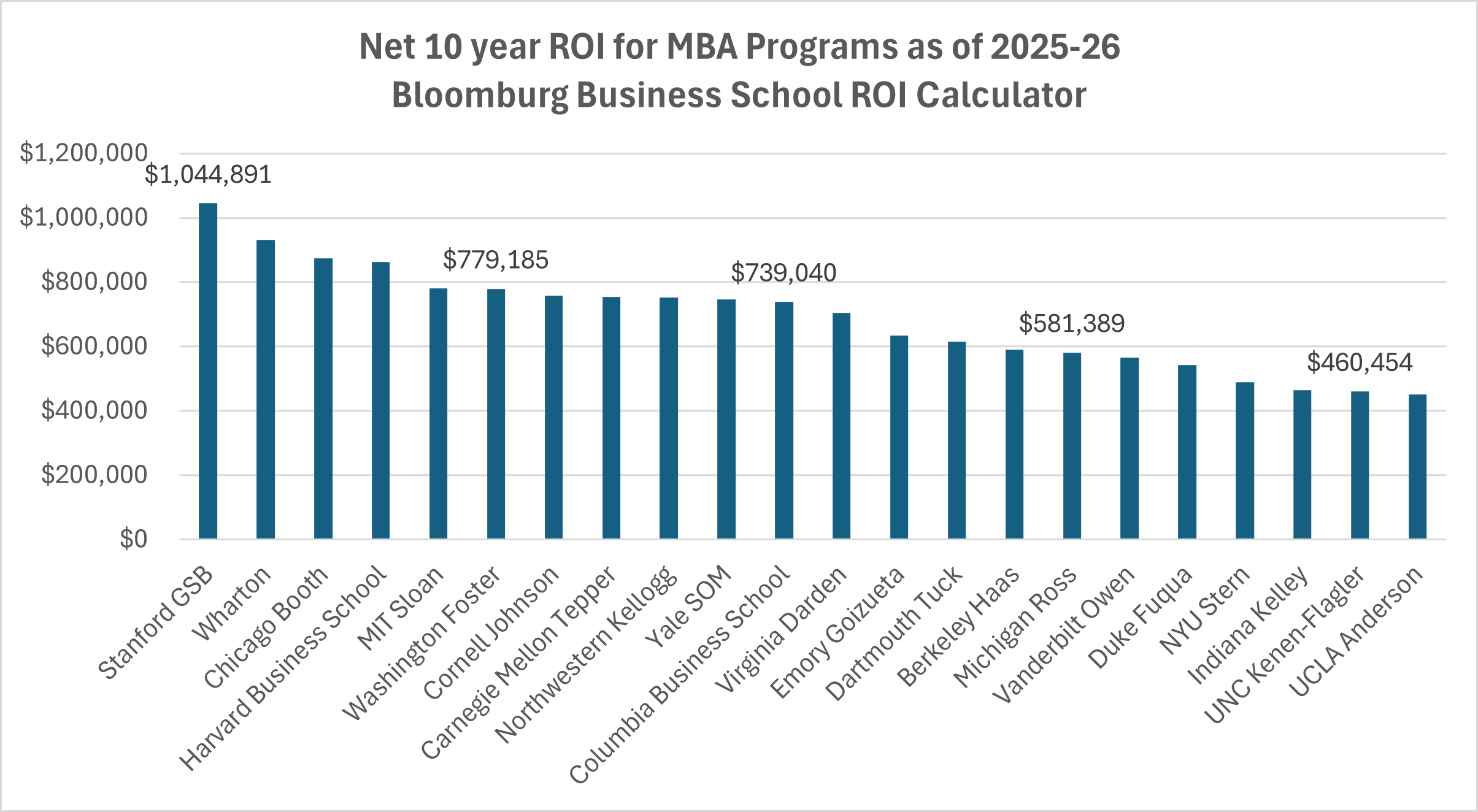
It is true that tuition and opportunity costs can exceed $200,000. In addition, large salary increases are not guaranteed, and payback periods have lengthened for some graduates. That said, the MBA continues to offer solid returns. For example, according to Bloomberg’s Business School Calculator for 2025 – 26, top MBA programs continue to deliver strong ROIs. Below is a table showing the ten-year Net ROI in dollars for a number of leading MBA programs using the Bloomberg ROI calculator.1 As you can see, despite the tuition cost and opportunity cost of time, the MBA degree continues to deliver hundreds of thousands of dollars in net ROI to MBA graduates.
In addition to the short-term ROI benefits, the MBA degree expands the number of credible career paths available to graduates, increasing long-term flexibility and resilience. In volatile labor markets, transferable skills and a strong professional network also help mitigate career risk.
“Everything an MBA Teaches Is Available Online.”
It is true that finance, analytics, and strategy content is widely available online, and bootcamps and certificate programs are faster to complete and cheaper than a full-time MBA. However, the MBA’s value lies not in content alone, but in context. Business school trains students to make decisions with incomplete information, under pressure, and within complex group dynamics. Leadership development is best learned in social environments, whether through cold calling in the classroom, persuading teammates in group projects, or leading student organizations. Additionally, credentials still matter. Employers continue to distinguish between self-directed learning and education obtained through selective, vetted institutions. In our conversations and surveys with MBA applicants, they consistently mention that experiential learning, team projects and leadership immersions are very appealing features of MBA programs.
“Degrees Matter Less Than Experience Now.”
While skills-based hiring is increasing, MBA programs continue to add value by accelerating student experiential learning through case studies, internships, and hands-on projects. Moreover, elite industries such as consulting, private equity, investment banking, and corporate leadership development programs continue to recruit MBAs heavily. A number of these elite firms often focus their recruiting on students from elite MBA programs because the firms value the skills that these students bring to the organization.
“MBAs Don’t Create Entrepreneurs.”
While it is true that there are successful entrepreneurs who do not hold MBAs, it is also true that many entrepreneurial ventures fail because the founders have gaps in business fundamentals. MBA training can reduce founder error rates in areas such as hiring, capital raising, governance, and scaling. The degree is particularly valuable for non-technical founders and for entrepreneurs building complex, capital-intensive organizations. In addition, MBA students looking to start companies often find co-founders, capital, and more within their university. For example, Harvard Business School touts that among the 155 HBS Class of 2025 graduates who started a business upon graduation, 37% connected with a Co-Founder at HBS. It is also not unusual for MBA students to team up with those studying in an engineering or life sciences program at the same university as they seek to launch a business.
Closing Thought
For ambitious professionals seeking accelerated responsibility, long-term flexibility, and leadership roles in complex organizations, the MBA remains one of the most effective platforms available. In a world defined by volatility rather than stability, the degree’s combination of structured learning, experiential leadership development, and lifelong networks continues to deliver — not just a financial return, but enduring career resilience.
Graham Richmond contributed to this article
-
- To estimate the ROI of an MBA degree, Bloomberg asks recent MBA graduates about 1) current pre-MBA salary 2) expected post MBA salary and expected signing bonus 3) tuition and living expenses during the MBA program and 4) amount borrowed and interest rate on the student loans. Bloomberg then estimates the total cost per business school as the sum of tuition + living expenses, interest expense on student loans and opportunity cost of foregone salary. If a student earned income during a summer internship, this amount is subtracted from the foregone salary. Bloomberg then calculates the benefit as the increase in compensation per year post MBA compared to an estimate of the student’s salary without an MBA during the first ten years after business school. To determine the ROI by MBA program, Bloomberg surveyed recent MBA graduates at each business school and then calculated a ten-year ROI by school based on the median answers provided by students at each school.
- To estimate the ROI of an MBA degree, Bloomberg asks recent MBA graduates about 1) current pre-MBA salary 2) expected post MBA salary and expected signing bonus 3) tuition and living expenses during the MBA program and 4) amount borrowed and interest rate on the student loans. Bloomberg then estimates the total cost per business school as the sum of tuition + living expenses, interest expense on student loans and opportunity cost of foregone salary. If a student earned income during a summer internship, this amount is subtracted from the foregone salary. Bloomberg then calculates the benefit as the increase in compensation per year post MBA compared to an estimate of the student’s salary without an MBA during the first ten years after business school. To determine the ROI by MBA program, Bloomberg surveyed recent MBA graduates at each business school and then calculated a ten-year ROI by school based on the median answers provided by students at each school.