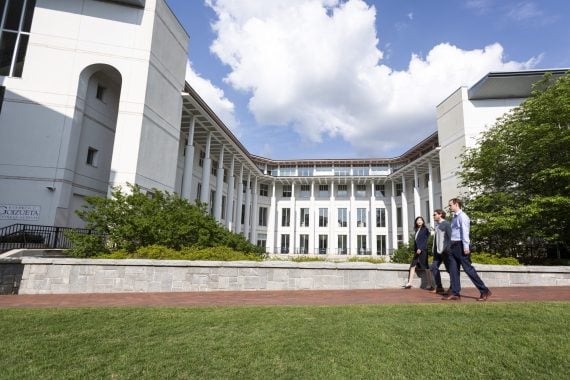



We are excited to kick off our Admissions Director Q&A series for the 2026-2027 admissions season! To start, we welcome back Melissa Rapp, Associate Dean of Graduate Admissions for Goizueta Business School at Emory University.
Melissa Rapp leads strategy, recruitment, and enrollment across MBA and Specialized Master’s programs. She brings more than 20 years of experience in graduate management education and enrollment leadership. Prior to joining Goizueta, Melissa held leadership roles at several top institutions, including serving as Director of Admissions for the Full-Time MBA and MSMS programs at Kellogg School of Management at Northwestern University. Throughout her career, she has focused on building admissions strategies and student experiences that are both thoughtful and human-centered.
Melissa is a frequent speaker on the future of graduate business education, enrollment strategy, and leadership development. She is passionate about creating pathways that help talented people grow, lead, and thrive. Read on for her insights into Goizueta admissions and more.

Clear Admit: What is one aspect of your MBA program that you wish applicants knew more about?
Melissa Rapp: New students are often surprised by how quickly Goizueta students become deeply engaged in the classroom, recruiting process, and broader community. Academics, leadership development, career preparation, alumni engagement, and access to industry are not separate experiences here. They work in sync from day one.
Career preparation is a priority for our students, so it starts before classes begin. Leadership development is embedded into the curriculum, not layered on top of it. Faculty bring current business challenges directly into the classroom, and students are expected to engage with real organizations and real decisions early in the experience.
We recently redesigned the curriculum after collaboration with students, alumni, faculty, and employers. Students begin with a quantitative bootcamp during onboarding to help build confidence and create a strong foundation for the program.
They also explore how emerging technologies are reshaping business and leadership in real time. Flexible Fridays create dedicated space for networking, interview preparation, and collaborative case work with peers.
One of my favorite additions is Growth Week, where students bring together everything they have been learning in the core curriculum to solve a real business challenge for a corporate partner. This year, students worked with leaders from The Coca-Cola Company. The energy that week is incredible because students see how the knowledge they built throughout the core curriculum comes together to solve real business problems.
There is a momentum to the experience here that students feel very quickly.
CA: Walk us through the life of an application in your office from an operational standpoint. What happens between the time an applicant clicks “submit” and the time the committee offers a final decision?
MR: When you are trying to truly get to know someone, you can’t rely on any single data point. The best thing about people is how dynamic and different they are. Our review process reflects that and allows us to consider candidates fully and thoughtfully.
Once an application is submitted, it receives an initial review from a member of the admissions team. The team looks at academic performance, career trajectory & goals, demonstrated leadership, the candidate’s lived experience, and fit with the community.
As interview invitations begin going out, the process becomes dynamic. Interviews, second reviews, and committee conversations are all happening simultaneously. Every application receives multiple evaluations before a final recommendation is made.
I always tell applicants that we are not trying to admit one “type” of student and there are no perfect applicants. We are building a class made up of people who will challenge one another, support one another, and learn from one another. That requires thoughtful discussion and a holistic process.
At the end of the day, every admissions decision contributes to the kind of community we are building at Goizueta.
CA: How does your team approach the essay portion of the application specifically? What are you looking for as you read an essay? Are there common mistakes applicants should try to avoid? What is one key thing candidates should keep in mind as they sit down to write?
MR: Honestly, the essays that stay with me are rarely the most polished. They are the ones that feel honest, thoughtful, and self-aware.
We approach the essays as an opportunity to better understand the person behind the application. The strongest responses help us understand how someone thinks, what they value, how they have grown, and what experiences have shaped them along the way.
A common mistake applicants make is trying to sound like what they think a business school applicant is supposed to sound like. That often leads to essays that feel overly rehearsed or disconnected from the actual person writing them. Another common misstep is using the essay as a second resume. We already know your accomplishments and titles. What we want here is perspective.
I always encourage candidates to focus less on impressing the admissions committee and more on being reflective and genuine. Applicants who really understand themselves tend to stand out. So is clarity around your goals, motivations, and the experiences that matter most to you.
The strongest essays feel like a real person having a meaningful conversation with the admissions committee.
CA: Could you tell us about your interview process? Approximately what percentage of applicants are invited to interview, who typically conducts interviews, and what should candidates expect in terms of interview style and format — including whether interviews are conducted virtually, in person, or if you offer both options?
MR: Our interviews are by invitation and are designed to feel much more like conversations than formal interviews.
Most interviews are conducted virtually with members of the admissions team, though we also offer limited in-person interviews during select preview events and campus programs.
Interviewers have access to a candidate’s resume, but not the full application. I like that approach because it allows the conversation to develop naturally and keeps the focus on getting to know the individual rather than revisiting every detail of the application.
We are trying to understand how someone thinks, reflects, connects with others, and engages in conversation. Some of the best interviews are the ones where applicants relax a bit, become genuinely engaged, and let their curiosity and personality come through.
We also leave time for candidates to ask questions because the interview process should go both ways. We want candidates to learn about Goizueta as much as we want to learn about them.
CA: If your admissions process includes any video-based components — such as video essays or recorded interview responses — what advice would you offer applicants preparing for this part of the process?
MR: Our video essay is intentionally brief, but it gives the broader admissions committee an opportunity to experience a side of the applicant beyond the written application.
My biggest piece of advice is not to overthink it. We are not looking for polished performances or perfectly scripted responses. We are looking for authenticity, thoughtfulness, and presence.
Answer the question directly, keep your response personal and grounded, and let your personality come through naturally. Candidates are often at their best when they stop trying to sound “MBA-ready” and simply sound like themselves.
CA: Is there anything in particular international students should keep in mind during the admissions process?
MR: Some of the most meaningful conversations, friendships, and learning experiences in our MBA program happen because of the global perspectives students bring into the classroom and community. International students are not a separate part of the Goizueta experience. They are central to it.
From an application standpoint, I encourage international applicants to be thoughtful and specific about their goals and motivations. Help us understand not only where you have been successful, but also how you hope to grow and what kind of impact you want to have moving forward.
I also encourage students to engage with the admissions team early and to begin preparing for visa-related processes as soon as possible after admission. We work closely with Emory University International Student and Scholar Services to support students throughout that transition.
International students are navigating not only business school, but often a new country, recruiting market, and professional culture at the same time. Having strong relationships with classmates, faculty, career coaches, and alumni can make a meaningful difference in helping students build confidence quickly.
CA: Conversations about MBA value often center on jobs, salaries, and ROI. What are some of the other ways students benefit from the MBA experience that may be harder to quantify upfront?
MR: Career outcomes absolutely matter, and applicants should think carefully about ROI. But some of the most important parts of the MBA experience are much harder to quantify upfront because they reveal themselves over time.
One of the biggest shifts I see in students is confidence. Not confidence in the sense of having all the answers, but confidence in their ability to handle uncertainty, lead through complexity, and step into opportunities they may not have pursued before business school.
Students also start thinking differently about problems, teams, and decisions. They become more strategic, and more comfortable working across perspectives and industries. Those are skills that they continue to use for the rest of their careers.
Another thing that is difficult to fully appreciate before business school is the long-term value of the networks students build. During the MBA experience, students build relationships with classmates, alumni, faculty, staff, and mentors who often become lifelong advisors, collaborators, and friends.
I think many students initially come to business school focused on what they will do next professionally. What often surprises them is how much the experience shapes them personally and changes the way they see themselves and their future.
CA: Are there any trends in the applicant pool, admissions process, or MBA experience that you are particularly focused on right now (e.g. AI, changing career interests, evolving student expectations, new curricular offerings, etc.)?
MR: One of the biggest shifts we are seeing is that students want an MBA experience that delivers strong career outcomes and leadership development but also feels relevant to where business and work are headed right now.
AI is certainly part of that conversation. Students across industries are thinking about how technology is changing decision-making, leadership, and the way organizations operate. That has pushed business schools to think differently about how technology shows up in the classroom, not as a standalone topic, but as part of broader business conversations and decision-making.
Applicants are also evaluating MBA programs differently than they did even a few years ago. They still care about rankings and outcomes, of course, but they are paying much closer attention to the day-to-day experience. They want to know whether faculty will know them, whether alumni are responsive, how quickly they can engage with employers, and whether they will have opportunities to contribute once they arrive on campus.
We are also seeing career paths become much less linear. More students are interested in intersections between industries and functions, whether that means analytics and strategy, healthcare and technology, or entrepreneurship and social impact. That has reinforced the importance of creating experiences that are interdisciplinary, experiential, and connected to real business challenges.
What excites me is that students are asking sharper and more thoughtful questions overall. They are looking carefully at culture, access, and the ways an MBA program will shape both their careers and their personal growth.
CA: Is there anything else you’d like to highlight about your MBA program or admissions process?
MR: I think applicants learn a great deal about a school during the admissions process itself. Applying to business school is a major decision, and candidates should feel comfortable asking difficult questions, evaluating programs honestly, and having real conversations along the way.
I am very proud of how engaged and accessible people are throughout that process at Goizueta. We genuinely enjoy working with students and helping them think carefully about what they want from an MBA experience and the kind of environment where they will be challenged, supported, and able to grow quickly