



Sponsored Content
Why do business schools publish employment reports and what can these reports illuminate for MBA applicants? Stephen Pidgeon T’07, Executive Director of Tuck Career Services, is here to walk us through the trove of information these reports provide–and how they may be significant to you.

Pidgeon joined Tuck in 2010 from McKinsey in London where he focused on health care consulting with a functional specialty in organizational design. He is the author of the bestselling books “How to Get A Job In Consulting” and “Case Interviews for Beginners.” Before attending Tuck, Stephen directed and produced multiple television series and a movie.
Read on for his insights into how to interpret post-MBA placement, consider industries and geography, and more.
The Value of MBA Employment Reports
When considering an MBA, it’s important to have accurate information about the return on such a major investment.
One of the most important pieces is the career you step into after graduation. In order to make sure you are able to fairly assess different MBA programs, there is a rigorous set of standards that all schools follow when putting together their employment data. These standards ensure that you can compare ‘apples to apples’ and make an informed decision.
As a Tuck alum myself, I still remember scouring employment reports as I researched MBA programs. My goal with this article is to help you identify some of the most useful insights these reports can offer.
The Class Profile
Pay careful attention to the size of the class, as this varies significantly. Tuck is one of the smallest full-time MBA programs, which creates a unique sense of community while also increasing access to resources such as faculty and Career Services. Among MBA programs, we have the highest ratio of advisers to students.
Look closely at the number or percent of students seeking employment. Some schools have a relatively low percentage of students in this situation, whereas most of ours are on a similar path.
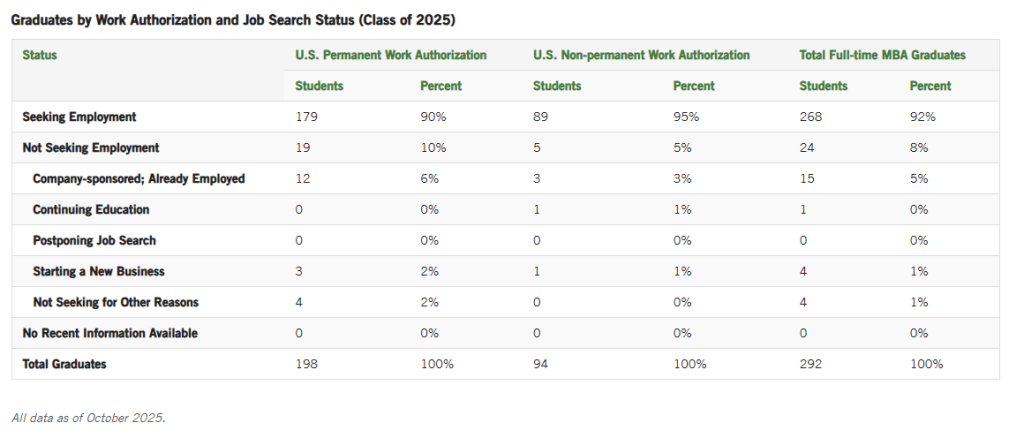
Usually schools will break down the reason for ‘not seeking employment.’ One of these categories is ‘starting a new business.’ At Tuck, relatively few students launch a business immediately after graduation, yet a large percentage of our alumni eventually become entrepreneurs. We’ve found that many graduates first build skills, experience, and networks in traditional post-MBA roles before launching their own ventures later in their careers.
Pro Tip
Look at the number of students for which the school is saying they had “NO INFORMATION AVAILABLE.” This means that after having a student in their program for two years, the school had no information about the student’s job search.
At Tuck, this number is always zero—we know you and your job search journey. After all, we’ve worked side by side with you for two years, and that support doesn’t end at graduation. It continues for the rest of your life.
Industry Placement
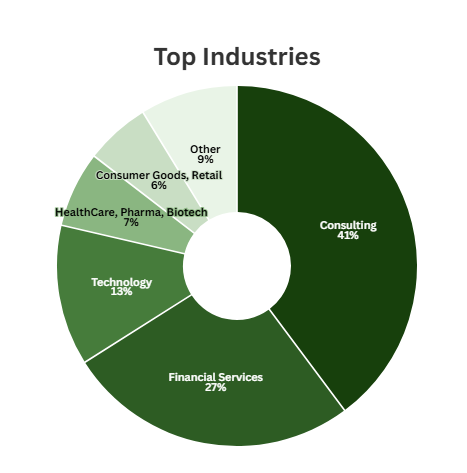
The next section in MBA employment reports tends to be industry placement, along with compensation. Sometimes I get asked why Tuck has such a high percentage of students going into consulting, and the answer is that the industry results are driven by student demand. We ask all of our incoming students about their career goals, and the industry interests they express at the start of the program closely mirror the employment outcomes we see at graduation.
Tuck has a particular strength in consulting because the profession rewards many of the qualities our students value and develop here: collaborative problem-solving, thoughtful leadership, and clear communication. In addition, we have three advisers on our team who previously worked for ‘MBB’ firms. Other schools have to bring in outside experts for a day to teach consulting interview skills, whereas we have the luxury of in-house expertise day in, day out.
If you’re not thinking of yourself as a future consultant or banker, that’s OK! We help students succeed in a broad range of industries, including tech, health care, energy, consumer goods, and more. If you want to understand whether an MBA, and a specific MBA program, might help you reach your goals, I’d encourage you to spend time on LinkedIn. Look at companies in the field you want to be in and see if you can find employees with an MBA.
Location Placement
One question prospective students often ask is whether attending business school in a small town like Hanover, New Hampshire, limits their career options after graduation. The answer is no. As our employment statistics show, many Tuck graduates go on to careers in consulting, investment banking, and other industries and are most likely to end up in cities such as New York, Boston, San Francisco, and Chicago.
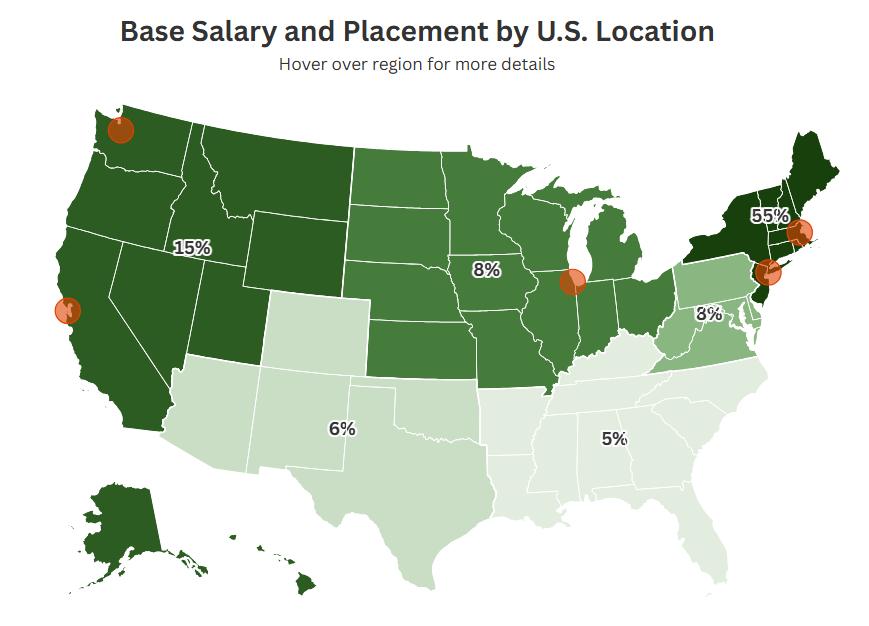
That’s one of the things I appreciate most about Tuck: You can spend two years living and learning in a beautiful place and close-knit community, then pursue opportunities in virtually any major business hub after graduation.
Compensation
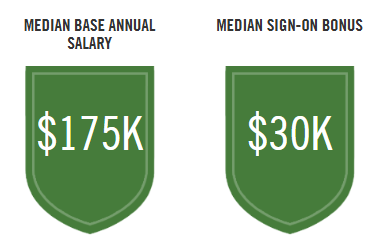
When I was looking at applying for an MBA, compensation was the thing I looked at most closely—after all, you need to ensure a financial return on your investment. Make sure to look at the ranges of salary for your chosen field, not just the highest possible outcome. Median salary is usually a fair approximation of what you might hope to achieve, assuming you succeed in the interview process for your dream job. But a prudent financial model might take into account a slightly lower target salary, just in case.
One thing that employment reports tend not to show is equity. Interestingly, consulting and banking tend not to provide equity until later on in your career, whereas some industries like tech often start out with stock options as a significant part of the compensation package.
Summer Internships Stats
Some people use the summer internship to experiment and try something new. Others use it as a pipeline into a future they’ve already planned. As with full-time recruiting, internship recruiting is driven heavily by alumni, making it important to choose a program with a strong, engaged network in your field of interest. Tuck is widely known as having one of the most responsive and loyal networks in all of business education.
Often, internship recruiting starts within weeks of your arrival, so make sure to find out what kind of career support the program offers before you arrive. We reach out to all admitted students early in the summer so that we can get to know you and help you start thinking about how to hit the ground running.
Final Thoughts
An employment report is a useful guide, but it isn’t a guarantee. It can provide a high-level view of the kinds of roles and financial outcomes an MBA may help you achieve, but every student’s path is different.
What the report can’t capture is the work you’ll put in, the unique experiences and perspectives you’ll bring, or the support you’ll receive along the way. Our role is to help you make the most of the opportunities available to you and achieve the goals that matter most to you.