


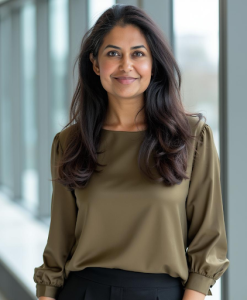
In this installment of our Admissions Director Q&A series, we meet Sabah Khan, the new Assistant Dean of MBA Admissions and Enrollment Management at UC Berkeley Haas School of Business.
In this role, Sabah is chief enrollment strategist for the Full-time, Evening/Weekend, and Executive MBA programs. She has 20 years of multi-sector leadership experience, including five years leading high performance talent strategies in high growth tech at Stripe, and a decade of MBA admissions experience at Stanford’s Graduate School of Business. At Stanford she led a team that grew enrollment throughout the candidate lifecycle from market research through yield.
Read on for Sabah’s insights on the admissions process, her favorite aspects of the Haas MBA program, and how to be your most authentic self in your application. And, stay tuned for a special podcast episode with her for more advice!
Clear Admit: What is one aspect of your MBA program that you wish applicants knew more about?
Sabah Khan: UC Berkeley’s Haas School of Business is at the epicenter of the artificial intelligence revolution, focusing on creating “AI-native” business leaders. Our applicants should understand the depth of our overall AI offerings. UC Berkeley is recognized as a world leader in this space, the Haas faculty is at the leading edge of this work, and Dean Jennifer Chatman is leading the charge.
Our AI certificate program includes 39 courses offered as AI electives, and will equip students with comprehensive AI capabilities required for so many career paths in business today.
It exposes students to the challenges of managing and integrating AI agents while working within teams, and transforming the way that stakeholders, business partners, and industries interact in the economy. It will also prepare Haas students to collaborate with AI-focused students in other areas across the university (engineering, data science, and AI programs) to bring ideas to market.
Students should also know that we are the singular business school with the greatest proximity to the world’s leading AI labs including Anthropic, OpenAI, and Perplexity, based in San Francisco, where many of our alumni work. The Bay Area is also home to tech industry giants like Google, Meta, Salesforce, Apple, Nvidia, and many other industry leading employers across sectors like healthcare (including UCSF and Sutter) and financial services (including Visa and Wells Fargo).
CA: Walk us through the life of an application in your office from an operational standpoint. What happens between the time an applicant clicks “submit” and the time the committee offers a final decision?
SK: Our evaluation process is centered on a holistic understanding of every candidate. Once an application is submitted, it undergoes a comprehensive review by our admissions team, where we look beyond the numbers to understand each applicant’s unique story and potential. This multi-layered approach allows different perspectives to shape our understanding of the candidate.
Candidates who show strong potential are invited to interview. From there, the application advances to a full admissions committee discussion. By this stage, a candidate has often accumulated advocates within the team: people who have read their file, conducted their interview, or championed their potential along the way. Those advocates present the candidate’s case to the committee. The result is a collaborative effort designed to build a new diverse, dynamic class.
CA: How does your team approach the essay portion of the application specifically? What are you looking for as you read an essay? Are there common mistakes applicants should try to avoid? What is one key thing candidates should keep in mind as they sit down to write?
SK: We’ve updated our essay portion to give you more ways to show us who you really are.
Our long-standing prompt, “What makes you feel alive?” is now a video essay. Please don’t worry about the production value; we’re not looking for polish. We want to see your energy, your passion, and the personality that doesn’t always come through in writing. Think of it as a direct line to the admissions committee.
The written portion remains anchored by the short- and long-term goals essay, which are intended to show us where you’ve been, where you’re headed, and why one informs the other.
We’ve also added an optional “distance traveled” essay—a chance to give us context. This is a place to share significant challenges, first-generation status, a non-traditional path, or anything that a resume doesn’t capture.
One piece of advice: your unique perspective is your greatest competitive advantage so be true to yourself and show us who you are. We want to connect with the real you, not an AI-generated version of who you think we want to see. Be honest and introspective, and let that carry through everything you submit.
CA: Could you tell us about your interview process? Approximately what percentage of applicants are invited to interview, who typically conducts interviews, and what should candidates expect in terms of interview style and format?
SK: We invite roughly a third of applicants to interview. Interviews are conducted by trained second-year students and alumni who know our culture well. To keep the conversation fresh and unbiased, interviewers only have access to your resume. The interview is structured around our four Defining Leadership Principles: Question the Status Quo, Confidence Without Attitude, Students Always, and Beyond Yourself. You won’t receive the questions in advance, but for each principle you’ll be given a prompt and the freedom to choose the stories that best represent you.
This format goes beyond your resume. We’re not just interested in what you’ve done — we want to understand how you’ve done it, and how you’ll contribute to the distinct, culture-driven community at Haas.
CA: If your admissions process includes any video-based components, such as video essays or recorded interview responses, what advice would you offer applicants preparing for this part of the process?
SK: The video essay is a chance for us to see your personality, your passions, and your communication style in a relaxed, informal setting. Unlike an impromptu exercise, you’ll have time to prepare.
Our biggest piece of advice: don’t script it. Think of it as telling a story to a new friend at a networking event. It should be natural, genuine, and conversational. A few bullet points to keep you on track are fine, but we want to hear you talk, not perform.
CA: Is there anything in particular international students should keep in mind during the admissions process?
SK: International students bring perspectives we deeply value at Haas. Our advice: be specific in your essays and interviews about why Haas is the right fit and how an MBA connects to your career goals. We strongly encourage international applicants to apply in earlier rounds as visa timelines can be unpredictable, and an earlier start gives you more breathing room.
Once you’re here, you’ll find a vibrant global community and strong support resources, from the Berkeley International Office to student-run clubs.
CA: Conversations about MBA value often center on jobs, salaries, and ROI. What are some of the other ways students benefit from the MBA experience that may be harder to quantify upfront?
SK: An area that’s hard to quantify is what makes us distinct: our culture of developing leaders who are innovative and entrepreneurial, but also deeply principled. Our Defining Leadership Principles aren’t just words—they shape everything from admissions to classroom culture to how our alumni engage with the world.
What also sets us apart is the UC Berkeley ecosystem. As part of the number one public university in the world, our MBA students can draw on the resources and world-class strengths of the entire university. This breadth helps prepare our graduates to lead at the intersection of business, technology, and social impact.
If you want to make a real difference, there is no better place to do it than Berkeley Haas.
CA: Are there any trends in the applicant pool, admissions process, or MBA experience that you are particularly focused on right now?
SK: We are focused on expanding and integrating AI into all aspects of the MBA. Our faculty, many of them early adopters of AI tools, are critical to the student experience. They’re teaching students and startups how to separate commercial potential from hype and where to draw ethical lines. To name a few: Toby Stuart, who heads our entrepreneurship & innovation group, has a deep Silicon Valley network and is researching AI’s impact on business closely. In finance, Adair Morse is looking at fair AI use in credit markets and Anastassia Fedyk is researching firm-level implications of AI on hiring and innovation. Abhishek Nagaraj is studying how the industry is evolving and which companies are poised to dominate. Our students benefit from this deep research and AI expertise.
CA: Is there anything else you’d like to highlight about your MBA program or admissions process?
SK: Two through lines have motivated my career: increasing access to opportunity and unlocking human potential. Admissions sits at that magical intersection. Being able to shape the trajectory of someone’s life is an incredible privilege, one where impact and meaning collide for me. We’re in a time of tremendous transformation technologically and societally, and the question of who we equip to lead us through these tectonic shifts is going to be one of the defining equity questions of our time. Berkeley’s public mission as a world-class institution within a larger UC system has both the reach and the responsibility to help answer it. The scale of that platform for change made coming back to a career in admissions feel urgent.