

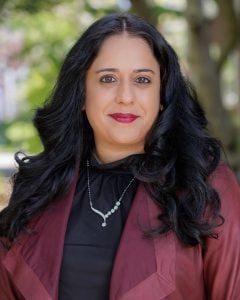
We welcome back Rupal Gadhia, Managing Director of MBA Admissions and Financial Aid at Harvard Business School, for our ongoing Admissions Director Q&A series.
Gadhia graduated with an MBA from Harvard Business School in 2004. Her post-HBS career began in brand management with Sara Lee and Campbell Soup Company, followed by a move to Booz & Co. as a management consultant. Leveraging her passion for brand and consulting, she joined the Brand Union, managing North American strategy and research for consumer and corporate clients, and was recruited to Interbrand to lead the relationship for two of their largest clients.
In 2017, she was recruited to Genpact as a global vice president of brand and digital marketing and helped guide the company through a brand transformation, leading a global team made up of the creative, editorial, talent marketing, digital, social, and brand groups. In her most recent pre-HBS role, Gadhia was a senior vice president and global head of marketing for SharkNinja’s robots and home environment categories, where she focused on bringing new innovations to market. Gadhia re-joined HBS as Managing Director of MBA Admissions and Financial Aid in October 2023.
Keep reading for more information on the HBS MBA application process, tips on how to prepare for your interviews and write your most authentic essay, and Gadhia’s favorite aspects of life on campus.
Clear Admit: What is the one aspect of your program that you wish applicants knew more about?
Rupal Gadhia: HBS is making significant investments in artificial intelligence, leveraging it to enhance teaching and learning across the school. Initiatives include the introduction of a new course, Data Science and AI for Leaders, in the first-year Required Curriculum and the work of the Digital, Data, and Design Institute, which advances research and curriculum development in digital transformation and AI. We have also been encouraged by strong student engagement with our AI-powered tutor bot, designed to help students prepare for case discussions and reinforce key concepts.
Our students and alumni are actively shaping the AI landscape, founding and leading companies such as Daydream, Argus Systems, winner of our New Venture Competition, Summer Health, and Harvey AI. On the career front, HBS partners with many AI companies and brings high profile speakers to campus including Aravind Srinivas (Founder, Perplexity AI) and Xiao Hong (Founder, Manus AI). We’ve also seen a significant increase in graduates pursuing careers in AI product management, digital transformation, and data-driven strategy across industries.
Whether you are already on a technical path and looking to deepen your leadership abilities, or you’re hoping to pivot into a more tech-drive sector or role, HBS provides the curriculum, tools, and network to support your career goals.
CA: Walk us through the life of an application in your office from an operational standpoint. What happens between the time an applicant clicks “submit” and the time the committee offers a final decision?
RG: We have two application rounds – you can apply by September 3, 2025 (Round 1) or by January 5, 2026 (Round 2) to enroll in the fall of 2026. Once we reach the submission deadline for a given round, we begin our review.
After the round deadline, each application is thoroughly reviewed by at least two different members of the Admissions Board. During our reading period, our focus is on getting to know you as an applicant. We consider the application as a whole and look carefully at every aspect of your application, including your job history, resume, recommendations, academic background, and essays, to gain a comprehensive understanding of who you are.
The second part of the application process is an interview with a member of the Admissions Board. The interview helps us to learn more about you while using your application as the jumping off point for the conversation. I love this part of the process as we finally get to meet the person behind the application.
The last part of the process for the applicant is the Post-Interview Reflection. An honest, authentic approach to this written reflection works best.
Our Admissions Board will read the Post-Interview Reflection as we make a final decision on your candidacy. After that, we send final decisions to our applicants on the specified decision release date.
CA: How does your team approach the essay portion of the application specifically? What are you looking for as you read an essay? Are there common mistakes that applicants should try to avoid? What is one key thing they should keep in mind as they sit down to write?
RG: As it did last year, this year’s application will feature three essays. This year’s essay prompts are:
- Business-Minded Essay: Please reflect on how your choices have influenced your career path and aspirations.
- Leadership-Focused Essay: What experiences have shaped how you invest in others and how you lead?
- Growth-Oriented Essay: Curiosity can be seen in many ways. Please share an example of how you have demonstrated curiosity and how that has influenced your growth.
The most helpful essays build on the rest of the written application and bring all the aspects of your application together. We know it can be tempting to write, rewrite, and rewrite again. Just be careful in all that refining that you don’t edit out your personality. Be authentic and be yourself!
CA: Could you tell us about your interview process? Approximately how many applicants do you interview? Who conducts the interview and what is the nature of the interview? Will your admissions interviews be in-person or virtual for the 2025-2026 admissions season?
RG: The interview is our way to get to know you better. Interview invitations typically come about four to six weeks after the application deadline. You will have the option to interview virtually, in-person on campus, or in-person in select cities.
One thing that is different in our interview process is that we do not use students, faculty, or alumni volunteers for our interviews. We have about two dozen individuals on our Interview Board who receive regular training, and each conduct many interviews. This helps us stay calibrated and consistent.
An HBS interview lasts 30 minutes. Because the interview is a conversation about you, there are no brain teasers, mental math problems, “case questions,” or anything like that. Although we may reference your resume in the interview, we try to go much deeper. We may dive into something you wrote in an essay, a short answer field, or something a recommender might have mentioned. Through this conversation, we hope to learn more about your experiences, leadership abilities, and the impact you hope to make through business.
CA: Is there anything in particular international students should keep in mind during the admissions process?
At HBS, international students make up over a third of the class, hail from over 60 countries, and are vital to our community and our mission. We hope that anyone who is interested in making a difference in the world will apply.
CA: What is your favorite spot on campus?
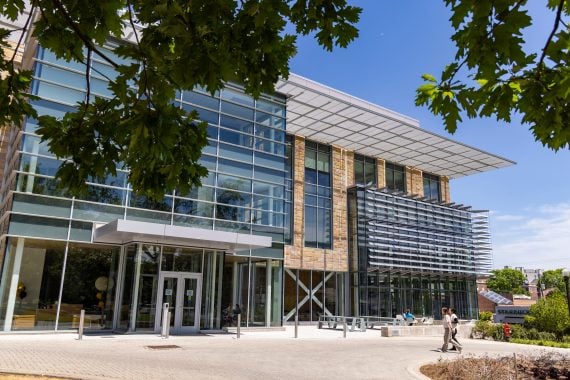
RG: Klarman Hall, our 1,000-seat auditorium, is my favorite spot on campus. Completed in 2019 it is one of our newest buildings and hosts thousands of students, faculty, staff, alumni, and other visitors who take part in the many campus activities each year – from the student-led HBS Show to the New Venture Competition. It is also where we first welcome our admitted students during our Admitted Students Welcome, my favorite event of the year!
CA: Is there anything else you’d like to highlight about your MBA program or admissions process?
RG: I’d love to highlight a few of our elective courses focused on technology and entrepreneurship. Our faculty have been hard at work incorporating more AI-focused offerings into the elective curriculum with topical cases in the evolving landscape. One example is Generative AI for Business Leaders, taught by Suraj Srinivasan. This course explores how generative AI is driving rapid change across industries, companies, and business functions. The course also includes hands-on practice to help students understand how the technology works and how to build applications. Whether you aspire to be a corporate innovator or a startup founder, this course is an excellent deep dive into the world of AI.
Two additional highly popular courses are The Founder Mindset, taught by Reza Satchu, and Founder Launch, co-taught by Reza Satchu and Shai Bernstein. The Founder Mindset examines the choices all founders face when starting a venture and provides the frameworks and practical tools for building, scaling, and eventually exiting the business. Throughout the semester, students analyze pivotal choices made by more than 20 funders who set out to change the world, and they even have the opportunity to deliver a pitch as part of their final project.
Founder Launch is designed to help a handpicked group of student founders successfully launch their ventures through milestone-driven execution, direct feedback from successful investors and peers, and a cohesive and supportive community. Students pitch their ideas to corporate leaders and investors, including Michelle Zatlyn (MBA 2009), founder of Cloudflare. Notably, all four of this year’s HBS New Venture Competition finalists came from the Founder Launch course, and several students have already raised funding.