


In this edition of our Admissions Director Q&A series, we hear from Lawrence Mur’ray, Executive Director of Admissions and Financial Aid at Dartmouth Tuck.
Before joining the Tuck School in August 2022, Lawrence served as the Senior Assistant Dean of Graduate Business Programs at Fordham University’s Gabelli School of Business, where he was responsible for strategic enrollment management for more than 15 graduate business programs.
Before his time at Gabelli, Lawrence spent more than ten years in MBA and undergraduate business program administration at UNC’s Kenan-Flagler Business School. Across these roles, Lawrence oversaw enrollment management, student engagement, academic services, global programs, and career and professional development. Lawrence also spent time at Indiana University’s Kelley School of Business and held several leadership roles in admissions and athletics at his alma mater, the University of Arizona. He has undergraduate degrees in psychology and political science and graduate degrees in business and public administration from the University of Arizona.
Lawrence and his husband split time between Hanover, NH, and NYC with their dog, Daisy. He enjoys sports and the outdoors, travel, live music, technology, reading, and spending time with friends and family.
As his teams manage admissions, recruiting, marketing, and financial aid, Lawrence has a wealth of insight into the admissions process and what to expect in the Tuck MBA program–all shared below.

Clear Admit: What is the one aspect of your program that you wish applicants knew more about?
Lawrence J. Mur’ray: I’m always surprised when applicants question if it’s possible to pursue bulge bracket banking or FAANG/Triple-A tech at the Tuck School. The numbers in our most recent employment report for the class of 2024 speak for themselves.
- 44% of the 2024 graduates pursued careers in consulting, which includes strong MBB (McKinsey, Bain, and Boston Consulting Group) representation with a median starting salary of $190,000 and a $30,000 signing bonus.
- 24% of the 2024 graduates pursued careers in financial services (including, but not limited to, investment banking, investment management, private equity, venture capital, and fintech) with a median starting salary of $175,000 and a $50,000 signing bonus.
- 10% of the 2024 graduates pursued tech careers with a median starting salary of $147,500 and a signing bonus of $35,000.
In addition to having highly active student clubs and organizations associated with these career paths, our centers provide students with the opportunity to engage on a deeper level at the intersection of research/theory, practice/application, and professional development.
CA: Walk us through the life of an application in your office from an operational standpoint. What happens between the time an applicant clicks “submit” and the time the committee offers a final decision?
LJM: Once applicants hit submit, their application gets randomly assigned to one of our admissions committee members. I say randomly because we want this to be fair—no one’s getting an advantage based on who reads their file first. And here’s something important: every single application gets a full read. Doesn’t matter what their GMAT score is, what their GPA looks like, or where they work. We’re reading the whole thing.
We actually do the first read before we have any interview information. Why? It gives us more flexibility with the interview timeline. During this first review, the committee member is evaluating everything, making a preliminary recommendation, and deciding whether the applicant will get an interview invitation. We send those invitations out on a rolling basis.
Once interviews are done, we assign a second reader—again, from our admissions committee. If applicants didn’t get an interview, their application goes straight to our director of evaluation for final review. If additional consideration is warranted, the director may call for an interview, a third read, a supplementary English evaluation, or additional input from Tuck colleagues. Otherwise, they review the application and make an admissions decision. For guaranteed interviews, we hold the application until we get the interview evaluation back, then it goes through the same process.
Then everything comes to our full committee for final decisions. What people might not realize is that we actually do this in two stages. First, we’re looking at admissibility. Then, in a completely separate session, we review admitted candidates for merit scholarships.
The whole thing is designed so everyone gets multiple sets of eyes on their application. That’s what holistic review means to us.
CA: How does your team approach the essay portion of the application specifically? What are you looking for as you read an essay? Are there common mistakes that applicants should try to avoid? What is one key thing they should keep in mind as they sit down to write?
LJM: Our essays are designed around our four admissions criteria—smart, accomplished, aware, and encouraging. What we’ve done is frame each prompt so it connects directly to one of these qualities, then we ask the specific question. When we’re reading essays, we’re looking for three main things: authenticity, which means it feels honest and personal; clear thinking; and concision. This is where applicants get to show us who they are in their own words.
Now, basic stuff—yes, applicants need to proofread! Grammar mistakes, typos, and especially mentioning other schools by name… these things happen more than you’d think, and they’re completely avoidable.
Something we need to talk about with AI becoming so prevalent: we expect applicants to write their own essays. Their ideas, their experiences, their voice—that all needs to come from them. Can AI help them brainstorm or catch errors? Sure. But the heart of what they’re saying has to be authentically theirs. We can tell when something doesn’t sound genuine or when it doesn’t match up with the rest of their application.
The biggest piece of advice I’d give anyone sitting down to write is to just be themselves. Don’t try to guess what we want to hear. Tell us their real story, share their actual perspective. That’s how we get to know who they are and what they’d bring to our community.
CA: Could you tell us about your interview process? Approximately how many applicants do you interview? Who conducts the interview and what is the nature of the interview? Will your admissions interviews be in-person or virtual for the 2025-2026 admissions season?
LJM: The interview is the applicant’s chance to show us those four criteria we keep talking about but this time in conversation. It gives us more insight into who they are, what they’ve done, where they’re headed, and how they plan to get there. Here’s the thing: everyone we admit will have interviewed. No exceptions.
There are two ways applicants can get an interview. If they’re applying Round 1 and get their complete application in by early September, or in Round 2 and submit by early December, they’re guaranteed an interview. For all other applicants, interviews are by invitation only after we review their application and decide an interview would help us understand them better.
How many people do we interview? It depends on the year—the size of the pool, the strength of the candidates. We try to interview as many viable applicants as possible, though it’s still a selective process where we’re making strategic decisions about who to invite.
Most interviews are conducted by our second-year students—we call them Tuck Admissions Associates, or TAAs. They’re specially trained for this, and they’re fantastic at it. The interview runs about 30 to 45 minutes, and what’s interesting is that interviewers only have the applicant’s resume. That’s it. They’re asking behavioral questions to get applicants to show them evidence of being smart, accomplished, aware, and encouraging. At the end, applicants get to flip it around and ask the interviewer about their experience.
Applicants can choose between in-person or virtual interviews—whatever works better for them. We value both formats equally. If they choose in-person, they can do that during our comprehensive campus visit program.
CA: Is there anything in particular international students should keep in mind during the admissions process?
LJM: International students are absolutely vital to our community at Tuck. From an admissions standpoint, they go through the exact same process as domestic students—same criteria, same standards, same application. We’re evaluating everyone on being smart, accomplished, aware, and encouraging.
What’s important for international applicants to remember is that being international isn’t something they need to overcome in our process. It’s something that adds tremendous value to our community. We’re actively looking for the global perspective and diverse experiences that international students bring. That’s part of what makes our program stronger and enriches the experience for everyone.
CA: What is your favorite spot on campus?
LJM: There’s this perfect spot just in front of Buchanan Hall where I love to sit on the grass. It’s one of those places where you can see the full scope of what Dartmouth is all about.
When I look to my left, up Tuck Mall, I see Baker-Berry Library—this iconic building that represents the history and tradition of the institution. It’s been the heart of academic life here for generations, and seeing that continuity is powerful.
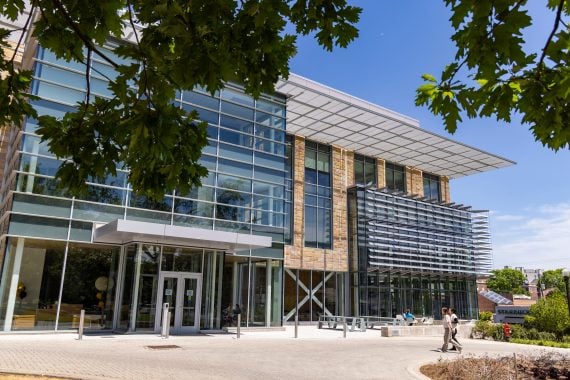
But then when I glance to my right, that’s where it gets really interesting. You see this incredible intersection of our historical foundations and our future. There’s the Tuck School, where we’re preparing the next generation of business leaders. Right next to it is Thayer School of Engineering, where students are tackling everything from sustainable technology to cutting-edge research. And sitting in between Thayer and Tuck is the Irving Institute for Energy and Society—one of the newest additions to campus where faculty and students from across disciplines are working together on energy transition research, climate solutions, and building a more sustainable energy future. It’s designed as a “programmatic mixing valve” that brings together students and faculty from both schools to participate in shared research.
Sitting there, I can see the span of Dartmouth’s commitment to excellence—from preserving our rich academic traditions to pushing the boundaries of what’s possible in business, engineering, and the critical work of addressing our world’s energy challenges. It’s this perfect reminder of why this place is so special and how our students get such an incredible education here.
CA: Is there anything else you’d like to highlight about your MBA program or admissions process?
LJM: There are two things I want to make sure people know about.
First is our approach to leadership development. Leadership has always been central to what we do at Tuck and it’s not just about taking a class or two. We’ve built it into everything—academics, experiences outside the classroom, and time for real reflection on how students are growing as leaders. The goal is simple: when students graduate from Tuck, they’re ready to take on the responsibilities that come with being wise leaders.
It starts from day one with our integrated core curriculum. First-year students get a powerful experience early in their MBA experience where they compare and contrast how they view themselves with how others see them. That self-awareness becomes the foundation for their leadership development plan, and they have access to individualized coaching to support it. We’ve got tons of elective courses on leadership, too, plus all kinds of activities beyond the classroom that help students develop things like confident humility—knowing what they know and what they don’t—empathy for different perspectives, and judgment about when and how to take risks.
But by doing is how students really learn leadership. Our experiential learning programs are incredible for teamwork, problem-solving, and leadership development. Study groups from day one build those skills and help students appreciate diverse perspectives. First-Year Projects have students applying what they’re learning to real business challenges for actual clients. Global Insight Expeditions take students abroad to see how business works in different parts of the world. These experiences don’t just teach them—they accelerate their whole leadership trajectory.
The second thing I’d like to highlight is: we have so many ways for candidates to experience Tuck firsthand. We offer a wide variety of opportunities for applicants to visit campus and see the Tuck experience up close. Can’t make it to Hanover? We’ll meet candidates when we’re in their neck of the woods at one of our many travel events. And if neither of those work, we’ve got a large number of virtual engagement opportunities too. The point is, we want candidates to get to know us in whatever way works best for them.