

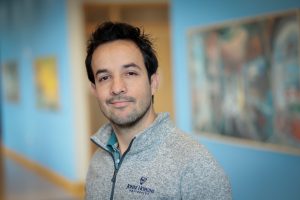
Juan Fernandez, Johns Hopkins Carey MBA Class of 2027
Age: 39
Hometown: Medellin, Colombia
Undergraduate Institution and Major: Universidad de Antioquia, Biomedical engineering.
Pre-MBA Work Experience: Field engineer, Medical devices, G. Barco S.A, 2008-2012; Founder CEO, Medical devices, Bioin Soluciones, 2012 – 2020; Head of Innovation, Medical devices, Bimedco, 2020 – 2023; Founder CEO, Medical devices, SmartTIVA Inc, 2023 – Present
Why did you make the decision to attend business school? Why now?
When I arrived in the United States, I realized that my company was already at an advanced stage of technological development. We had achieved many of the validations that other startups in the ecosystem were only beginning to plan for. But at the same time, we had no network or meaningful connections here and our plan was not fully tailored to the US market. That’s why we decided to enter the Johns Hopkins ecosystem and begin participating in accelerators and entrepreneurship programs. During this period, I saw that while our products were highly advanced, our business model was not at the same level. I knew I needed a formal business education to bring our strategy, structure, and execution up to par with the progress we had already achieved on the technological side.
Through those experiences at JHU, I had the opportunity to connect with the Carey Business School, including one of their executive education programs hosted there (the i4SUD). That was the turning point for me. The access to top scientific and academic support, combined with an emphasis on practical, interactive learning, was exactly what I needed.
Why did you choose Johns Hopkins Carey Business School? What factors figured most prominently into your decision of where to attend?
I chose Johns Hopkins Carey Business School because of its unique positioning at the intersection of healthcare, business, and technology. The school provides specialized training in healthcare management, Hospitals systems will be my future clients and I need to understand how they work. At the same time, Carey’s close integration with Johns Hopkins Medicine gives me access to one of the strongest clinical research networks in the world. That proximity makes it possible to validate products and conduct clinical studies backed by the university’s global reputation in biomedical engineering and healthcare. The addition of the new AI for Business certification within the MBA further strengthens the program’s relevance, aligning directly with the technological challenges and opportunities shaping the future of healthcare.
What do you think is your most valuable or differentiating contribution to the Class of 2027?
My direct experience taking medical technology from idea to market. Over the past ten years, I have navigated the full cycle of innovation: securing patents both in Colombia and the United States, preparing regulatory submissions to the FDA and INVIMA, and running customer discovery and real-world validations. In Colombia, our products are already in daily use with real patients in operating rooms, which has given me a practical understanding of how technology must adapt to complex clinical settings and how complex the cash cycles are in the healthcare sector.
This background allows me to contribute to class projects not only with knowledge from the course material but also by bringing in the challenges, constraints, and problem-solving approaches that come with launching and scaling in the real world. I can help bridge the gap between academic exercises and the realities of business execution, offering insights grounded in regulatory hurdles, customer adoption, and clinical implementation.
Tell us a fun fact about yourself that wasn’t included on your application:
I also have 2 kids, one is 3 years old, and the other one is 5 months. This poses an additional challenge and restrains on time, but also my biggest driver and motivation to keep pushing. For those who don’t have kids, this is indeed a fun fact!! I do have fun making Lego castles and playing in splash parks.
Post-MBA career interests:
Raise funds, keep growing the business, bring our technologies to the market, incorporate in Maryland, and keep my connections to Johns Hopkins. But most importantly: Keep creating.
Advice for Current Prospective Applicants:
–What is one thing you would absolutely do again as part of your application process?
Showing my drive, not being afraid to show my passion. Network my way into the school. I attended as many events as I could before applying, I knew the admissions crew beforehand, and this brought me a different level of confidence and familiarity to the interview.
–What is one thing you would change or do differently?
In this particular application, nothing. It was a well-executed plan. I would’ve attended more of the in-person events, if I had the time to do it. (I attended several, but could’ve been more)
–What is one part you would have skipped if you could—and what helped you get through it?
Skip the hesitation. If the opportunity feels good, go for it. I say this because every single part of this process felt right for me, made sense from every angle, I was the first officially enrolled student of my cohort, and even so, there was a little bit of hesitation at some point, It might be human nature, but I’d try to skip it.
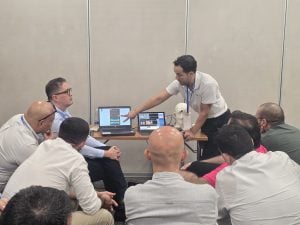 What is your initial impression of the Johns Hopkins Carey students/culture/community?
It is a driven community with a diverse set of skills. I enjoy running into classmates in the hallways who come from healthcare management, others with more than ten years of marketing experience, as well as lawyers, physicians, scientists, and real estate professionals. This diversity makes every conversation and every group project not only strong in perspective, but also unique and engaging.
What student organizations have you joined/are you hoping to join and why?
ALPFA (Association of Latino Professionals for America) at JHU. Anesthesiology study groups at JH medicine. Summer incubator at the PAVA center for entrepreneurship. VMP (Venture Mentorship Program) at JHTV. I4SUD innovations for substance use disorders at Carey.
Not all these are necessarily student-led but show the diverse set of options we as students have here.
What is one thing you have learned about Johns Hopkins Carey that has surprised you?
The quality of the professors and their relevance in the public opinion. The same person that is teaching you about a balance sheet structure will be talking to the president at a White House hearing the next week (this example is a true story, but it is also the theme).
What is one thing you are most excited about in your first year?
I am most excited about knowing my classmates and building a strong brand within my cohort. I don’t just want to collaborate with them in class. I hope to bring some of them into my company as interns, work together on fundraising, and connect with the Baltimore entrepreneurship ecosystem while expanding our network. My goal for the first year is to register and headquarter the company close to campus and create our own version of a summer internship right at the school’s center, with faculty serving as consultants and the Johns Hopkins network as a bridge to investors. It will require additional funding and overcoming some barriers, but with non-dilutive funding already in motion, I believe it is possible. It sounds like a fun dream, but a dream worth chasing.