

Javier Rodriguez Del Campo took a leap moving to Boston with no network and entering Harvard Business School to earn an MBA alongside highly driven peers. But the environment built his confidence, and made him more comfortable operating in ambiguity. In this Real Humans: Alumni, Del Campo explains why he pursued an MBA to increase his market value and open him up to wider roles in more industries worldwide, and how HBS prepared him for his role at Amazon.
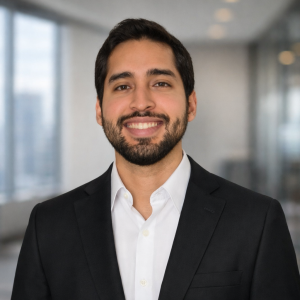
Javier Rodriguez Del Campo, HBS MBA ’24 Senior Product Manager at Amazon
Age: 30
Hometown: Arequipa, Peru
Undergraduate Institution and Major: Universidad de Lima, Industrial Engineering
Pre-MBA Work Experience: 3 years in McKinsey & Company, 2 years in startups (Payments, e-commerce, and Healthcare)
Post-MBA Work Experience: 2 years in Amazon, Tech & Logistics
Why did you choose to attend business school?
Having been exposed to many MBAs while at McKinsey, I knew an MBA would increase my market value and open up opportunities beyond Latin America and beyond roles that typically recruit heavily from consulting backgrounds (like strategy)—including more operational, technical, and execution-focused roles. I also wanted to broaden my network across industries and better understand the full spectrum of career options—not just expand the paths available to me but learn directly from people in different industries and from their experiences. Finally, I felt an MBA was the best way to dedicate time to exploring entrepreneurship and applied AI in a practical way while advancing my career.
Why HBS? What factors figured most prominently into your decision of where to attend?
I chose HBS for the community, entrepreneurial ecosystem, and geography. First, the alumni network and global footprint—especially in Latin America—were exceptional. I had worked with several alumni and came away thinking they were great people: humble, generous with their time, genuinely curious, and always eager to keep learning. Second, HBS has an unusually strong entrepreneurship ecosystem, with a high concentration of founders, operators, and investors. Being in the Cambridge/Boston area also meant proximity to the broader innovation community across Harvard and MIT, including the ability to take courses that strengthened my toolkit in analytics, innovation, and modern operations. Finally, an important factor was that my wife and I wanted to prioritize living in the Northeast, where we would have more options to continue our careers after graduation.
What about your MBA experience prepared you for your current career?
Academically, I gained broader perspective across industries and strengthened some technical skills. Beyond that, some classes with emphasis on “founder mindset” and leadership reshaped how I think about ownership and committing to long-term goals. Negotiation and other hands-on, “learn-by-doing” projects were consistently useful as well. Personally, the biggest value came from my classmates. Learning from people with different backgrounds and risk appetites—especially those building in tech and entrepreneurship—expanded my thinking. It was also a soft landing into the U.S. corporate environment: working closely with such a diverse group of peers helped me build stronger relationship skills, collaborate across different styles, and become more effective at navigating new teams and cultures.
How do you feel that your MBA has been an asset when it comes to navigating new challenges, such as AI?
The MBA experience involved a lot of change and uncertainty—moving to Boston, starting a network from zero, building a community, and going through classes and recruiting alongside highly driven peers. That environment definitely made me more comfortable operating in ambiguity and helped me build confidence navigating new situations.
On AI specifically, I already had significant experience in advanced analytics and applied AI (machine learning), so I entered with strong context. But during my second year, the “second wave” of AI—especially the momentum around OpenAI—accelerated quickly, and what helped me most was again the community: conversations with classmates building AI products and discussions with professors about where AI creates real business value versus hype.
What was your internship during business school? How did that inform your post-MBA career choice?
I interned at Sevi Health, and it was an great experience. It sat at the intersection of healthcare and technology—building a tech-enabled operating model and supporting growth through M&A in primary care. What stood out most was how mission-driven it felt: the goal wasn’t only economic outcomes, but also genuinely improving people’s lives through better healthcare. It clarified something important for me: I’m happiest when my work has an entrepreneurial feel—building, iterating, and owning outcomes—whether inside a startup or within a larger organization and were I have a real impact on people wellbeing.
Why did you choose your current company? What factors figured most prominently into your decision of where to work?
I chose Amazon because it offered a rare combination: the chance to be entrepreneurial inside a large company. My department was (and still is) being built, which creates real ownership, freedom to execute, and plenty of opportunity. The second factor was scale—you can generate meaningful impact quickly. And at the time, being based in Boston also mattered because it allowed me to stay close to my wife.
 Advice to current MBA students:
–One thing you would absolutely do again as part of the job search?
Over-prepare. Recruiting in the U.S. is extremely competitive, and companies expect you to understand their process and what “great” looks like before you even get the interview invite. Preparing only after you’re invited is usually too late. There are ton of resources to leverage and people who can help you through this process.
–One thing you would change or do differently as part of the job search?
I would ask for help earlier and more often. Many people genuinely want to support you—second-years, alumni, and classmates—and I was slower than I should’ve been to leverage that guidance.
–Were there any surprises regarding your current employer’s recruiting process?
Not really. The process was structured and transparent, and because of the company’s scale there are many resources that outline expectations clearly.
–What piece of advice do you wish you had been given during your MBA?
Plan ahead. The MBA is a great time to explore, but opportunities don’t appear automatically. Timelines move fast, so you need to start early—on recruiting, relationships, and any “extra” goals you care about—because momentum compounds quickly. I would recommend to have an attack plan even before starting classes with key milestones to reach based on recruiting deadlines.