




David Brown, Cornell Johnson MBA Class of 2028
Age: Cornell SC Johnson College of Business
Hometown: Aurora, IL
Undergraduate Institution and Major: The United States Military Academy – International Relations and Spanish
Pre-MBA Work Experience: US Army Intelligence Officer, 10 Years
Why did you make the decision to attend business school? Why now?
After active duty, I was ready to translate my skills toward a different way of service, and business school was the clearest path to do so deliberately.
In the military, I diagnosed organizational structures to find vulnerabilities and make decisions on allocating resources under uncertainty. I want to transition my experience to measuring business value from two sides: equity, how value is created and captured, and operations, how value is protected and scaled daily. The MBA is how I’m closing that gap and turning my training into fluent business judgment.
Leaving active duty was a natural inflection point. Rather than drifting into the next role, the MBA enables a deliberate transition where I develop skills and a network of mentors and peers to keep learning from long after school.
Why did you choose Cornell? What factors figured most prominently into your decision of where to attend?
I gravitated to Cornell’s practical investment in students.
As an intelligence officer, I was always considering my teams, our stakeholders, adversaries, equipment, and messaging. Every facet needed to align to help commanders understand ambiguous situations and lead effective operations, and it took a lot of repetitions to do it well. Becoming a business leader who optimizes processes and allocates resources requires that same grasp of intricacies across leadership and economic principles, and Cornell provides comprehensive programming to practically integrate the theory and application of these ideas.
Resources like my Roy H. Park Fellows cohort, core team, and semester immersion are already giving me immediate feedback on applying classroom principles to business situations.
And last spring, before I arrived at campus, the Career Management Center and fellow students coached me on developing my pitch and resume to land several pre-MBA externships; a true pre-matriculation ROI that validated my choice.
What do you think is your most valuable or differentiating contribution to the Class of 2028?
My ability to read organizations and connect with the people inside them, quickly and authentically.
Over the past decade, I moved seven times to lead new military organizations, each with its own culture, incentives, and unwritten rules. I learned to read a room fast: who holds influence, what the team actually values versus what’s stated on paper, and how to earn trust for leadership capital.
I bring that same curiosity and speed to Cornell. I look forward to reaching across mentor networks, clubs, and backgrounds early, because it’s strategic and how I’ve learned to navigate people and organizations. My contribution will be enhancing Johnson’s collaboration to help my classmates and me successfully navigate the MBA together.
Tell us a fun fact about yourself that didn’t get included on your application:
My First job was scooping ice cream at an Oberweis Ice Cream shop while I was in high school.
Post-MBA career interests:
Consulting and Asset Management
Advice for Current Prospective Applicants:
–What is one thing you would absolutely do again as part of your application process?
Visit schools. School strategies, classrooms, programming, and cultures are vastly different in person, even though their goals and processes look similar on the websites. Gaining first person perspective made my application and acceptance decisions much more informed.
–What is one thing you would change or do differently?
Explore industries more deeply before applying. There’s so much opportunity out there, and the MBA is a great way to position yourself to access it, but you need a grasp on which directions to explore going in. Also, the months just before school starts are a perfect window for companies to notice your potential and invite you to see how they work, so gain awareness of these opportunities and how they align to your background early so that you can maximize your experience.
–What is one part you would have skipped if you could—and what helped you get through it?
Honestly, nothing. Though the MBA application is far from a convenient process, every step is informative and loosely mirrors recruiting for post-MBA jobs. The hardest part is learning the nuances: the timing tricks on the test, how to tailor questions to gain insights on information calls, and how to answer essay prompts both directly and through explaining your lived experience. Those lessons kept me up late on many nights during applications, and recruiting is showing me how important they remain after the application.
 What is your initial impression of the Cornell students/culture/community?
Community driven and deeply integrated.
I had a warm welcome from my admissions interviewer, Abdul-wahab Alahi ‘26, his classmates, and the alumni speakers from the acceptance series. As I bring up these names to my classmates and faculty, it’s amazing to see how many other people know their stories. It says a lot about how tight knit this network really is.
Additionally, Ithaca isn’t a large city, but the cohort makes the most of what’s here. I’ve found common ground with classmates and faculty around the gyms nearby. A few of us recently tried a hot yoga studio together, and we’ve ended up connecting on hiking trails and at get-togethers; sometimes all in the same day.
What student organizations have you joined/are you hoping to join and why?
Mentorship has been crucial to my transition from the Army to graduate school and business opportunities. This past year I joined American Corporate Partners and the Veterans Coaching Project to earn my Project Management Professional certification and gain clarity on applying my experience to the next phase of my career.
I’m looking forward to continuing to learn about post-MBA opportunities through the new Johnson Structured Mentorship Program. I want to work with Johnson alumni to understand how they pursued their short-term goals while strategically learning new skills and building foundations for lasting careers.
What is one thing you have learned about Cornell that has surprised you?
The structured intensity.
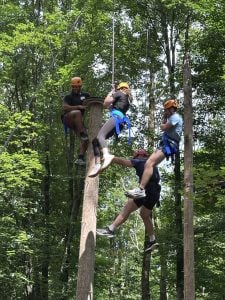
Johnson spent two weeks orienting my class to the MBA program and to each other before grouping us into teams, having us navigate obstacles, and pitching business ideas together. As we worked, we also took classes on leading teams and managing ourselves through conflict. It refreshed a lot of experiences I’ve had over the years, and it set a great tone that put everyone on equal footing from day one as we entered the semester together. Now that the semester has started, this same focus is throughout the curriculum that instills basic business principles into us before giving us tailored internship immersions to finish out the year.
What is one thing you are most excited about in your first year?
I’m excited to grow alongside my classmates. I’ve gained a lot of experience working with teams across Army analysis and recruiting units, and I’m curious how new lessons and new peers will reshape how I understand my past and chart the future.
It’s such a unique privilege to navigate new academic and professional endeavors alongside such a diverse cohort, and it’s enticing to work through case studies and recruiting prep with classmates who are figuring out their own next steps too.
Watching how differently we each interpret the same cases or lessons and channel them into success for completely different goals will be one of the best parts of the year.