



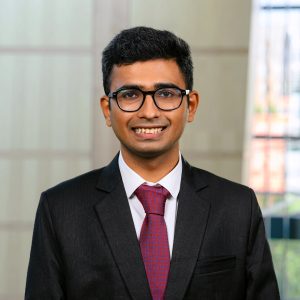
Khush Trivedi, Georgetown McDonough MBA Class of 2028
Age: 25
Hometown: Mumbai, India
Undergraduate Institution and Major: Narsee Monjee College of Commerce and Economics, Financial Accounting
Pre-MBA Work Experience: Associate, Venture Capital, 4 years
Why did you make the decision to attend business school? Why now?
I decided to pursue an MBA because I reached a point in my career where I had strong execution skills in venture capital and investment banking, but I wanted the broader business toolkit, the network, and the credibility to move into a bigger role in finance and make a global impact through my work. Most of my deal experience was domestic, and I wanted to build the skills and exposure needed to work on cross-border, institutional, and global deals. Now felt like the right time because I had built enough of a track record to know exactly what I wanted to do next, and I wanted to make that move while I had the momentum and clarity to make the most of it.
Why did you choose Georgetown McDonough? What factors figured most prominently into your decision of where to attend?
With my learning goals in mind and my prior industry experience, I knew that Washington, D.C., a city at the center of major global economic and policy decisions and in close proximity to major financial hubs, was the place to be. From an investment banking perspective, Georgetown has a strong track record placing students on the Street, and the alumni network carries real weight during recruiting.
My conversations with faculty also shaped my decision. Speaking with Dean Paul and Dean Sudipta, I felt that Georgetown was a place where my experience in venture capital and startup fundraising could become genuinely valuable to the broader community, rather than just another line on a resume. That feeling was reinforced by Georgetown’s decision to make artificial intelligence a core part of the curriculum rather than an elective, which told me the school is thinking seriously about where business is headed.
Additionally, Georgetown’s commitment to Cura Personalis, care for the whole person, aligned with my personal values and was strongly showcased throughout my interactions with school representatives during the admissions process. I was also drawn to Georgetown’s strong focus on entrepreneurship, which felt like a natural extension of my own background.
Lastly, for anyone planning to attend business school, financing should always be a factor you consider. Among the schools I was fortunate to be choosing from, the Merit Scholarship I received from McDonough helped cement my decision.
What do you think is your most valuable or differentiating contribution to the Class of 2028?
I hope to contribute to my class with my experience across early-stage startups and fundraising in an emerging market. I carry a regional insight into how fundraising works in emerging markets, from the early days of cold emailing angel investors for a seed round to later rounds where development finance institutions get involved. I have seen both ends of that spectrum up close. Along the way I got comfortable with the reality of building something in a market where the playbook is still being written. This work found me early in my career, and it shaped how I think about risk, patience, and what it really takes to build in an emerging market. I would be glad to bring that perspective into conversations with my fellow Georgetown entrepreneurs.
Tell us a fun fact about yourself that didn’t get included on your application:
Among my friends, I am known as the designated power napper. Whether it’s a ten-minute break between deal calls or a quick recharge before a long night out, I somehow always end up falling asleep anywhere and waking up ready to go.
Post-MBA career interests:
My primary post-MBA goal is to move into investment banking, with a particular interest in technology and healthcare deals given my background in venture capital. I’m staying open as I learn more during recruiting.
Advice for Current Prospective Applicants:
–What is one thing you would absolutely do again as part of your application process?
I would absolutely do the video interview again the way I did it. It asked us to go beyond the resume and academics, writing our own script and recording ourselves, so it forced me to bring my true self forward rather than a polished, generic version of myself. I would also repeat the amount of time I spent talking to current students and alumni before I applied.
–What is one thing you would change or do differently?
I would start earlier. I was working full time in Mumbai through the process, so test preparation and essays were mostly squeezed into evenings and weekends. Giving myself a few more months of runway would have taken pressure off and left more room to refine both the essays and my interview preparation. One thing I got right was joining GMAT Club early. The platform was incredibly helpful, and I made friends there for life who ended up at business schools across the world. Having someone alongside you during prep makes a real difference, it reminds you that you are not doing this alone.
–What is one part you would have skipped if you could—and what helped you get through it?
If I could go back, I would skip the overanalyzing that went into my essays. It pushed me into a later application round than I needed. I understand the effort that goes into getting every word right, but at some point you have done the work, and you need to trust your gut and submit rather than second-guess yourself.
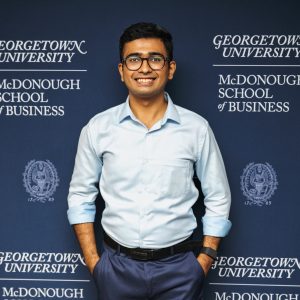 What is your initial impression of the Georgetown McDonough students/culture/community?
My first impression is that the community here lives the “Hoyas for Hoyas” spirit, students genuinely show up for each other, and that same warmth carries through from the admissions office to my day-to-day interactions across the university.
I have felt welcomed not just within McDonough but across Georgetown University more broadly. I have also noticed how heavily the university leans into entrepreneurship, which fits well with my own interests coming from a venture capital background.
What student organizations have you joined/are you hoping to join and why?
I’ve joined the Georgetown Finance Club and the Entrepreneurship and Venture Capital Club. Finance Club connects directly to my interest in investment banking, it gives me access to technical prep, recruiting events, and alumni in the space. I’ve always been connected to the entrepreneurship community and want to give back, so the Entrepreneurship and Venture Capital Club felt like a natural fit, and it also complements the Entrepreneurial Finance and Venture Capital elective I’m taking this term.
What is one thing you have learned about Georgetown McDonough that has surprised you?
One thing that surprised me about Georgetown McDonough is that the Ethics Project is not a one-time assignment but a year-long commitment that starts from day one. My team of six spent our first weeks weighing our own proposed ideas against a formal scorecard covering social impact, problem strength, business viability, and market demand, among other factors, before settling on a direction to pursue. I also did not expect that every team is given a real budget from the university to bring their idea to life, which made it clear this project is meant to be taken seriously rather than treated as a classroom exercise. That combination of structure and real resources told me Georgetown wants students to build an ethical mindset continuously, not just checking a box.
What is one thing you are most excited about in your first year?
I’m most excited about two things. First, the Executive Challenge at the end of Leadership Communication, a day-long role-play where alumni act as board members and executives, and you must navigate real difficult conversations with them under pressure. It’s a live test of influence, conflict, and decision-making skills rather than classroom theory. Second, I’m looking forward to AI for Leaders in Mod 2, since understanding how AI is reshaping leadership decisions and strategy feels essential for the kind of finance career I’m building toward. Together, they capture what excites me most about this program, pairing hands-on leadership skill-building with forward-looking, relevant coursework.