


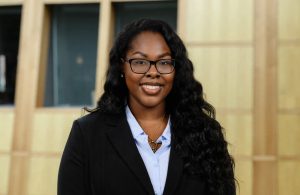
Ciara Terry, Georgetown McDonough MBA Class of 2028
Age: 25
Hometown: Baltimore, MD
Undergraduate Institution and Major: Spelman College, Political Science and Educational Studies Minor
Pre-MBA Work Experience: Pre-MBA experience, I served in varied public policy roles as an analyst in housing, education and social policy. I also was a consulting commercial strategy analyst at Deloitte and I served as a consumer insights manager at Suzy, providing qualitative insights for Fortune 500 companies within the last two years. Additionally, I am currently developing my own startup called Condolo, an AI bereavement marketplace to assist with end of life planning.
Why did you make the decision to attend business school? Why now?
My path to business school actually started back in 2019, during my sophomore year at Spelman College. Through conversations with alumni, I was exploring law school because I wanted to be a change agent in education policy and equity spaces. But several alumni gave me advice that stuck with me: if you don’t want to be in the courtroom, don’t pursue law school just to avoid being in the classroom. That reframed how I thought about my career. I didn’t want to be pigeonholed, and I leaned into following my own curiosity rather than a single prescribed ladder.
After graduating from Spelman in 2022, I built experience across industries and at this point in my life, I wanted to create impact.The real turning point came at the end of January, when my uncle passed away. In the midst of juggling several work projects, I stepped in to support my aunt, coordinating logistics and managing arrangements, including travel and lodging, down to sorting out Airbnb bookings, during one of the most vulnerable times in her life.
At the same time at work, I was working with the product team, providing feedback on our new offering and I had an “aha” moment. End-of-life arrangement is an enormous, emotionally loaded process, and people need faster, more convenient access to resources and support when they’re grieving, especially when they’ve lost a partner or someone very close to them.
That realization is what led me to start building Condolo. This past spring, I spent the time building, networking with founders and research development. After attending NYC Tech Week in June and pitching live in front of an audience, I recognized I couldn’t build this alone. I had a real gap in my business acumen that I needed to fill and I wanted to build this company the right way.
Georgetown McDonough became available to me at exactly that moment in June and I took it as an opportunity of a lifetime. For me, business school is twofold. It’s a way to build social capital, and it’s a way to see the world through a more nuanced business lens. My background is in the social sciences, so I already know how to advocate, think about governance, and generate insight, but I wanted to complement that with a deeper understanding of how businesses are formed, financed, governed and built for resiliency in the age of AI. That combination is exactly why I chose to pursue an MBA at Georgetown.
Why did you choose Georgetown McDonough? What factors figured most prominently into your decision of where to attend?
McDonough was the only school I applied to. I visited the campus when I was in high school and I loved it ever since. Even at that age, I could tell how successful and well-connected the alumni network was, how value-driven the institution was in its association with the Jesuit belief system and how it would complement me, a girl with big dreams and aspirations together.
Location was also a huge factor. DC has quietly been the central thread running through my entire career journey. My very first internship was on Capitol Hill. When I started at Deloitte, I was based in Tysons Corner. When I taught 7th grade World Studies and American Studies, I was in a part of Northeast DC. And now, coming back for business school is essentially my fourth chapter in this city, which feels fitting, especially since my initials happen to be CAT, and a cat has nine lives. DC has been central to my growth as a woman, a leader, an advocate, and now as a business owner and founder, so returning here for my MBA felt like coming full circle.
Beyond personal history and location, the curriculum was decisive. Georgetown recently updated its curriculum to emphasize a more intersectional view of AI with business, which felt invaluable given the current moment. Georgetown is already known for its focus on globalization and its large international student population, but what stood out to me is how deeply that internationalism is embedded directly into the classroom experience, not just present on campus, but built into how the material is taught.
I also valued that Georgetown is one of the few programs that bakes policy and governance directly into its business curriculum. My prior experience has been rooted in advocacy and governance, and I wanted a program where that background would be validated and built upon, not sidelined. When you think about the future of business, AI, and the workforce, you can’t ignore governance, regulatory frameworks, and social and environmental factors as core risk considerations. Georgetown’s willingness to weave that into the core curriculum, alongside its DC location and the personal connection I’ve had with the school since high school, were the biggest factors in my decision.
What do you think is your most valuable or differentiating contribution to the Class of 2028?
One of the most valuable things I bring to the Class of 2028 is that I’m an innate leader who is also, at my core, a connector. I genuinely love being the bridge between people and opportunities, whether that’s recruiting, mentorship, friendship or just helping people find the right room to be in. That leadership shows up as a bias toward action: I don’t take long to speak up or advocate for what’s right when I see something worth addressing. In a business context, there’s a difference between being pushy and being someone who inspires others to challenge themselves and act with intentionality. I fall firmly in the latter camp. For example, when classmates are weighing two different recruiting paths, I try to be a voice of reason around potential, intentionality, and timing.
I’m also big on fostering healthy competition, pushing people to bring their best selves into a room, whether that’s in the classroom or across different levels of industry. At the same time, I don’t need to be the person in power to lead. I take an active-listening approach: contributing ideas, but also making a point to notice when someone in a classroom or club organization isn’t speaking up, and making sure their voice gets included.
What really differentiates me is the breadth of my network and experience. Across my career, I’ve worked across consumer insights, governance, policy, finance, and marketing which gives me a fairly unparalleled, cross-functional view of how those pieces connect. I’ve also been active in the job market recently, which means I can offer real-time, current feedback on how people should position themselves for recruiters. Between that knowledge base, that network, and my instinct to encourage and actively listen to others, I see myself as a real resource for my classmates.
Tell us a fun fact about yourself that didn’t get included on your application:
I participated in the 2011 Cherry Blossom Festival in DC with the Black-Eyed Peas! It was my first year moving into Maryland and I was in the 5th grade. I danced and sang “I Got a Feeling” for several miles, which was so exhausting and fun!
Post-MBA career interests:
Post-MBA, my goals center on two spaces: venture capital and media and entertainment.
Media and entertainment is a space I have always wanted to explore and gain real experience in, specifically within streaming, at companies like Apple, HBO, Netflix, and Google. Given that streaming itself was one of the biggest disruptors of traditional TV in the 2010s, a shift that only accelerated during the pandemic. I want to contribute to the commercial strategy and direction of companies like these.
The other post-MBA path I am drawn to is venture capital, specifically at the early and pre-seed stage. As a founder myself, I would love to work on the diligence side of assessing new businesses, not chasing unicorns, but identifying companies that are genuinely positioned to grow and act as change agents. There is a lot of doomsday narrative around AI right now, but also a lot of noise, and I am interested in how VC firms and other funding vehicles discern signal from noise when disbursing capital. I am also motivated by the equity gap in this space: women receive only about 2 percent of venture capital funding, and Black women receive a fraction of a percent of that. Long term, I would like to build toward having my own fund, one that creates opportunities for women, people of color, and founders from nontraditional backgrounds who have ideas that can fix real consumer experiences, whether in healthcare or other legacy industries that have not seen meaningful innovation in a long time.
Advice for Current Prospective Applicants:
–What is one thing you would absolutely do again as part of your application process?
Doing a genuine, extended period of introspection before diving into the application. I spent a long time researching Georgetown’s curriculum, the specific coursework and classes I’d be able to take, and alumni outcomes, but just as importantly, I spent real time reflecting on what I wanted to do and what I could actually bring to Georgetown, not just what Georgetown could give me. I’d absolutely do that again, and I’d encourage other applicants to do the same. Don’t over-index on finding a clever “hook” for your essay or on obsessing over GRE/GMAT prep at the expense of everything else. Spend real time on the thesis of who you are and what you’re bringing to the university. That introspection is what actually made my application process worthwhile.
–What is one thing you would change or do differently?
Apply earlier. I got a bit of a Hail Mary blessing. I wasn’t in round 1, round 2, or round 3; I came in through rolling admissions. If I had applied earlier, I would have been able to structure my summer for preparation much better, and I also would have had more time to pursue external scholarship opportunities. My biggest takeaway is that it’s never too late to make the decision to apply to business school, and rolling admissions periods mean you can still apply as late as June depending on the school. That said, applying earlier gives you a real edge in qualifying for external scholarships and other support.
The other thing I’d do differently is connect with more institutions along the way. I only applied to Georgetown because it was truly my only choice, but even so, I wish I had talked to more alumni and current students at other schools for network building. I did speak with people at Duke, Emory, Stanford, and Wharton, but I’d have gone further in understanding the admissions trajectories at schools with rolling admissions, just to have a clearer sense of timing and options.
–What is one part you would have skipped if you could—and what helped you get through it?
If I could skip anything, it would be the imposter syndrome phase, that stretch of second-guessing whether I’d actually get in, and over-iterating on essays, documentation, and choosing recommenders instead of just executing on a plan I already had. That back-and-forth cost me time and, honestly, probably contributed to some early stumbles. My advice is to prepare seriously, but don’t let continuous self-doubt slow down execution.
What helped me get through it was recognizing where I could remove friction from the process. For example, I skipped the GRE/GMAT entirely by securing a test waiver, which saved significant time and stress. If you’re able to qualify for a waiver at your target school, especially if you’re applying in a later round, I’d recommend pursuing that. That said, if you think a strong GRE or GMAT score would actually strengthen your application and give admissions more context on you, it can be worth taking for that reason.
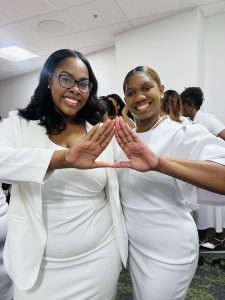 What is your initial impression of the Georgetown McDonough students/culture/community?
It’s been a great, eye-opening shock in the best way. Coming from an HBCU, I was used to diversity on campus, but experiencing that diversity from a truly international lens has been something new and really special, getting to hear live, firsthand experiences from classmates around the world. For example, I took a classmate who grew up in Panama to try a new chicken sandwich at Shake Shack. Being surrounded by people from Australia, Peru, Guatemala, and other places domestically I haven’t had the chance to visit has been genuinely cool.
One of my best initial impressions has been the sense of togetherness rather than over-the-top competition between groups. The culture actively speaks life into the idea that we’re going to get great employment outcomes by working together to get there, rather than against each other. I’ve also picked up a great lesson on networking, not just networking “up,” but genuinely focusing on yourself and your own growth. Other schools may say the same thing, but Georgetown has actually made that real for me. On top of that, people are genuinely willing to have candid conversations about the future, including the future of AI, the future of the workplace, analytics, and marketing, and there’s a real sense that people are preparing seriously for that future. Overall, my impression has been incredibly eye-opening, in the best possible way.
What student organizations have you joined/are you hoping to join and why?
So far, I’ve joined the Graduate Women in Business chapter, the Black MBA chapter, and the Venture Capital and Entrepreneurship chapter. I’m also hoping to get involved with some of the business centers, particularly one focused on retail. I had a lot of retail clients in my prior work, and I want to keep expanding my knowledge of segmentation and thought leadership through the white papers and work coming out of that center. I’m also looking at taking on more of a liaison or assistantship role with the Technology Club, since fostering connectivity around tech is something I care about.
Beyond the career-focused and affinity organizations, I’m planning to join a few fun clubs a bit later, after recruitment season settles down, likely around mid-October. I’m a former golfer, so the golf club is on my list, and I’d also like to join the wine club. My approach has been to prioritize the career and affinity organizations first, then layer in the social clubs once recruitment quiets down.
What is one thing you have learned about Georgetown McDonough that has surprised you?
The rigor of the coursework itself has genuinely surprised me. I love how case structuring pushes us to build analytical arguments backed by real statistics and measures. It’s not just high-level theory, it’s getting into the weeds in a way that will leave us truly prepared by the time we graduate in 2028.
What is one thing you are most excited about in your first year?
I’m excited to travel! My goal is to attend Black Ski Week in Utah at the end of January. MBA Spring Break in Colombia. As well, intern in the west coast in either Los Angeles or San Francisco.