


Sponsored Content
Artificial intelligence may be dominating headlines, but the bigger shift happening in business is about much more than AI. From generative AI and automation to machine learning, blockchain, and emerging digital platforms, technology is changing how organizations operate, compete, innovate, and create value.
For tomorrow’s business leaders, the challenge isn’t becoming a technologist. It’s knowing enough about technology to ask the right questions, recognize opportunities, make informed decisions, and lead organizations through constant change.
That’s why technology fluency is becoming an essential part of an MBA education.
At Emory University’s Goizueta Business School, technology is woven throughout the MBA experience. That foundation begins in the core curriculum with Technology Trends & Transformations, a course designed to help students understand emerging technologies and, more importantly, their strategic implications for business.
From Understanding Technology to Knowing What to Do With It
Technology Trends & Transformations takes a broad view of the forces reshaping business. Students explore frameworks for managing innovation alongside topics including generative AI, blockchain and decentralized finance, robotic process automation, and technology governance.
Rather than approaching these subjects as isolated technical concepts, the course asks students to consider a more consequential question: What does this technology mean for the way a business creates and captures value?
Through the course, students learn to:
- Understand the strategic role of digital technologies in creating sustainable business value.
- Identify, evaluate, and apply emerging technologies to real-world business scenarios.
- Analyze and anticipate technologies that could reshape traditional business models, while considering the ethical implications of those changes.
The course also reflects a reality that makes technology education particularly challenging: the technology itself won’t stand still. Content evolves as new technologies and trends emerge, with different Goizueta faculty members bringing specialized expertise to each topic.
The result is not a checklist of technologies that students are expected to memorize. It is a framework for thinking about whatever comes next.
And that foundation can be taken much further through electives that put students directly into the technology they are learning about—and challenge them to apply it to real business problems.
Building Enough Technical Fluency to Lead
In Data Management, Analytics, and Artificial Intelligence, students move from understanding AI and analytics to actually building with them. Taught by Associate Professor of Information Systems & Operations Management Rajiv Garg, the course feels more like a working product lab. Students learn SQL, Python, process automation, and agentic AI—and then use those tools to solve business problems.
“The managers who succeed in the AI era will be those who can reimagine how work gets done,” Garg says. “In this course, our students learn to see opportunities where others only see technology.”
That philosophy is reflected in the projects students build. Working in teams, students choose an industry, identify a problem, and develop a functioning prototype.
One team created CodeBlue IR, an AI-enabled clinical workflow assistant designed to capture real-time information during emergency cardiac events and generate structured, trackable notifications for healthcare professionals. Another developed Traider, a financial-market intelligence platform that uses machine-learning models, automated alerts, and real-time data to give individual investors access to sophisticated analytics. A third team built the Local Business Intelligence Assistant, an AI-powered system designed to give small-business owners access to forecasting, KPI dashboards, anomaly detection, and AI-generated explanations without requiring a dedicated analytics team.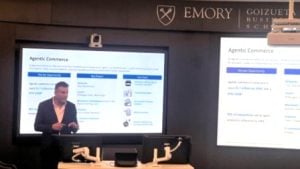
For students, the experience is as much about judgment as technology. They use generative AI to create and refine code, but they also test and audit its output, examine bias, and determine when automation is useful—and when human judgment matters more.
“The future of work will be built on human–AI collaboration,” Garg explains. “Managers who succeed will be the ones who understand both the power and the limitations of AI, and who stay curious about how this partnership can help innovate solutions and enable quicker decisions.”
That combination—technical fluency paired with critical thinking—is increasingly valuable across business functions. Students don’t need to become engineers. They need to be able to work effectively with the people, systems, and technologies shaping how their organizations operate.
Turning Innovation Into Business Value
Technology fluency also means understanding how to turn a proven innovation into business value. Can it solve a meaningful customer problem? Will people pay for it? What business model makes sense? And how can an organization turn a promising technology into sustainable growth?
Those are the questions at the center of Monetizing Innovations, an elective led by Associate Professor of Marketing Saloni Firasta Vastani.
The course combines marketing strategy, monetization frameworks, and entrepreneurial execution, giving students a framework for turning emerging technologies into viable business opportunities. Students work with frontier technologies while learning to assess market readiness, identify revenue streams, and develop go-to-market models.
The learning is grounded in real companies and real questions. Through live cases and client projects, students have explored monetization strategies for generative AI, software platforms, and agentic AI. MBA teams have examined how companies such as Waymo and OpenAI can use strategic pricing, data monetization, and ecosystem design to sustain innovation.
For Jamil Kassam 25MBA, a consultant at Bain, the opportunity to apply the course concepts made the experience particularly valuable. “I loved the opportunity to apply the different tools taught on a single company of my choosing throughout the semester,” he says. “Together with amazing guest speakers, this format helped me appreciate the nuance and complexity of selecting revenue models and pricing strategies.”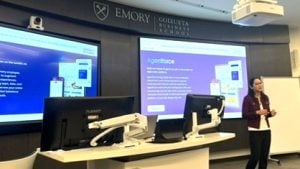
That real-world orientation extends beyond the classroom. The course partners with The Hatchery, Emory’s Center for Innovation, giving students exposure to venture creation and innovation management. Guest speakers from firms including BCG and Simon-Kucher also bring perspectives on how companies are developing forward-looking monetization strategies for an increasingly technology-driven economy.
The impact can extend beyond a single course. Mariana Stephens 25MBA, who came to the program with a background in global health, says the course showed her how innovation and monetization frameworks could be applied beyond traditional business contexts. The experience was significant enough that she pursued a directed study with Vastani the following semester.
Preparing for Roles That Haven’t Been Invented Yet
The combination of a broad technology foundation and opportunities to apply that knowledge reflects a larger shift in what organizations expect from business leaders.
A product leader needs to understand how AI can reshape the customer experience. A consultant needs to evaluate where automation can create an advantage. A marketing leader needs to understand how data and AI are changing personalization. A finance leader needs to assess the implications of new digital business models. An entrepreneur needs to recognize where emerging technology creates an opportunity before the market becomes crowded.
Technology is no longer confined to the IT function. It is increasingly intertwined with strategy, operations, marketing, finance, entrepreneurship, and organizational leadership. Goizueta has evolved its MBA curriculum accordingly, taking an increasingly interdisciplinary approach that challenges students to examine business problems from different functional perspectives and understand how those perspectives intersect.
That changes what it means to be “business ready.”
At Goizueta, students develop technology fluency not as an end in itself, but as part of becoming more capable business leaders. They learn to move between the worlds of technology and strategy—to understand what new tools can do, where they create meaningful value, what risks they introduce, and how organizations can put them to work.
Because the goal of an MBA education isn’t to prepare students for the jobs that exist today. It’s to prepare them to lead businesses through whatever comes next.