


In this Fridays from the Frontline, get an inside look at the all-important element of the MBA: the internship. Ahita Paul, Yale School of Management MBA ’26, shares her experience working at Boston Consulting Group. Read on for her story.
Internship Spotlight: Ahita Paul, Yale SOM MBA ’26, Boston Consulting Group
Ahita Paul ’26 drew on her SOM coursework to navigate a professional world that is rapidly changing with the rise of generative AI.
Internship: Boston Consulting Group, Washington, D.C.
Hometown: Calcutta, India
Pronouns: she/her/hers
The SOM classes you’re using on the job: Customer, Executive, Competitive Strategy, and (most often) Business Ethics
Go-to work lunch: A toss-up between Chang Chang and Momofuku’s tingly chili noodles, depending on the day’s mood. And I cannot recommend the BCG office barista enough!
After-work routine: Either out at happy hour or horizontal on a couch (depending on energy levels), sometimes debriefing the day with fellow interns.
Favorite thing about internship city: D.C. feels just right. It’s walkable, full of great food, and the buildings aren’t so tall that they block out the sky. It’s got energy without feeling overwhelming.
Before SOM, I worked at the intersection of product management and data science, building data tools for commercial banking sales teams. I thrived on the pace and problem-solving; but over time, I began to crave the bigger picture beyond how and why we build. I wanted to tackle the kind of problems that inform growth, positioning, and trade-offs. That curiosity led me to business school and then to consulting, where I could zoom out, think more strategically, and explore impact at a broader scale.
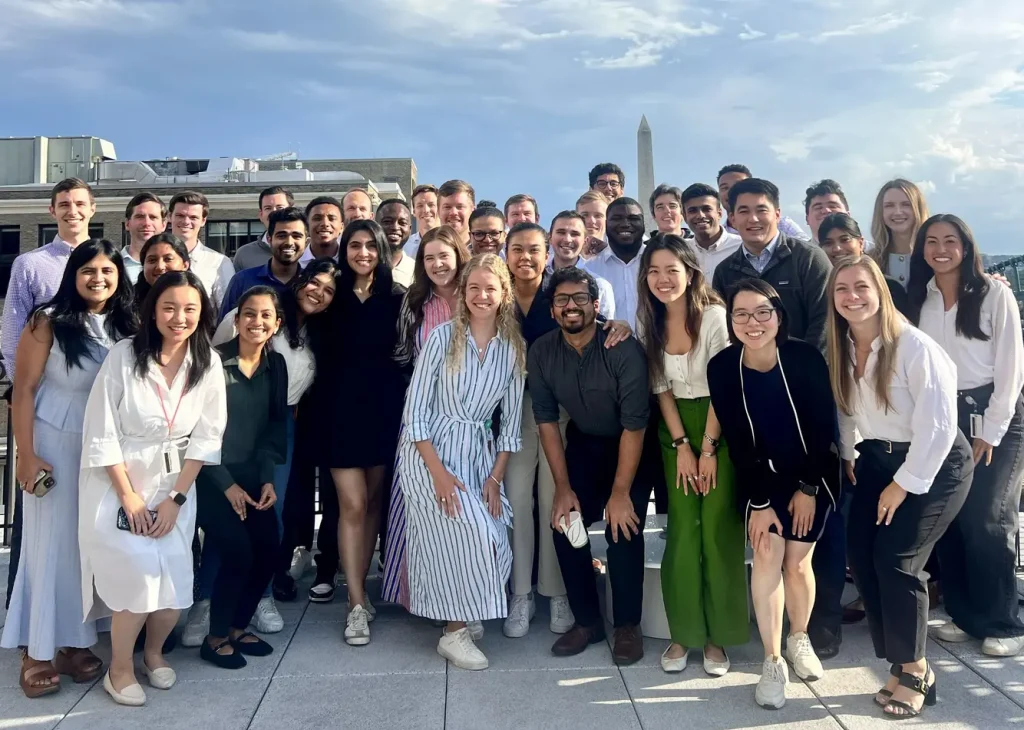
This summer, I joined BCG’s Washington, D.C., office as a digitally tagged consultant (someone with an expressed interest in exploring technology and digital projects) and worked on a go-to-market strategy transformation for a large B2B software company. The project was a great mix of familiar and new. I drew on my background in product management and tech while also learning about competitor benchmarking, technology ecosystem assessment, and application rationalization opportunities that allow clients to improve efficiency and better align systems with their growth agenda.
What stood out to me the most was how much our ways of working have already changed in just the past year that I’ve been in school and out of the workforce. With generative AI in the picture, everything feels faster, but also a bit more fragile. Gen AI tools can synthesize huge amounts of information quickly, but sometimes with subtle errors—a misplaced statistic, an assumption slipped in without support, or a polished recommendation that falls apart once tested against the client’s context. It’s been incredibly helpful for getting up to speed on new concepts, but we had to stay really intentional about quality, accuracy, and making sure we were still thinking critically. That’s where the lessons from the SOM course Business Ethics came in handy: the class taught me how to assess questions of ownership and responsible AI, and to ensure I wasn’t chasing outputs or outsourcing judgment.
Continue to read the full post here.