

The 2025 MBA employment reports reveal a striking divergence across top programs: Stanford GSB and Berkeley Haas posted double-digit increases from 2024 to 2025 in the share of MBA graduates accepting tech industry jobs with Berkeley Haas jumping 14 percentage points to 39% and Stanford GSB rising 13 percentage points to 35%, the largest tech share either program has reported in over seven years. While HBS and MIT Sloan notched modest gains, Northwestern Kellogg, Chicago Booth, and Yale SOM all moved in the other direction. What’s driving the gap?
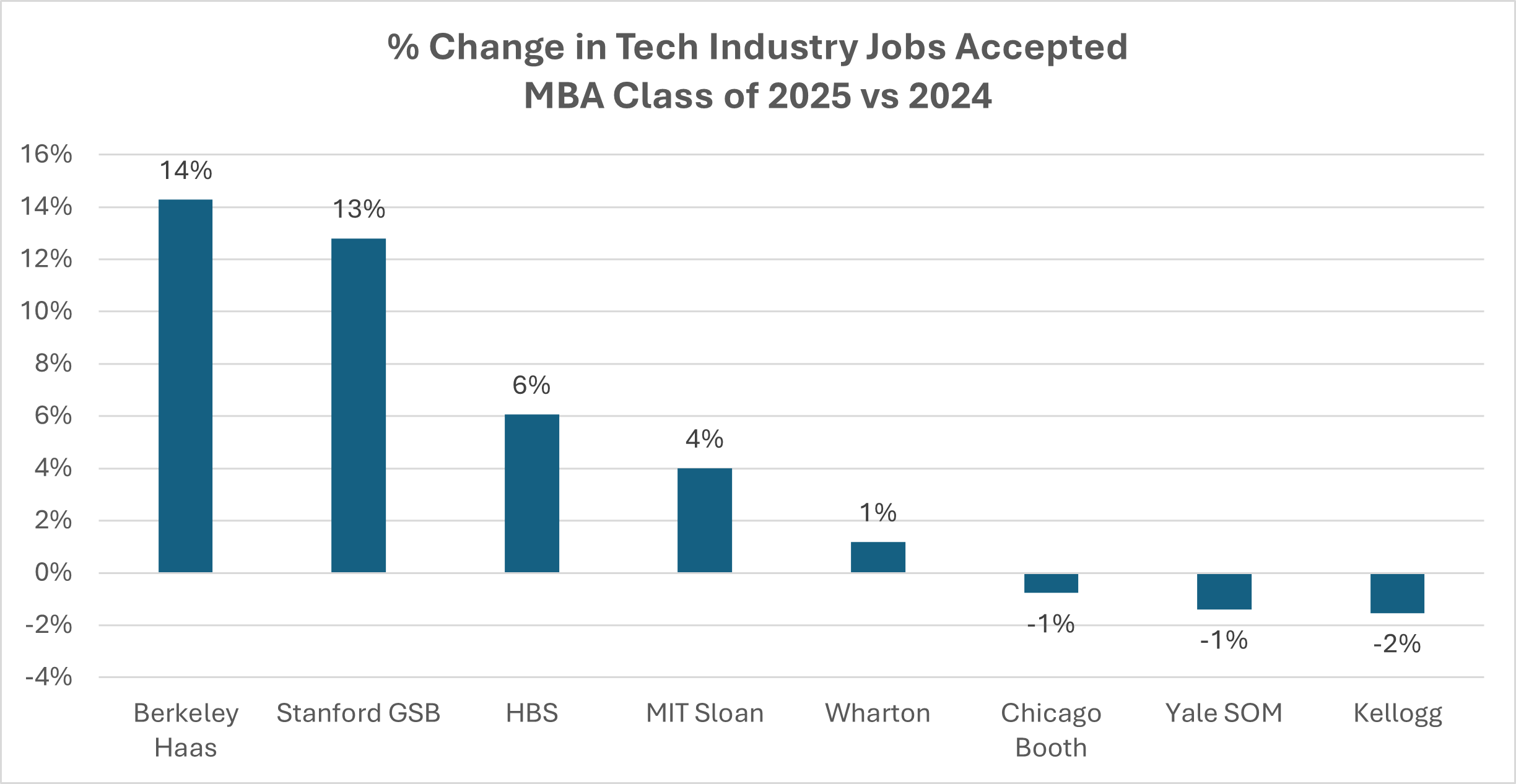
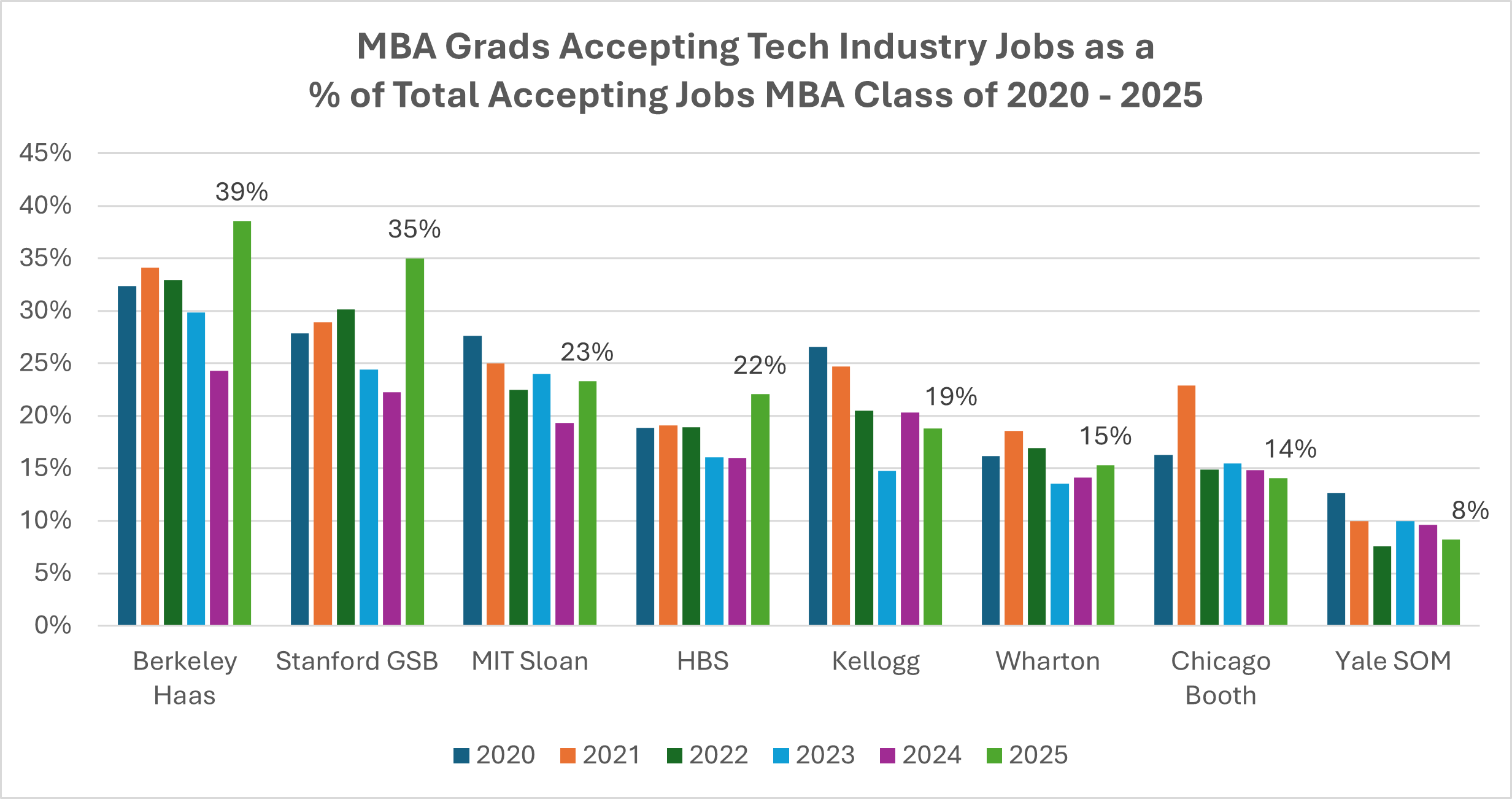
Stanford GSB’s career office pointed directly to AI hiring as the driver, noting in its MBA Class of 2025 employment report that, “There was a notable surge in graduates accepting opportunities in enterprise technology, fueled by hiring in AI-related organizations with roles in product management, go-to-market, customer success, and sales.”
The Bay Area AI Funding Boom of 2024
The underlying driver is a historic surge in venture capital flowing into Bay Area AI companies. According to Crunchbase, venture funding to U.S. companies in 2024 totaled $178 billion — around 57% of total global funding. Of all U.S. funding, $90 billion flowed into Bay Area companies, driven overwhelmingly by AI investing. Compare that with 2023, when Bay Area companies raised $59 billion — a 52% jump year over year. That large capital influx translated directly into headcount growth at AI startups across San Francisco, and MBA-friendly roles in product management, go-to-market, and customer success were among the first to be filled.
Why Bay Area schools outpaced the others
Geographic proximity gave Berkeley Haas and Stanford GSB a structural advantage that schools like HBS and MIT Sloan simply couldn’t replicate at the same scale. The AI startup funding boom that concentrated in the Bay Area in 2024 created a pull effect that disproportionately benefited Stanford GSB and Berkeley Haas because they are physically embedded in that ecosystem. Most of the new AI companies hiring MBAs — Anthropic, OpenAI, Scale AI, Perplexity, and others — are headquartered in San Francisco. MBA recruiting for venture backed startups is still heavily relationship and network-driven, and Bay Area companies naturally recruit most intensively at the business schools in their backyard. In addition, Stanford GSB and Haas have deep, embedded alumni networks inside these firms, giving their students a structural advantage in accessing roles that may never even be posted to broader recruiting platforms.
The 2024 AI boom was unusual in that it was concentrated in a handful of AI companies located in San Francisco. That concentration meant the spillover effects to non-Bay Area schools were limited. HBS and MIT Sloan caught some of it — Anthropic and OpenAI did recruit there — but at nowhere near the same intensity as at Stanford GSB and Berkeley Haas.
With Bay Area AI funding accelerating further in 2025, the more pressing question may be whether this represents a permanent reordering of MBA career outcomes or whether the rest of the field will catch up as AI hiring eventually spreads beyond a handful of San Francisco zip codes.