

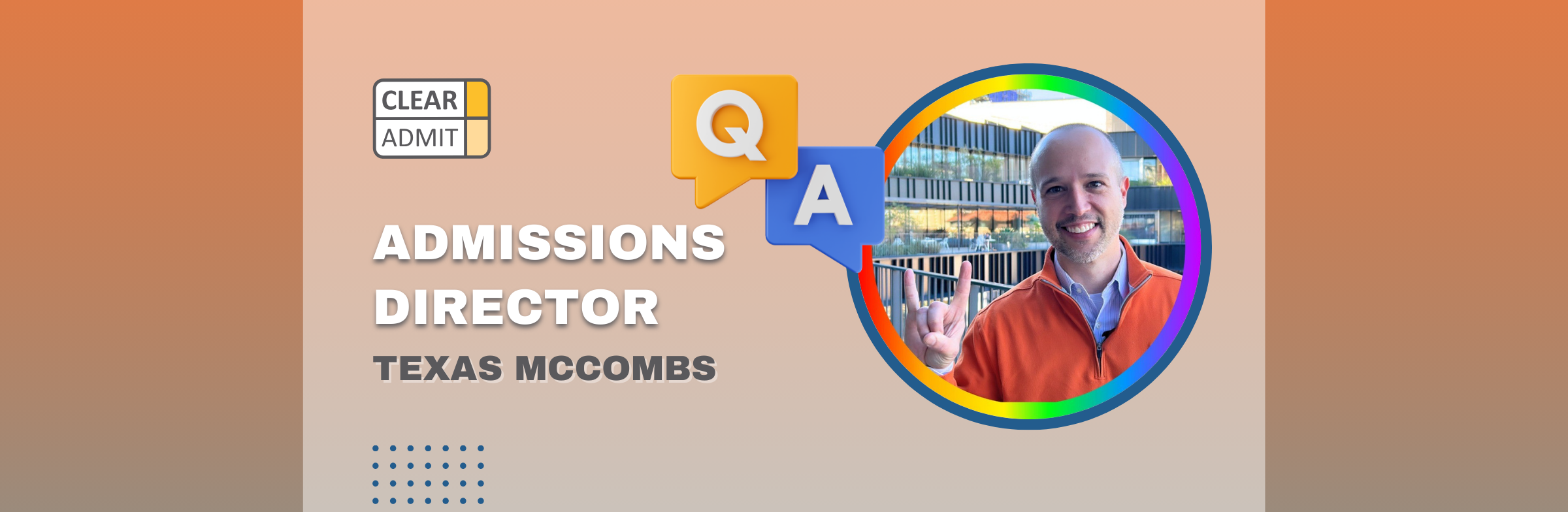
We are back in Austin, Texas, at the University of Texas at Austin’s McCombs School of Business for another chat with Rodrigo Malta, Assistant Dean of MBA Marketing, Recruiting, and Admissions in today’s installment of our MBA Admissions Director Q&A series.
Rodrigo has spent nearly two decades helping prospective students find their path into graduate business education. He leads a team overseeing recruitment, admissions, and marketing across five MBA programs, with a deep commitment to access, reducing bias in the admissions process, and building a community where people feel valued for who they are. A proud Longhorn and McCombs MBA alum himself, Rodrigo knows firsthand the weight of this decision and the impact it can have. Born outside the U.S., he has a personal stake in making sure this program is a place where everyone can show up fully and leave ready to make their mark.
Read on for updated info about McCombs, what to expect from the application process this year, and Rodrigo’s take on the latest trends in MBA programs and AI.

Clear Admit: What is one aspect of your MBA program that you wish applicants knew more about?
Rodrigo Malta: One aspect of the Texas McCombs Full-Time MBA that I wish more applicants knew about is the Hildebrand Scholars Program. This is not simply a scholarship. Through a competitive selection process, a small group of exceptional students is chosen to receive significant financial support and access to a highly tailored professional and leadership development experience. Hildebrand Scholars benefit from personalized programming, mentorship, networking opportunities, and leadership-focused activities designed to accelerate their growth during and beyond the MBA. It is one of the most distinctive and high-impact opportunities available to Texas McCombs students, yet many applicants are not fully aware of the depth of the experience.
I also wish more applicants knew about the Hildebrand Leadership Fellows Program, which is available to all Texas McCombs MBA students. Unlike the Scholars Program, the Fellows Program is designed to be accessible and self-paced, allowing students to engage with leadership development opportunities throughout their MBA journey regardless of their prior experience or career goals. Through curated learning experiences, leadership content, and personal reflection, students can develop the skills needed to lead effectively in today’s business environment. It is a flexible but highly impactful program that complements the academic and career development opportunities available across the Texas McCombs MBA experience.
CA: Walk us through the life of an application in your office from an operational standpoint. What happens between the time an applicant clicks “submit” and the time the committee offers a final decision?
RM: After you hit submit, the first thing we ask is that you complete our required video assessment within seven days. It’s six prompts, each with 10 seconds to prepare and 90 seconds to respond, giving us an opportunity to get to know you beyond your resume and test scores. We also strongly encourage all Full-Time MBA applicants to complete an optional virtual interview with a member of our McCombs Ambassador Committee. While not required, the interview provides another opportunity to showcase your communication and collaborative skills, share your motivations for pursuing an MBA, and connect with the Texas McCombs community.
From there, our admissions committee conducts a holistic review across three areas: academic aptitude, work experience and leadership potential, and your motivations for pursuing an MBA and joining McCombs. We’re not plugging numbers into a formula; we’re evaluating your full story and future potential. After review, we make one of three decisions: admit, waitlist, or deny. All applicants are automatically considered for merit-based scholarships, and admitted students receive scholarship information along with their admissions decision.
CA: How does your team approach the essay portion of the application specifically? What are you looking for as you read an essay? Are there common mistakes applicants should try to avoid? What is one key thing candidates should keep in mind as they sit down to write?
RM: Our two 250-word prompts are short by design, which means every word has to earn its place. When I read essays, I’m looking for specifics. Not “I’m a collaborative leader,” but the moment that proves it. Show me a real situation: how you navigated something hard, how you’ve grown, what you actually learned. That’s what makes an essay stick.
What gets me engaged is when someone connects the dots — between where they’ve been, why an MBA makes sense right now, and why McCombs specifically. That last part matters. “Strong career outcomes” isn’t a reason. Tell me what you’ve learned about our program that made you think, this is the place.
The most common mistakes I see: vague answers that could apply to any school, restating the resume, and going over the word limit. We can also tell when someone has leaned too hard on AI. The essays need to be in your voice, reflecting your experiences. Stay concrete, stay specific, and trust that a well-chosen story will tell me more about you than a highlight reel ever could.
CA: Could you tell us about your interview process? Approximately what percentage of applicants are invited to interview, who typically conducts interviews, and what should candidates expect in terms of interview style and format?
RM: All applicants complete a required video assessment – answering to 6 prompts, with up to 90 seconds each. You have seven days to finish it, so there’s no need to feel rushed. One thing to know going in: you only get one attempt per question, so use the practice rounds before you start recording. This is our baseline look at every candidate: consistent, structured, and designed to let you communicate beyond what’s on paper.
For Full-Time MBA applicants, we also offer an optional virtual interview with current MBA students. These are real conversations, usually 20 to 30 minutes, focused on collaboration and motivation, and a chance to ask genuine questions about student life. Our student interviewers also share observations with the admissions committee, so it’s worth doing.
CA: If your admissions process includes any video-based components, such as video essays or recorded interview responses, what advice would you offer applicants preparing for this part of the process?
RM: The video assessment is not a gotcha. You have seven days after submitting to complete it, the prompts cover a range of competencies, and we deliberately rotate questions so you’re less likely to find a “right answer” floating around online. What we’re looking for is authentic: how you communicate, how you think, how you carry yourself.
My honest advice: don’t over-rehearse. A polished, scripted answer usually sounds like one. Find a quiet space, give yourself time to think before each response, and just talk to us. The candidates who do well are the ones who sound like themselves, not like they’ve memorized a framework.
The optional admissions interview works the same way. Your student interviewer has been through this process. Ask them real questions. Be curious. That’s the spirit of it.
CA: Is there anything in particular international students should keep in mind during the admissions process?
RM: Start by checking whether you even need an English proficiency score — many applicants don’t. Depending on your country, where you studied, or where you’ve worked, you may qualify for a waiver. If you do need to test, McCombs accepts TOEFL iBT, IELTS Academic, and the Duolingo English Test, which is new this cycle. Just make sure scores are in before you submit; don’t let timing catch you off guard.
Beyond logistics, use your essays and video assessment to give us context. Don’t assume we’re familiar with your institution, your industry, or the business environment you’ve been operating in. That context helps us understand your story.
About a quarter of our current class comes from a country other than the U.S. with more than 30 countries represented in our class, and Austin’s ecosystem creates real opportunities to build a U.S. network. Our career services team works specifically with international students on visa considerations and employer connections. We want you here and we want you to succeed after you leave.
CA: Conversations about MBA value often center on jobs, salaries, and ROI. What are some of the other ways students benefit from the MBA experience that may be harder to quantify upfront?
RM: I’d start by acknowledging that Texas McCombs delivers strong ROI on the metrics most people focus on. We offer a relatively accessible tuition compared to many peer programs, generous scholarship support, and outstanding career outcomes. Those factors matter, and prospective students should absolutely consider them when evaluating an MBA investment.
What is harder to quantify is how an MBA changes the way you see yourself and what’s possible for your future. An MBA opens doors you may not have even known existed, and the knowledge, experiences, and confidence you gain give you the ability to walk through those doors. Just as importantly, you gain a community that becomes a lifelong support system. Your classmates, alumni, faculty, and mentors celebrate your successes, but they’re also there to help you get back up when things don’t go according to plan. That kind of network, trust, and sense of belonging is incredibly difficult to measure, but it’s one of the reasons an MBA can be truly invaluable.
There’s also the power of the Texas McCombs and University of Texas brands. Beyond rankings, having McCombs on your résumé signals that you’ve been challenged, developed, and prepared to lead. It’s a reputation that follows you throughout your career, opening conversations, creating connections, and helping you stand out in competitive environments. The combination of personal growth, lifelong community, and a respected brand is what creates lasting value long after the first post-MBA job offer.
CA: Are there any trends in the applicant pool, admissions process, or MBA experience that you are particularly focused on right now?
RM: One trend I’m particularly focused on is AI fluency and what it means to prepare leaders for a business environment where AI will be embedded in nearly every function and industry. At Texas McCombs, we’re not treating AI as a standalone topic. We’re integrating it throughout the MBA experience, so students learn how to leverage these tools strategically, make better decisions with data, and understand both the opportunities and limitations of AI in business. We want our graduates to be comfortable working alongside AI, not competing with it.
At the same time, we’re leaning even more heavily into the human side of leadership. The more technology advances, the more valuable uniquely human skills become. Things like communication, judgment, influence, relationship building, and leading through uncertainty can’t be automated. That’s one reason we’re excited about initiatives like our Hildebrand Leadership Fellows Program and other leadership development opportunities that help students build these capabilities intentionally. The future belongs to leaders who can combine technological fluency with emotional intelligence, and our goal is to ensure McCombs graduates leave with both.
CA: Is there anything else you’d like to highlight about your MBA program or admissions process?
RM: I’ll say this: the thing that keeps me most energized about McCombs in 2026 is that we’re doubling down on the human side of business education at a moment when a lot of people assume technology is pushing that aside. If anything, it’s made the human stuff more important. How you lead, how you listen, how you build trust, and how you bring people together are the skills organizations need most.
That philosophy shows up in how we build our cohorts, how we design our curriculum, and how we run our admissions process. We’re especially proud that every applicant has the opportunity to complete application components that allow us to hear their story directly, including our video assessment and optional interview. Those experiences help us understand who you are beyond the bullet points on a résumé, your test score, or your job title. We want to know the person behind the application because the relationships you build at McCombs will last for decades, and that’s not something you can capture in a ranking or spreadsheet.
If you’re considering McCombs, reach out. Talk to a current student or alum. Ask hard questions. We’re pretty open about who we are and what we’re building, and I think that says a lot about the kind of community you’ll find here.