

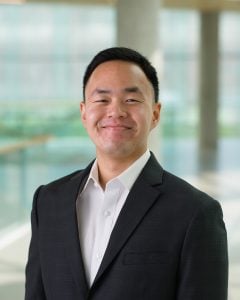
Morris Chang, Carnegie Mellon Tepper MSBA Class of 2027
Age: 24
Hometown: Taipei, Taiwan
Undergraduate Institution and Major: University of Southern California, Cognitive Science & Data Science
Pre-MSBA Work Experience: I recently joined ServiceNow and work in Customer Success. Previously, I spent one year at S&P Global on the Enterprise Data Management team.
Program: PT MSBA
Expected Graduation Year: 2027
Why did you make the decision to attend business school? Why now?
My undergrad studies gave me a strong foundation that blends human insight with technical problem-solving. Studying Cognitive Science and Data Science taught me how people think and how data can inform better decisions.
After entering the enterprise software industry, I started seeing how powerful that combination can be in business environments. Working in customer-facing roles, I really enjoy partnering with organizations and people to help them make decisions around technology.
At the same time, I started noticing gaps in my understanding of business strategy, execution, and how decisions scale across an organization. My experience has shown me what I don’t know, and business school allows me to learn with context while continuing to grow.
Why did you choose Carnegie Mellon Tepper? What factors figured most prominently into your decision of where to attend?
On Tepper School’s homepage are the words: “Data-Informed. Human-Driven.” That resonated with me because it perfectly captures how I believe modern business should operate.
Technology has become inseparable from modern business, and I felt that the Tepper School intentionally designs its Master of Science in Business Analytics (MSBA) program with this in mind. The emphasis on leadership and impact also mattered a lot in my decision.
Beyond the Tepper School’s philosophy, I also found that the program has the most comprehensive and well-designed experience for online students, from the cohort format to the campus experiences to the flexible course design.
What do you think is your most valuable or differentiating contribution to the class?
In Customer Success, conversations with clients often start with a metric. For example, low usage. But that number is rarely the full story. I’ve learned to treat data as the beginning of the question, not the answer.
What I bring to the class is the habit of asking what the metric doesn’t capture. While analytics are essential and help inform, it’s people who have to make decisions under uncertainty. In business, the most important step is often the simplest: talk to the customer. That’s where you find out what’s hiding between the numbers.
Tell us a fun fact about yourself that didn’t get included on your application:
I am a huge comedy nerd! From stand-up to sitcoms to sketch to film, I love them all. Having lived half my life in Taiwan and half in the US, I’ve become fascinated by what makes different people laugh and why jokes land differently across cultures. If business school doesn’t work out, maybe I’ll teach a Master’s in Comedy Translation.
Post-MSBA career interests:
More than any specific role, I want to be someone who makes the people around me better: my customers, my colleagues, the teams I’m part of. My experience so far has taught me that the best next step isn’t always the one you planned, and the career move I made at the start of this program is proof of that. I’m excited to see where my curiosity, analytical skills, and love of working with people take me!
Advice for Current Prospective Applicants:
–What is one thing you would absolutely do again as part of your application process?
Using it as an opportunity for deep self-reflection.
The biggest value I gained from the application process was the clarity it brought to my goals. Writing the essays forced me to think about who I am, what I want, why I want it, and who I want to become. A few months later, that clarity actually led me to pursue a job opportunity that felt more aligned with my goals.
–What is one thing you would change or do differently?
Start early.
I applied late in the cycle and missed the deadlines of a few programs I liked. Everything worked out, as the Tepper School was my top choice, but starting earlier would have made the process less stressful and given me more time to work on the applications.
–What is one part you would have skipped if you could—and what helped you get through it?
Overthinking the timing.
I spent too much time debating whether to pursue an MSBA now or wait, which delayed taking real action. What helped me get through it was committing. Once I made the decision, everything became clearer and more manageable. I learned that taking action, even under uncertainty, is often better than waiting for the right moment.
 How has the program’s flexibility enabled you to pursue your personal and professional goals without compromising your work-life balance?
Flexibility was non-negotiable for me. I didn’t want to pause my career to grow, I wanted to grow alongside my career.
Shortly after the first semester started, it became obvious that the program is deliberately designed for working professionals. The structure makes it possible for me to continue building momentum at work while investing in long-term development. I also appreciate that professors are very understanding of our situation and willing to work with us to help us succeed!
How do you manage to balance the demands of the program with your professional responsibilities, and what strategies have worked best for you?
I find that each mini-semester feels different depending on the course load and format. Before each mini starts, I take the time to review the syllabus and map out what the next two months will realistically look like. It can vary widely depending on if a course is heavy on tests, projects, or group work. Treating each mini like a focused sprint helps me keep things manageable and reduce stress.
How has the online format of the program allowed you to immediately apply what you’re learning to your current role and advance your career?
I believe this is the most underrated advantage of the part-time online format. For me, work and school don’t conflict at all, rather they enhance each other. I frequently find myself connecting what I learn in the classroom to real business problems in my role.
This is what separates it from undergrad. Instead of learning in theory, I get to test ideas in real time. This has allowed me to both accelerate my professional growth and fulfill my curiosity.
Despite being in a remote program, how have you built meaningful connections with peers, faculty, or mentors, and how has this sense of community enriched your experience?
The first campus experience, BaseCamp, was incredible and immediately immersed me in the Tepper School community. In particular, the team bonding activities at the scout camp made the cohort feel real. I’m already looking forward to meeting my peers again at the next campus experience!
Beyond that, certain classes have intentionally fostered collaboration. For example, one professor designed a semester-long business game that blended competition, teamwork, and learning. It made the virtual environment feel more dynamic and personal and encouraged me to build connections with peers.
What is one thing you have learned about Carnegie Mellon Tepper that has surprised you?
How accessible the Masters Career Center (MCC) is!
Shortly after starting the program, I had the opportunity to interview at ServiceNow for my current role. I reached out for support, and the Director of the MCC scheduled a one-on-one mock interview with me the very next day.
That level of responsiveness made all the difference and helped me secure the offer. It reinforced to me that the Tepper School invests in its students far beyond the classroom.