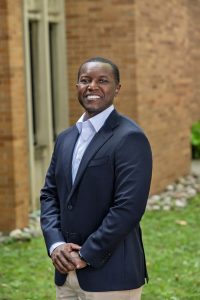
Mwangi Mark Thuita, Toronto Rotman MBA Class of 2028
Age: 30
Hometown: Nairobi, Kenya
Undergraduate Institution and Major: Cornell University, Philosophy and Government (Bachelor of Arts)
Pre-MBA Work Experience: Program Analyst, Philanthropy, Andrew Carnegie Foundation (formerly Carnegie Corporation of New York), four years; Technical Advisor, Diplomacy, Permanent Mission of Kenya to the United Nations (New York), six months; Program Assistant, Research, Social Science Research Council (New York), two years
Why did you make the decision to attend business school? Why now?
Early in my career, I believed meaningful change came from governments and altruistic actors such as donors and nonprofits. My early work reinforced that view. I did development and peacebuilding research at the Social Science Research Council, supported Kenya’s mission to the United Nations, and then spent four years as a grantmaker at the Andrew Carnegie Foundation, where I reviewed hundreds, if not thousands, of proposals to tackle complex social, political and even geopolitical problems.
Over time, I noticed how few of those proposals gave the private sector a real role. That seemed strange to me. Across most of the world, commerce, entrepreneurship, investment and industrialization are what have created jobs and lifted people into prosperity. I came to see that change that scales and lasts rarely comes from one-off projects designed by outsiders. It comes from thriving, responsible private sectors in developing countries that transform communities first and economies next. I also came to believe that the social impact sector has a lot to learn from how businesses allocate resources, measure results and scale what works.
I knew how to analyze a social problem, but not how to build, finance or grow a business. Business school is where I close that gap, so I can help bring private-sector tools and capital to the problems I have spent my career working on.
Why did you choose Toronto Rotman? What factors figured most prominently into your decision of where to attend?
By the time I applied, I was ready for a new adventure. After living in Kenya and the U.S., Toronto felt like an exciting next chapter, and I already had friends and other ties here, which made a big move feel much less daunting.
Rotman also felt like the best place to start my career in Canada. I loved how diverse and global the student body was, and that the campus is right in the centre of the city, close to everything. Its alumni network runs deep across the country’s banks, consulting firms and technology companies, and the alumni I’ve met since arriving have been remarkably generous with their time and advice.
Then there was the chance to become a Junior Fellow at Massey College, an incredible community of graduate students and senior scholars from across the University of Toronto. Conversations over dinner there can move from science to literature to foreign policy, and it means I don’t have to leave the world of policy and ideas behind while I learn business.
What do you think is your most valuable or differentiating contribution to the Class of 2028?
My background in policy, philanthropy and the impact sector is less common in business school, and I hope it adds a useful perspective. I’ve spent years working on issues affecting Africa, the Middle East and the United States, much of it focused on what happens when systems stop working: when political order breaks down and economic progress stalls along with it. That has given me a feel for the policy, regulatory and governance questions that sit underneath many business decisions, and I hope to bring that lens to class discussions, especially when a case turns on what happens if the rules of the game suddenly change. I’m also a natural connector. I love introducing people who should know each other, and I hope to do the same here, whether through study groups, club events or the dinners I enjoy hosting for friends.
Tell us a fun fact about yourself that didn’t get included on your application:
I’m a huge geography nerd and can name the flag of almost every sovereign country.
Post-MBA career interests:
I’m still exploring, but strategy consulting is my main focus for now. Longer term, I’d like to explore venture capital or impact investing focused on Africa and other emerging markets.
 Advice for Current Prospective Applicants:
What is one thing you would absolutely do again as part of your application process?
I would absolutely ask friends for help again. A few of them read my essays and ran mock interviews with me, and their honest feedback made a huge difference.
What is one thing you would change or do differently?
I would have applied sooner. I spent a lot of time hesitating and waiting until my application felt perfect. That’s an impossible standard.
What is one part you would have skipped if you could, and what helped you get through it?
As an international student, the study permit process can be challenging. Gathering documents, proving finances and waiting on processing times was stressful. What helps is starting early and being very organized. UofT was helpful whenever I had questions.
What is your initial impression of the Toronto Rotman students/culture/community?
So far, it’s been amazing. The students are incredibly supportive, and there’s no sense of competitiveness. We help each other study, practise cases together, and spend time outside of class exploring Toronto’s food scene and cultural events like Nuit Blanche. I feel that my classmates want me to succeed, and I feel the same way about them.
What student organizations have you joined/are you hoping to join and why?
I’ve joined the Management Consulting Association and the Business Technology Association to build new skills and prepare for my career pivot. Rotman Net Impact keeps me connected to the world of social impact. And the Rotman African and Caribbean Business Club is where I’m building community with fellow students from African and Caribbean backgrounds.
What is one thing you have learned about Toronto Rotman that has surprised you?
How many opportunities there are to learn by doing. It feels like every other week there’s a new case competition, and many are run in partnership with well-known firms. That adds an extra layer of excitement, since a strong performance can sometimes lead to an interview.
What is one thing you are most excited about in your first year?
Taking Business Design Fundamentals in my fourth term. It’s a hands-on course where you work in consulting teams to tackle a real industry challenge, from field research with customers through to a final proposal.