


In this Fridays from the Frontline, Regina Vargas Elias Calles, London Business School MBA ’26, shares her eye-opening Global Experience to Beijing. Read on for what the trip taught her about sustainability, the economic system in China, and more.
Beijing Global Experience – Business, Sustainability, and Innovation at Scale
 By Regina Vargas Elias Calles, LBS MBA ’26
When I signed up for London Business School’s Global Experience course in Beijing, I expected a week of company visits and lectures. What I didn’t expect was how quickly those experiences would reshape the way I think about business, sustainability, and scale.
Our course focused on business resilience in a changing climate, and there may be no more relevant place to explore that topic than China. As the world’s largest industrial economy and a key player in global supply chains, what happens in China does not stay in China. It has ripple effects everywhere.
Over the course of a week, we explored how Chinese businesses and institutions are navigating the transition toward sustainability, while also experiencing firsthand the speed and ambition that define the country today.
A system, not just a market
One of the most interesting insights from the week came early on. China is not just a market. It is a system.
Through faculty sessions, we learned how the relationship between government, local authorities, and businesses shapes the economy in a coordinated way. The system is goal driven, long-term focused, and deeply interconnected, with the state playing roles not only as regulator, but also as investor, coordinator, and even customer.
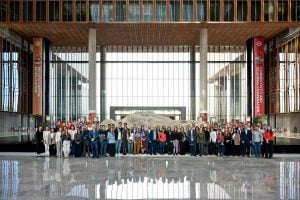
This helps explain something we saw repeatedly throughout the week. Speed at scale. Whether it is infrastructure, clean energy, or electric vehicles, initiatives do not just happen. They are executed quickly and with clear direction.
Inside China’s innovation engine
Two of the standout moments of the trip were our visits to companies at the forefront of China’s push toward sustainability.
At the Xiaomi Automobile Super Factory, we saw firsthand what modern manufacturing looks like at scale. The level of automation and efficiency was striking, but what really stood out was the pace. Cars moving through production with incredible speed and precision. We even got to test one of their vehicles, experiencing acceleration from zero to one hundred kilometers per hour in under two seconds. It was equal parts learning experience and adrenaline rush.
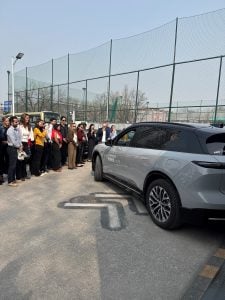
At NIO, we explored one of the most interesting innovations in the EV space, battery swapping. Instead of waiting to charge your car, you can replace the battery in minutes. Seeing this system in action made it clear how China is approaching sustainability not just through improvements, but by rethinking entire business models.
Across both visits, one message was clear. Sustainability in China is not separate from competitiveness. It goes hand in hand with quality, affordability, and global ambition.
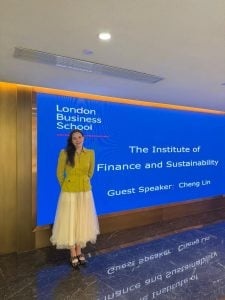
Sustainability at scale
Beyond company visits, we also engaged with institutions shaping the broader sustainability agenda.
At the International Sustainability Standards Board, we learned about the push to create a global baseline for sustainability disclosures, essentially a common language for how companies report climate related risks and opportunities.
Academic sessions also highlighted how China’s energy transition is being driven by a combination of policy, investment, and technological innovation. Rather than relying only on market mechanisms, the approach is highly coordinated and state led, aiming to build entire industries from electric vehicles to renewable energy at scale.
The takeaway was simple. Sustainability here is not just about reducing emissions. It is also about economic strategy and global leadership.
A campus that felt familiar and different
One of my favourite moments of the week was our visit to Tsinghua University, including a visit to the library where I was wowed by a section filled with historic books.
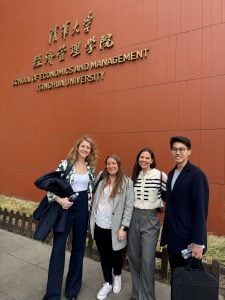
We were welcomed by students who guided us around campus, sharing their experiences and giving us a glimpse into life at one of China’s top institutions. Walking through the campus and hearing their stories, I could not help but compare their MBA experience to my own at LBS.
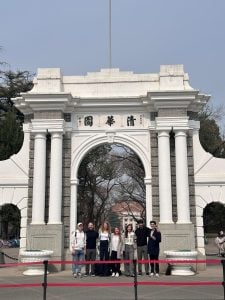
There were clear similarities, but also meaningful differences in perspective and context. It was a reminder that while business education is global, it is also shaped by where you are.
Beyond the classroom
Of course, no trip to Beijing would be complete without experiencing its culture.
Visiting the Forbidden City was a highlight. It is an incredible space that brings centuries of history to life. It is hard not to feel the weight of China’s past while walking through it.
Equally memorable was our hutong walking tour, where we explored traditional neighbourhoods, tried local food, and even had a chance to practice Chinese calligraphy. These moments offered a different perspective on Beijing, one that balances rapid modernization with deep cultural roots. That contrast between tradition and technology became a recurring theme throughout the week.
Rethinking sustainability and business
Looking back, the biggest takeaway from the course is how China is approaching sustainability with a level of determination and coordination that is hard to ignore.
This is a country that is not only acknowledging the challenges of climate change, but actively positioning itself at the forefront of solutions, particularly in areas like electric vehicles, clean energy, and green finance.
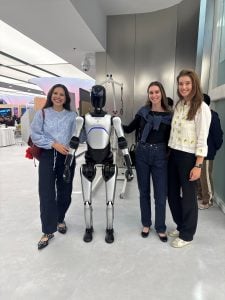
For me, the experience changed how I think about the relationship between sustainability and business. It is not a trade-off. Companies can be both innovative and impactful, driving progress while remaining competitive.
Final thoughts
In just one week, Beijing challenged many of my assumptions.
It showed me an economy that is complex, fast moving, and deeply strategic. It showed me a country where sustainability is not just a goal, but a priority embedded into business decisions.
And perhaps most importantly, it reminded me that to understand global business today, you need to see it up close.
This course was far more than a week of company visits and lectures. It was a window into how business is evolving.