

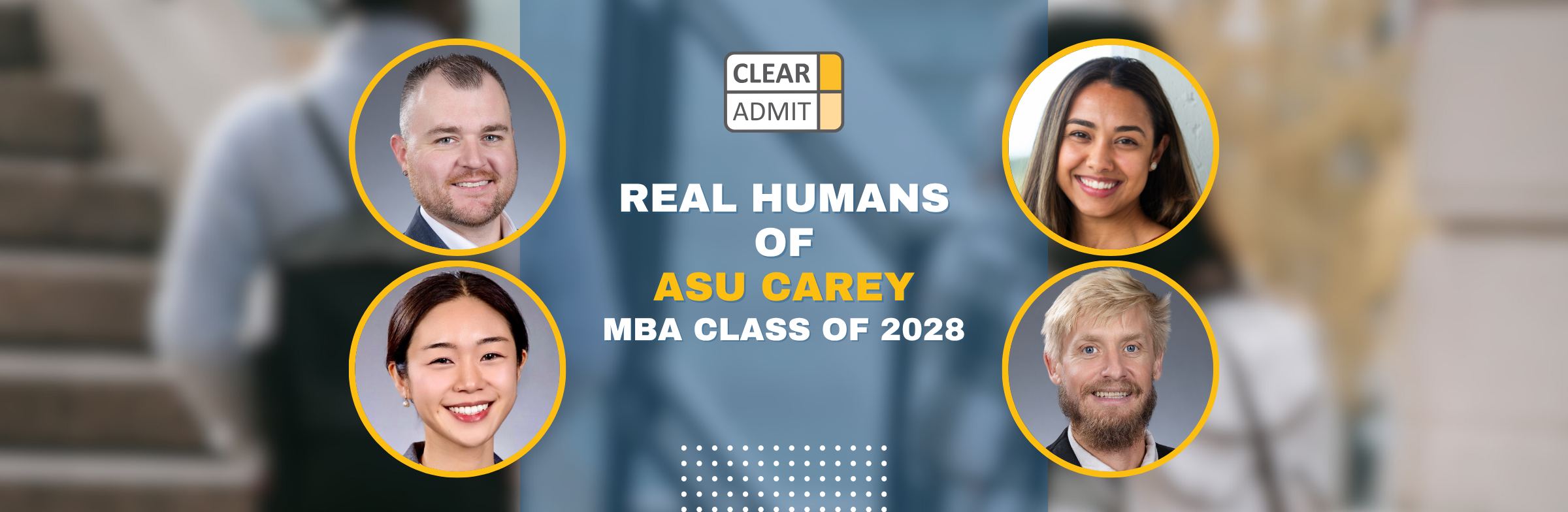
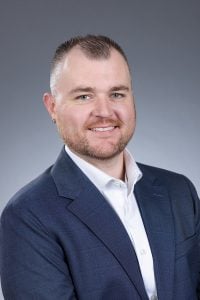
Matthew Vail, ASU Carey MBA Class of 2028
Age: 34
Hometown: Flagstaff, Arizona
Undergraduate Institution and Major: Arizona State University, W. P. Carey School of Business and Barrett, The Honors College
Pre-MBA Work Experience: Head of Marketing and Strategy, DeMar Consulting Group, two years, covering growth strategy, post-merger integration, and executive analytics. Before that, several years in restaurants and hospitality, and time as an R&D technician at a medical device manufacturer, working on heart valves.
Why did you make the decision to attend business school? Why now?
An MBA was always part of the plan once I began back in school. There is a whole bunch of context as to how that came about, but really, on my third attempt at finishing my undergrad, I told myself, “I really want to give myself a chance at the life I’ve always wanted.” Through conversations with colleagues at work, mentors at the university, and family and friends, the MBA emerged as a clear path into the career and life I was looking for.
Why now really came down to reaching a point in my career where I had enough exposure to higher-level decisions to know I wanted to operate there more consistently. For the last two years, I ran marketing and strategy for a consulting firm, which put me in acquisition conversations, post-merger integration work, and in the middle of helping shape executive decisions.
Those experiences gave me confidence in what I could contribute, but they also showed me how much more I wanted to understand. I wanted a stronger foundation in finance, analytics, strategy, and the broader business disciplines so I could move from contributing to important decisions to being better equipped to lead them. The MBA felt like the right next step to turn that experience into a much broader and more complete business toolkit.
There were also specific areas where I knew more depth would make me better. I could often tell when a number in a model was carrying more weight than it should, and I wanted the technical foundation to take it apart, test the assumptions, and explain why. At the same time, AI was rapidly changing the professional environment, and I knew I needed to understand how to work with and integrate those tools in ways that created real business value. That made now the right time, and ASU’s willingness to embrace AI as a business tool made W. P. Carey an especially strong fit.
Why did you choose ASU W. P. Carey? What factors figured most prominently into your decision of where to attend?
I did my undergrad at ASU, so there was an obvious familiarity bias, and I made a point of giving other schools a real shot at convincing me not to.
What kept W. P. Carey was a lot of things! The curriculum and the academics were a contributing factor, sure. As I mentioned, the embrace of AI tools, as well as its strengths in analytics, supply chain, and technology, all of which align with where consulting is going. Another reason was the small cohort size. I think it’s incredible how massive ASU is, specifically the Tempe campus. The main difference between the undergraduate and graduate levels is class size. And that to me was a big factor. I believe my cohort is only 43 people. So, you really get to know your group. W.P. Carey’s motto of “Business is Personal,” on the surface, sounds a little corny, but when you are in it, it’s such a welcome change to the traditional mindset you see in movies of “it’s not personal, it’s just business.” People here remember you, they ask what you are trying to do, and they actually want to help you succeed. ASU’s broader mission of “measured not by whom we exclude, but rather by whom we include and how they succeed” is a direct counterargument to schools that pride themselves on turning away talent in the name of exclusivity. While the program is competitive, you are given a fair opportunity. The executive mentorships with current and former CEOs, CFO and other executives was the final piece. The mentors all come from different industries and backgrounds with expertise across everything you can think of. The opportunity to talk to real professionals who volunteer their time to help MBA students succeed and navigate was a huge differentiator from the other schools I talked with. ASU became the clear choice for me because it aligns with my values as a person and as a professional.
What do you think is your most valuable or differentiating contribution to the Class of 2028?
There were several years of trying to get my life together before this attempt at an education finally stuck. For much of my twenties, school was one of several things I let go of. I had dug myself into a pretty deep hole, both personally and academically, and spent the better part of a decade without much direction or purpose. I made destructive decisions, lost opportunities because of them, and eventually reached a point where I had to decide whether I was going to keep living that way or completely change the direction of my life.
I think what differentiates me most is the distance between where my life was headed and where I am today. There was a point in my journey when, had I not made a change, people very well could have been talking about the person I was instead of the person I ultimately became. Recovery forced me to confront my issues, rebuild my life, and reclaim an identity I had lost for a long time.
Over the last several years, I have poured an enormous amount of work into myself academically, professionally, and personally, earning my way from community college to ASU and now into one of the country’s leading business schools. For me, that progression has been about much more than getting an education. It has been about finally living up to what I always knew I was capable of.
What I bring to the Class of 2028 is the perspective that came from all of it. I know what it is like to lose direction, need help, be underestimated, make serious mistakes, and then spend years earning opportunities back. That makes me slower to assume I understand someone else’s story, more attentive to people who may not have the loudest voice in the room, and more conscious of how much can exist beneath the surface of someone’s life.
I do not think hardship makes my experience unique or more important than anyone else’s, but it has given me a lens that is difficult to acquire any other way. The person entering this MBA is the product of years of deliberate work, reflection, failure, growth, and redemption. That perspective is what I hope to contribute to my classmates, my teams, and the broader W. P. Carey community.
Tell us a fun fact about yourself that didn’t get included on your application:
I am a citizen of the Cherokee Nation, and my family’s Cherokee lineage dates back to the Trail of Tears. That connection has become increasingly meaningful to me as I have gotten older. For a long time, I did not really embrace that part of myself, not because I was ashamed of it, but because I was ignorant of what it meant. I knew it was part of my family history, but I did not really understand the history, the community, or the significance of being connected to it.
As I have gotten older, that has changed. It is one thing to know where your family comes from; it is another to realize that the history you read about is also part of your own family’s story. The Nation has also had a very real impact on my life. It supported my education through scholarships and financial assistance that helped me finish my undergraduate degree and ultimately get to this MBA. It has also provided resources to members of my family at different points when we needed them. That has given me a much deeper appreciation for what it means to belong to a community that continues to invest in its people generations later.
As I move further into my career, one of my long-term goals is to find a way to give some of that opportunity forward. Whether that eventually looks like mentorship, creating professional opportunities, supporting education, or something I have not figured out yet, I would like to help more Native American students and professionals see paths into rooms and careers where they have historically been underrepresented.
Post-MBA career interests:
Consulting is the goal because I am most interested in understanding problems, identifying opportunities, and figuring out how to make something work better. What makes that consulting especially interesting to me is the human side of it. I have always been fascinated by perception and consumer psychology, or why people choose certain brands, what makes them stay loyal, what influences what they buy, and how those behaviors should inform business decisions.
That is what draws me to strategy, transformation, and customer experience work. I am interested in the relationship between people and businesses and how each shapes the other. Analytics and AI add a layer of depth by helping uncover patterns in behavior and turn them into better decisions, better experiences, or new opportunities.
Consulting feels like the best place for me to do that kind of work because it allows me to approach those questions across different industries, functions, and types of problems. I want to develop broad judgment while learning to translate a deeper understanding of customers and organizations into recommendations that actually improve how a business operates and competes.
Advice for Current Prospective Applicants:
–What is one thing you would absolutely do again as part of your application process?
I would absolutely choose the same type of recommenders again: people who know you well both professionally and personally. I think that goes a long way. Someone who has actually seen how you work, how you respond to challenges, how you treat people, and how you have grown can tell a much more complete story than someone with an impressive title who only knows you at a surface level.
I would also put the same amount of time into my essays and get feedback from people I trusted. My goal was to make sure the application sounded like me and gave the admissions team a real sense of who I was beyond my résumé.
–What is one thing you would change or do differently?
I think I would cast a wider net from the beginning. I was a first-round admit, but candidly, ASU was not initially one of the programs I was most focused on. I had spent a lot of time looking elsewhere and trying to push myself beyond what was familiar. After speaking with the recruitment team, though, I saw the program differently and decided to apply. In hindsight, I wish I had given ASU that same level of consideration much earlier in the process.
I would also tell prospective students not to automatically skip the GMAT or GRE just because they qualify for a waiver. ASU waived the requirement for me based on my work experience and undergraduate academic performance, and at the time, I was happy to take the waiver. Looking back, though, I think the preparation itself would have been valuable. Quantitative reasoning, structured problem-solving, and comfort with working through unfamiliar problems are skills I am now using in class and in consulting case preparation. Even if the score is not required for admission, there can still be real value in going through the process.
What is your initial impression of the W. P. Carey students, culture, and community?
What has surprised me most so far is how much I genuinely enjoy being here. Of course I knew I would like the classes but I did not expect the classes themselves to be as engaging as they are. I remember thinking, “Stats and accounting, this is about to be brutal,” but while the work is challenging, they have turned out to be so much more. The content is much richer than I anticipated. The conversations go well beyond the textbook, the cases are real-world and relevant, and I find myself excited to show up and contribute at 8:00 in the morning—which, yes, prospective students, your classes really will start that early. (lol)
A big part of that is the people. Everyone is ambitious, but it has never felt like someone else has to lose for you to succeed. People share notes, explain concepts they understand better than you do, make introductions, and genuinely want to see each other do well. The range of experiences in the room also makes the classes better. I am constantly hearing perspectives from industries, countries, and professional backgrounds I have never been exposed to before, and that has made me much more curious about the people around me.
What is one thing you have learned about W. P. Carey that has surprised you?
As an ASU alumnus, there honestly has not been a ton about W. P. Carey that has surprised me. One thing that did, though, came during orientation when Dean Ohad Kadan talked about where the W. P. Carey name comes from and the legacy behind it.
What stuck with me was how naturally that story pairs with “business is personal,” which was an idea Amy Hillman introduced during her time as dean. The two were not created together, but they complement each other almost perfectly.
Prospective students may end up hearing that story for themselves, so I will not ruin it here. But if you are curious, it is worth a Google. For me, it made “business is personal” feel more like an extension of the people and legacy that have shaped W. P. Carey and ASU over time.
What is one thing you are most excited about in your first year?
I am most excited to get to know my cohort. If you have noticed, there is probably a theme running through many of my answers: people. I am a people person. I am constantly wanting to learn, grow, hear other people’s experiences, and understand how they see the world differently from me.
I am also excited about everything that comes with the first year: interviewing with companies I have wanted to work for, getting deep into consulting cases, taking on leadership roles, making decisions, being challenged, and figuring out what I am capable of in this next chapter. There is honestly a lot I am looking forward to, and what makes it even better is getting to experience it alongside the other students in my cohort.
For prospective students, there are so many things to look forward to at ASU. The resources are here, the opportunities are here, and there are people who genuinely want to help you take advantage of them. I am excited to see where this first year takes me, and hopefully, I will see some of you on campus!