


For military members seeking to transition back to civilian life or to hone their leadership skills and advance their careers, the MBA provides a sound pathway.
While the gap between military service and graduate business management education may seem wide, there are actually several threads between the two. Leadership is the most obvious example of this. Valerie Rivera of Stanford GSB explained that, alongside faultless timekeeping, her military service taught her to “motivate people when big salaries, perks, and stock options aren’t available” – a golden ability in the world of business. The “experience in high-pressure environments and crisis management” applies here, too, as does the “deep appreciation for working in an international space” and the “perspective that is rooted in resilience.”
The skills that veterans bring to MBA programs are highly sought after, and their ability to enrich business school classrooms well documented. So, with Veterans Day here, we wanted to dive into the myriad ways in which business schools support those with military backgrounds to succeed in their MBA programs.
MBA Admissions & Veterans
Supporting veterans to join MBA programs starts with admissions. And, for many business schools, supporting veterans through the admissions process means hosting events. Some schools, such as Michigan Ross and Cornell Johnson, hold Military Preview Days. These events welcome prospective students with a military background to campus, reiterating the schools’ enthusiasm for their applications and fostering a sense of community from the very start. Others, such as Georgetown McDonough, direct students towards external resources such as Service to School, an organization supporting veterans through the admissions process.
In our Real Humans series, we spoke to many MBA students who had transitioned into the world of business from a military background themselves. When we asked them what they might do differently as part of their application or what their advice to new applicants would be, many of them focused on connection. Brian Rojas of Dartmouth Tuck noted that current students were helpful, supportive, and “incredibly valuable.” Their insights, he said, “helped me translate my experiences into the civilian sector.” Kacie Heinz of Texas McCombs suggested that MBA hopefuls should connect “with other veterans in the program” – for her, doing so “gave me a deeper understanding of the commitment and community.”
Financial Support for Veterans
Committing to the inclusion of veterans in business school cohorts means lowering barriers to entry. The admissions support plays a part here, but, in many cases, this translates to financial aid, the establishment of fellowships, and the offering of scholarships. Chicago Booth candidates, for example, have access to a veteran-only $10 million scholarship pot; those applying to SMU Cox are eligible for (among others) the tuition-funding Veteran Readiness and Employment program; while prospective Georgia Tech Scheller students are eligible to apply for a range of scholarships, grant funding, fellowships, or application fee waivers.
Many business schools also partner with the Yellow Ribbon program – a provision of the Post-9/11 GI Bill that helps cover tuition costs for veterans. Northwestern Kellogg has participated in this program since its establishment, and, at Yale SOM, eligible military veterans are able to receive full tuition and fee coverage via its support. At Berkeley Haas, veterans may also apply to receive additional support, such as a monthly housing allowance, as part of the program.
Veterans Clubs
For the duration of an MBA program, Veterans Clubs are a core element of veteran support. As well as a sense of community, these offer incoming veterans services such as admissions support, mentorship, and assistance with the move from military to civilian life.
The Washington Foster Veterans Association, for example, aims to “ease the transition of new veterans and help translate their unique and extraordinary experiences into meaningful careers;” Pennsylvania Wharton aims to “unite Wharton MBA veterans in their commonality and individuality;” and the UVA Darden Military Association supports the school’s military community, which makes up an impressive 10–15% of each Full-Time MBA class, to thrive in its experiential and leadership-driven programs. At Harvard Business School, veterans receive support to develop professionally and throughout their job search process via the Armed Forces Alumni Association, an organization that also serves to build camaraderie and raise awareness for the military on Harvard’s campus.
For many veterans transitioning into an MBA, Veterans Clubs play a major role in their choice of school. In interviews with Clear Admit, Dr Arun Banerji identified London Business School’s Military in Business Club as a valuable opportunity to “connect with others;” George Ladner of Columbia Business School explained that the Veterans Club has “been incredibly supportive during my transition from the military;” and Ben Peterson of Vanderbilt Owen explained that it was the school’s community and demonstrable “commitment to veterans” that compelled him to apply there.
Occasionally, the communities built by these clubs extends beyond the school itself such as at Duke Fuqua. Duke’s “strong connection to the military,” described Veteran turned Microsoft Executive Jonathan Bulls, incorporates “opportunities for working with veterans in the community and active duty at military bases in North Carolina.”
Welcoming & Transitional Programs
NYU Stern runs a six-week transition program for Veterans-turned-MBAs: the Fertitta Veterans MBA Program. Established through the generous support of MBA alumni brothers Lorenzo and Frank Fertitta, Stern has been running the Fertitta MBA for close to 10 years. The program kicks learning off earlier in the summer in order to prepare veterans, with their long absence from academia, for the curriculum ahead. It does this via extra financial, statistics, and data analysis courses, as well as weekly corporate visits that allow for exposure to potential career paths. It’s no surprise that the program was, for Hyden Bruce, “a major reason I wanted to attend Stern.”
In May this year, Kellogg announced a distinct MBA program of its own: The Matt Caldwell Veterans Program. In honor of distinguished alum Matt Caldwell ’10 JD, MBA, U.S. Army veteran and President and CEO of the Florida Panthers, the program builds on the school’s existing support to extend veteran recruitment, expand mid-program support, and enhance veteran career outcomes. Scholarship availability, networking opportunities, and the creation of new initiatives will all increase under the new program.
Other business schools offer supplementary or non-MBA programs that focus on different aspects of the transition between military and civilian life.
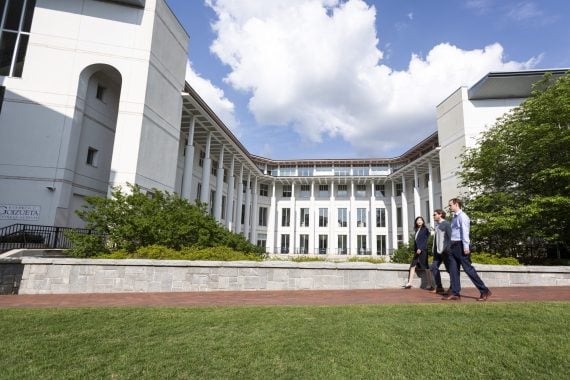
“The military is a very hierarchical organization” explains Orry Young, “whereas corporations tend to be highly matrixed. To get anything done in a corporate setting, you must adopt “peer leadership,” working with diverse and complex teams spread across organizational boundaries.” Young credits Emory Goizueta with providing the opportunity to acquire these skills, in particular, the leadership program led by LTG(R) Keen.
MIT Sloan runs a program similarly focused on leadership, which, like Keen’s program, is run by veterans themselves. The two-and-a-half day course, named “Leadership Lessons Learned from the Military,” dissects military leadership lessons and looks at how they may be applied to the world of business.
At UCLA Anderson, The Entrepreneurship Bootcamp for Veterans with Disabilities (EBV) supports veterans who are disabled as a result of their service to develop entrepreneurial abilities. The EBV offers experiential training and works in tandem with other programs and services to build more opportunities for veterans.
Online MBA Support
Many business schools support veteran engagement somewhat tangentially: by increasing their online offerings. The IU Kelley Direct Online MBA, the UNC Kenan-Flagler Online MBA, and the CMU Tepper Online Hybrid MBA all offer students the options to enroll from wherever they are based, and fit learning around busy schedules. This means, IU Kelley Direct Online MBA chair Ramesh Venkataraman explains, that “We also enroll a large population of active duty members of the military…. who travel often for work, and who need the ability to complete coursework while living or working abroad.”
Whatever you need along your journey from the military to b-school, leading business schools provide community, support and guidance to veterans. Advice from Clear Admit Co-Founder Graham Richmond and Community Manager Alex Brown recommend on our Wire Taps podcast that any interested applicants should “reach out to the veterans clubs.” Clubs are certainly a good place to start if you’re a veteran, and be sure to check your target programs’ websites for more connection opportunities–whether events, alumni outreach or more related to what we’ve highlighted above.